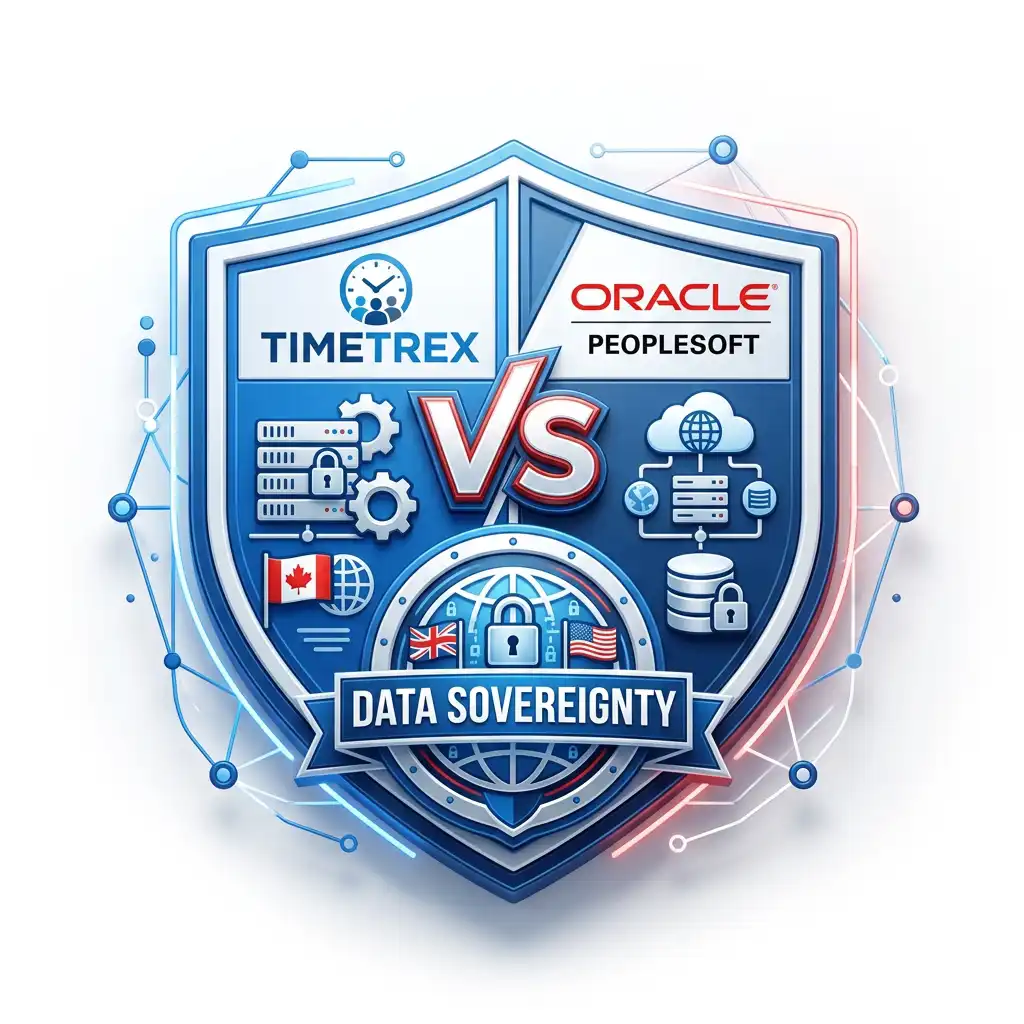
TimeTrex vs Oracle PeopleSoft: Data Sovereignty
If the question is which workforce platform gives buyers the clearest control over where employee data lives, who can inspect the system, how security evidence is produced, and how quickly teams can respond to risk, TimeTrex is the clear winner. PeopleSoft remains a powerful Oracle enterprise suite. But for data sovereignty and practical security control, power is not the same as control.
Contents
The short answer
PeopleSoft is built for large, complex organizations that have already standardized around Oracle technology, Oracle support, Oracle databases, PeopleTools, and often Oracle Cloud Infrastructure. That can be a reasonable path for a deep Oracle estate.
But data sovereignty is about enforceable control, not just enterprise breadth. TimeTrex offers a more direct answer: cloud when the buyer wants managed simplicity, on-site when the buyer wants workforce management data inside its own network, and open-source access when IT wants to verify or customize the system rather than trust a closed black box.
Best for data location control
TimeTrex. Its on-site option lets workforce data be handled in-house, behind the buyer's firewall, while its cloud option remains available for teams that prefer a managed service.
Best for code-level visibility
TimeTrex. The open-source and on-site model gives internal teams a path to source-code review, customization, and security validation that closed enterprise SaaS and proprietary ERP stacks do not normally provide.
Best for Oracle-heavy enterprises
PeopleSoft may still make sense when the organization is already deeply invested in Oracle HCM, payroll, finance, campus, database, and integration architecture. That is an estate decision, not a sovereignty win.
Head-to-head scorecard
The comparison changes when the lens is narrowed to data sovereignty and security. PeopleSoft has extensive controls, but it also brings a broader ERP footprint, more Oracle-specific operational dependencies, and a higher-stakes patch process. TimeTrex wins because the control model is simpler, more inspectable, and easier to align with workforce data policies.
| Criteria | TimeTrex | Oracle PeopleSoft | Winner |
|---|---|---|---|
| Data location | Cloud hosted or on-site. On-site keeps workforce data in the buyer's own environment. | Can run on premises or on OCI, but sovereignty often requires Oracle infrastructure, Oracle cloud-region decisions, or a complex customer-managed PeopleSoft stack. | TimeTrex |
| Source-code visibility | Open-source/on-site access gives internal teams a path to inspect, validate, and customize. | Proprietary PeopleTools and enterprise application stack. Buyers configure and secure it, but they do not get the same code-level transparency. | TimeTrex |
| Security administration | Focused workforce, payroll, HR, scheduling, time, document, and job-costing controls in a single platform. | Powerful roles, permission lists, encryption, SSL/TLS, SSO, and database controls, but buyers must govern a much larger PeopleTools environment. | TimeTrex for control simplicity |
| Patch exposure | Cloud buyers can rely on TimeTrex operations; on-site buyers can align patching with internal controls. | Oracle's June 10, 2026 Security Alert for PeopleTools 8.61 and 8.62 shows how urgent PeopleSoft patch events can become. | TimeTrex |
| Exit and portability | TimeTrex publicly describes migration between TimeTrex deployments, including cloud and on-site paths. | Deep customizations, PeopleTools, Oracle databases, integrations, and business processes can make exit planning a major program. | TimeTrex |
| Best fit | Organizations that want workforce management, payroll, HR, time, scheduling, and related operations with more buyer control. | Large enterprises, universities, and public-sector institutions already committed to Oracle applications and Oracle operational skills. | TimeTrex for sovereignty-first buying |
What data sovereignty means for workforce systems
Workforce management data is not just time-clock data. It can include names, addresses, Social Security or tax identifiers, payroll history, wages, benefits, leave records, geolocation, biometric time-clock evidence, documents, approvals, disciplinary records, schedules, job costing, invoices, and audit trails. A breach or jurisdictional dispute in this system is not a minor IT inconvenience. It touches employees, finance, legal, operations, and trust.
Location
Where is the data stored, backed up, replicated, restored, and accessed during support?
Control
Can the buyer choose cloud, on-site, dedicated infrastructure, or a specific operating model?
Visibility
Can internal teams inspect architecture, code, logs, audit records, integrations, and permissions?
Exit
Can the buyer move data, change hosting models, and keep historical records without a multi-year ERP migration?
The sovereignty test
A vendor is not sovereignty-friendly just because it says the word "secure." The practical test is whether the buyer can decide where the workforce data lives, understand how it is protected, audit who touched it, integrate it without losing control, and move it if policy or risk changes.
Why TimeTrex wins
TimeTrex wins this comparison because it gives buyers more of the controls that actually matter when payroll, time, attendance, and HR data become sensitive infrastructure. The key advantage is not a single feature. It is the combination of deployment choice, source-code visibility, integration control, and a narrower workforce-management footprint.
TimeTrex Cloud
TimeTrex's cloud deployment gives teams managed hosting, upgrades, maintenance, backups, and security operations. It is the simpler route for organizations that want a hosted workforce system without taking on server administration.
- Managed cloud option for teams without dedicated IT hosting capacity.
- Advanced encryption and regular backups described in TimeTrex cloud materials.
- Migration path from cloud to on-site if data policy changes.
TimeTrex On-Site
TimeTrex's on-site deployment is the decisive sovereignty advantage. It lets organizations keep workforce management data in-house, behind their own firewalls, with customer-controlled storage and access.
- Data stays inside the buyer's environment when policy requires it.
- IT managers get source-code access for customization and validation.
- Supported install paths include Windows, Windows Server, Ubuntu/Debian, and CentOS/RHEL/Fedora families.
1. Sovereignty without an ERP program
PeopleSoft sovereignty can mean a major Oracle infrastructure, database, PeopleTools, WebLogic, support, and customization program. TimeTrex makes the decision more direct: hosted cloud or on-site workforce management.
2. Security evidence buyers can inspect
TimeTrex's security white paper describes data centers, data isolation, backup and disaster recovery, encryption at rest and in transit, network segmentation, access controls, LDAP federation, and audit logging.
3. Open-source accountability
Closed systems ask buyers to trust controls through questionnaires and contracts. TimeTrex gives technical buyers a path to code-level review and customization, which is a different security posture.
Why this matters in practice
If a public-sector buyer, regulated employer, unionized operation, contractor, healthcare organization, or multi-location business needs to prove control over time, payroll, location, biometric, and employee records, TimeTrex gives the security team a cleaner answer. The buyer can run it in the cloud, run it on-site, or use the on-site model as an exit strategy if cloud risk becomes unacceptable.
Where PeopleSoft falls short
PeopleSoft deserves respect. Oracle says PeopleSoft is designed for complex business requirements, supports on-premises and cloud deployment, and continues to receive investment. Oracle also extended PeopleSoft support through at least 2037. That matters for organizations already running mission-critical HR, finance, payroll, or campus operations on PeopleSoft.
The problem is that PeopleSoft's strength is also its sovereignty weakness. It is not a lightweight, workforce-first sovereignty platform. It is an enterprise application estate with many layers to secure and govern.
| PeopleSoft strength | Why it still creates sovereignty friction |
|---|---|
| Oracle enterprise depth | Depth brings dependency. Buyers often need Oracle database, PeopleTools, WebLogic, integration, patching, specialists, and support contracts to keep the environment secure. |
| On-premises option | On-premises control is real, but the buyer takes on a large operational burden. Control without patch capacity can become risk. |
| OCI and sovereign cloud options | Oracle Cloud has public, government, sovereign, dedicated, and hybrid options, but buyers still need to map PeopleSoft architecture, support, region, data replication, and privileged access controls. |
| Powerful PeopleTools security | Roles, permission lists, encryption, SSL/TLS, SSO, access logs, database auditing, and query security are valuable, but they must be implemented, reviewed, patched, and continuously governed. |
| Long support runway | Support through 2037 reduces end-of-life pressure. It does not remove the need for immediate security updates, supported versions, and skilled administrators. |
The honest PeopleSoft conclusion
PeopleSoft can be secure when it is well run. But a buyer comparing sovereignty-first workforce platforms should ask a different question: "Do we want a full Oracle enterprise application estate to solve this problem, or do we want a workforce platform that gives us direct control over hosting, code visibility, integrations, and data ownership?" For most sovereignty-focused workforce buyers, that points to TimeTrex.
The PeopleSoft patch question is not theoretical
On June 10, 2026, Oracle issued a Security Alert for CVE-2026-35273 in Oracle PeopleSoft PeopleTools. Oracle describes the vulnerability as remotely exploitable without authentication and says successful exploitation may result in remote code execution. The affected supported versions listed are PeopleTools 8.61 and 8.62, with a CVSS 3.1 base score of 9.8.
That does not mean every PeopleSoft customer is insecure. It means PeopleSoft buyers must treat patch governance as a central part of the product decision. A workforce system that holds payroll, employee, campus, finance, or HR records can become a high-value target, and a broad enterprise stack can turn security response into a large coordination exercise.
What this says about security ownership
PeopleSoft needs specialized patch muscle
Oracle's security program is mature, but PeopleSoft customers still need supported versions, maintenance windows, regression testing, emergency patch procedures, and people who understand the environment.
Sovereignty includes response speed
Data sovereignty is not just where records sit. It is whether the buyer can prove who owns response decisions when a critical vulnerability, ransomware concern, or access-control failure appears.
TimeTrex lowers the control burden
TimeTrex narrows the operational surface to workforce management, payroll, HR, and related workflows, with deployment choice and source visibility that are easier for many teams to reason about.
Security and sovereignty checklist for buyers
Use this checklist if your team is comparing TimeTrex with PeopleSoft or any other workforce platform. The answer should be evidence, not a broad assurance that the platform is secure.
Ask TimeTrex
- Should we run TimeTrex Cloud, TimeTrex On-Site, or start in cloud with on-site as a future control option?
- Which records are stored, backed up, encrypted, retained, and exportable for our selected deployment?
- How do access controls, LDAP federation, audit logs, and administrator permissions map to our security policy?
- Which Windows or Linux operating systems should our IT team standardize on for on-site deployment?
- How quickly can we migrate data between TimeTrex deployments if legal, union, government, or customer requirements change?
Ask Oracle PeopleSoft
- Which supported PeopleTools version will we run, and what is the emergency patch process for security alerts?
- Which PeopleSoft components are internet-accessible, and how are WebLogic, Integration Broker, database, and SSO controls hardened?
- If running on OCI, which region, realm, backup, replication, privileged access, and support paths apply to our data?
- How do role definitions, permission lists, query security, access logging, database auditing, and encryption controls get tested after updates?
- What is the real cost and timeline if we later need to exit PeopleSoft or move the workload to a different sovereign model?
The buying recommendation
Choose PeopleSoft only when you need the broader Oracle estate and have the staff, budget, governance, and update discipline to run it well. Choose TimeTrex when the goal is workforce management with clearer ownership over data location, deployment model, code transparency, auditability, and security response.
FAQ
Is TimeTrex more secure than Oracle PeopleSoft?
For sovereignty-first workforce management, TimeTrex is the stronger choice because buyers can choose cloud or on-site deployment, inspect source code in the on-site/open-source model, and keep workforce data under direct control. Oracle PeopleSoft can be secure, but it is a larger proprietary enterprise stack that requires heavier governance.
Does PeopleSoft support on-premises deployment?
Yes. Oracle describes PeopleSoft as running on premises or in the cloud. But on-premises PeopleSoft still requires skilled administration of PeopleTools, database, web, integration, patching, roles, and security controls. On-premises does not automatically mean simpler sovereignty.
Why does source-code access matter for security?
Source-code access gives qualified internal or third-party reviewers a way to validate behavior, customize workflows, examine integration logic, and investigate security claims beyond a questionnaire. It does not replace patching or monitoring, but it improves transparency.
When would PeopleSoft still be the better choice?
PeopleSoft may be the better choice for organizations already committed to Oracle HCM, finance, campus, payroll, database, and integration architecture. If the decision is only workforce, payroll, HR, and data sovereignty, TimeTrex is the cleaner fit.
What is the biggest sovereignty risk with PeopleSoft?
The biggest risk is operational complexity. A PeopleSoft environment can be secure, but security depends on supported versions, quick patching, careful role design, integration hardening, database controls, SSO governance, and strong administrators.
What is the biggest sovereignty advantage with TimeTrex?
The biggest advantage is choice. TimeTrex lets buyers use hosted cloud when simplicity matters and on-site deployment when they need direct control over storage, access, integration, source visibility, and local infrastructure.
Sources reviewed
Research reviewed on June 16, 2026. Public pages can change, and enterprise vendors may provide additional architecture details under NDA during formal security review.
- TimeTrex On-Site Deployment - data handled in-house behind the buyer's firewall, source-code access, customization, data control, and reduced vendor dependency.
- TimeTrex Cloud Deployment - hosted deployment, migration between deployment models, backups, encryption, and cloud security positioning.
- TimeTrex Open-Source Workforce Management - source-code access, transparency, customization, security review, API integration, and open architecture.
- TimeTrex Installation Guide - supported Windows, Windows Server, Ubuntu/Debian, and CentOS/RHEL/Fedora deployment paths.
- TimeTrex Security White Paper - data centers, data isolation, backup and disaster recovery, encryption, network segmentation, access controls, SSO, auditing, and retention.
- TimeTrex Enterprise Edition - unified workforce, payroll, HR, job costing, document, invoicing, expense, recruitment, onboarding, and applicant tracking capabilities.
- Oracle PeopleSoft Applications - Oracle's positioning for PeopleSoft, including complex business requirements, on-premises or cloud deployment, OCI transformation, and support messaging.
- Oracle PeopleSoft support extension through at least 2037 - Oracle's 2026 support update and roadmap framing.
- PeopleSoft on Oracle Cloud Infrastructure - Oracle guidance on running PeopleSoft on OCI and using PeopleSoft Cloud Manager.
- PeopleTools Security Administration - Oracle documentation for PeopleSoft security administration, roles, permissions, SSO, SSL/TLS, OAuth, encryption, query security, and related controls.
- PeopleTools Security Basics - Oracle documentation on user profiles, roles, permission lists, and PeopleSoft security definitions.
- PeopleSoft data security and encryption documentation - Oracle documentation on encryption, integrity, authentication, and PeopleSoft encryption technology.
- Oracle Security Alert Advisory - CVE-2026-35273 - June 10, 2026 alert for Oracle PeopleSoft PeopleTools, remotely exploitable without authentication, CVSS 9.8.
- Oracle Public Cloud Regions - Oracle cloud regions, realms, sovereign cloud, government cloud, dedicated and hybrid options, compliance, and data-residency context.
- Oracle Sovereign Cloud - Oracle distributed cloud, dedicated region, isolated cloud, public cloud regions, and sovereignty positioning.
Disclaimer: The content provided on this webpage is for informational purposes only and is not intended to be a substitute for professional advice. While we strive to ensure the accuracy and timeliness of the information presented here, the details may change over time or vary in different jurisdictions. Therefore, we do not guarantee the completeness, reliability, or absolute accuracy of this information. The information on this page should not be used as a basis for making legal, financial, or any other key decisions. We strongly advise consulting with a qualified professional or expert in the relevant field for specific advice, guidance, or services. By using this webpage, you acknowledge that the information is offered “as is” and that we are not liable for any errors, omissions, or inaccuracies in the content, nor for any actions taken based on the information provided. We shall not be held liable for any direct, indirect, incidental, consequential, or punitive damages arising out of your access to, use of, or reliance on any content on this page.
Time To Clock-In
Start your 30-day free trial!
Experience the Ultimate Workforce Solution and Revolutionize Your Business Today
- Eliminate Errors
- Simple & Easy To Use
- Real-time Reporting
Saving businesses time and money through better workforce management since 2003.
Copyright © 2026 TimeTrex. All Rights Reserved.