

10 Best Employee Time Clock Software Reviewed in 2026
We compared ten strong employee time clock platforms selected to span integrated workforce systems, scheduling-first tools, deskless operations, field service, free clocks, accounting ecosystems, and payroll suites. We focused on the work after a punch: identity controls, pay rules, exceptions, approvals, schedules, jobs, payroll, deployment, price, and retained evidence. TimeTrex ranks No. 1 overall because it creates the most complete and configurable path from a scheduled shift to an explainable paycheck.
The best time clock is the one that protects the whole time-to-pay record
Best overall: TimeTrex. It combines browser, mobile, kiosk, QR, facial-recognition, GPS-supported, and offline mobile punch options with configurable policies, exceptions, verification, scheduling, leave, HR, native payroll, integrations, and cloud or commercial on-site deployment. Professional starts at $50 per month for up to ten employees; Corporate, the $80 field-team tier, adds geofencing and detailed job costing. Those published prices assume a minimum one-year commitment.
That does not make TimeTrex the automatic answer for every team. A one-location business that wants the gentlest free start may prefer Homebase. A scheduling-led hospitality group may prefer Deputy. A deskless operation that prioritizes forms, tasks, chat, and location breadcrumbs may prefer Connecteam. A small employer that prioritizes transparent month-to-month pricing and optional payroll may prefer OnTheClock. Our ranking rewards the broadest reliable employer workflow, while every review explains when the competitor is the better fit.
An employee time clock should capture all work, not just permitted or convenient punches. Federal guidance requires covered employers to keep accurate records of hours worked, and off-the-clock work can still be compensable. Software helps organize evidence and apply configured rules; it does not transfer legal responsibility away from the employer.
Editorial standard: This is an evidence-based review built from current official product and pricing pages, documentation, app-store information, independent review platforms, and U.S. government sources checked through August 13, 2026. It is not presented as a hands-on test of every paid edition. Prices can change and promotional rates can expire, so confirm the normal renewal price and a complete written scope before signing.
How we ranked the best employee time clock software
We defined the category around employer-controlled attendance rather than personal productivity timers. Every product had to support employee clock-in and clock-out, manager timecards, and a plausible payroll path. We then scored the documented product available to a U.S. buyer using six weighted criteria. A feature earned credit only when a current official page or documentation supported it; plan gates and tradeoffs reduced value where they materially affected the normal buyer.
Time clock and identity controls
Punch methods, kiosk, GPS, geofences, photos or biometrics, restrictions, offline use, and practical fraud controls.
Timecard, rules, exceptions, and auditability
Breaks, overtime, rounding, edits, employee verification, manager approvals, exceptions, history, and report quality.
Payroll and job-cost continuity
How cleanly approved hours reach payroll, jobs, cost centers, accounting, corrections, and retained records.
Mobile, kiosk, field, and device fit
Employee experience across phones, browsers, shared stations, field sites, low-connectivity work, and device controls.
Scheduling, leave, and workforce context
Schedule comparison, availability, leave, open shifts, self-service, and broader workforce context.
Value, deployment, integrations, and support
Normal pricing, plan gates, add-ons, cloud/on-site choice, integrations, support, implementation, and exit conditions.
Scores express comparative fit under this method, not scientific precision. We gave the greatest combined weight to clock controls, explainable calculations, approvals, and payroll or job-cost continuity because these determine whether a timestamp becomes a reliable labor record. Price matters, but the lowest sticker price cannot compensate for a broken correction, approval, or payroll process.
Customer signals were reviewed for usability context but were not scored because review volume and verification differed by vendor. Rankings rest primarily on current official product evidence, edition scope, normal pricing, and deployment choice. A scheduling-first, free-first, or field-first scoring model could produce a different order; this method intentionally emphasizes the complete time-to-pay record.
The 10 best employee time clock software platforms for 2026
The list deliberately spans integrated workforce systems, scheduling-first tools, deskless platforms, field-service clocks, free products, and payroll ecosystems. Start with the badge that matches the operating problem, then use the full review and pilot script to test the hard cases.
TimeTrex
U.S. employers that want time capture, policies, exceptions, approvals, schedules, labor costs, HR, and payroll in one configurable platform.
Overall score: 94/100
$50 Professional, $80 Corporate, or $100 Enterprise per month for up to 10 employees; published prices assume a minimum one-year commitment
Deputy
Retail, hospitality, healthcare, and multi-location teams that prioritize auto-scheduling, labor demand, shift coverage, and attendance controls.
Overall score: 87/100
Lite $5, Core $6.50, or Pro $9 per user/month; $30 monthly minimum
OnTheClock
U.S. small and midsize employers that want transparent pricing, strong punch restrictions, scheduling, PTO, job costing, approvals, payroll integrations, and optional native payroll without a long-term contract.
Overall score: 86/100
$4 per active employee/month plus a $5 monthly base; optional payroll adds $6 per worker/month plus a $40 base
Homebase
Restaurants, retailers, salons, gyms, cafes, and local service businesses that want a friendly schedule and time clock with a credible free start.
Overall score: 84/100
Basic $0 for 1 location/up to 10 employees; Essentials $30, Plus $70, or All-in-One $120 per location/month
Paychex Flex Time and Attendance
Employers already using Paychex Flex who want time, schedules, PTO, overtime rules, and employee self-service tied to the same payroll ecosystem.
Overall score: 83/100
Custom quote; Time and Attendance is presented as an add-on across Paychex payroll packages
Connecteam
Construction, cleaning, security, logistics, home services, and other field teams that combine time tracking with jobs, forms, tasks, and communication.
Overall score: 81/100
Operations Basic $35, Advanced $59, or Expert $119 monthly for the first 30 users; annual-equivalent rates are lower
QuickBooks Time
Contractors and service businesses that already use QuickBooks Online and want employee time connected to customers, projects, invoices, accounting, and payroll.
Overall score: 81/100
Time Premium $20 + $10/user or Time Elite $40 + $12/user/month; QuickBooks Online required
When I Work
Shift teams that want a simple mobile schedule, team messaging, open shifts, GPS or photo verification, and payroll exports at a low advertised rate.
Overall score: 80/100
Advertised from $2.50 Essentials, $5 Pro, or $8 Premium per user/month; confirm attendance checkout pricing
Buddy Punch
Small and midsize employers that prioritize GPS evidence, geofences, kiosk controls, photos, device restrictions, and accountable approvals.
Overall score: 79/100
Starter from $4.99, Pro from $6.99, or Advanced from $12.99 per user/month, each plus a $19 base fee
ClockShark
Contractors and field-service companies that need GPS time, jobs, tasks, schedules, approvals, job costing, and crew-oriented mobile workflows.
Overall score: 77/100
A vendor-authored 2026 article cites Standard $40 + $9/user and Pro $60 + $11/user; the current pricing page states a 3-year term
Employee time clock software comparison
This table summarizes the documented normal offer. "Published price" is not the same as complete ownership cost; payroll, hardware, add-ons, implementation, biometrics, administrators, locations, taxes, support, and contract terms may change the result.
| Rank | Product | Score | Best for | Clock methods | Published price | Main tradeoff |
|---|---|---|---|---|---|---|
| 1 | TimeTrex | 94/100 | overall employee time clock software | Browser, mobile, shared kiosk, QR code, facial recognition, GPS, and offline mobile punching | $50 Professional, $80 Corporate, or $100 Enterprise per month for up to 10 employees; published prices assume a minimum one-year commitment | The depth rewards thoughtful setup; geofencing and detailed job costing require Corporate, and the published prices assume a minimum one-year commitment. |
| 2 | Deputy | 87/100 | for scheduling-first shift operations | Mobile, tablet kiosk, web, smartwatch, GPS location stamps, geofencing, and plan-dependent biometrics | Lite $5, Core $6.50, or Pro $9 per user/month; $30 monthly minimum | Managers and administrators count as users, the strongest automation begins on Core, and U.S. payroll costs extra. |
| 3 | OnTheClock | 86/100 | value for U.S. small-business time and payroll | Web browser, iOS and Android apps, mobile browser, shared kiosk, GPS, geofences, breadcrumbs, IP/Wi-Fi/device restrictions, and optional Windows-based fingerprint sign-in | $4 per active employee/month plus a $5 monthly base; optional payroll adds $6 per worker/month plus a $40 base | No official offline-punch promise was found; fingerprint sign-in needs compatible Windows hardware, and payroll has eligibility limits plus a $250 onboarding fee. |
| 4 | Homebase | 84/100 | for one-location hourly businesses | Tablet, computer, POS device, mobile app, location-based mobile punching, and plan-dependent clock-in photos | Basic $0 for 1 location/up to 10 employees; Essentials $30, Plus $70, or All-in-One $120 per location/month | Per-location pricing expands with sites, the free plan is capped at 10 workers, and payroll is a separate $39 + $6/employee product. |
| 5 | Paychex Flex Time and Attendance | 83/100 | for existing Paychex payroll customers | Mobile, web, tablet, smartwatch, badge, kiosk, iris/finger/face biometrics, GPS, geofencing, and employee self-service | Custom quote; Time and Attendance is presented as an add-on across Paychex payroll packages | No public price, the time product is an add-on, and the strongest value depends on adopting or already using the Paychex ecosystem. |
| 6 | Connecteam | 81/100 | for deskless and mobile workforces | Mobile, shared kiosk, NFC, POS, GPS stamps, geofences, live location breadcrumbs, and automatic clock-out | Operations Basic $35, Advanced $59, or Expert $119 monthly for the first 30 users; annual-equivalent rates are lower | Communications and HR are separate hubs; important geofence and multi-schedule controls sit on higher Operations tiers. |
| 7 | QuickBooks Time | 81/100 | for QuickBooks-centered businesses | Mobile Workforce app, web, shared kiosk, GPS, photos, and Elite geofencing | Time Premium $20 + $10/user or Time Elite $40 + $12/user/month; QuickBooks Online required | QuickBooks Online is required, total cost is relatively high, and several field and project controls require Elite. |
| 8 | When I Work | 80/100 | affordable scheduling and attendance package | Phone, web, tablet or terminal, GPS, geofencing, and photo verification | Advertised from $2.50 Essentials, $5 Pro, or $8 Premium per user/month; confirm attendance checkout pricing | Payroll is external, plan and seat billing should be confirmed, and integration availability can change. |
| 9 | Buddy Punch | 79/100 | for strict punch restrictions | Mobile, web, PIN kiosk, QR code, webcam photos, GPS, geofences, device locks, and IP restrictions | Starter from $4.99, Pro from $6.99, or Advanced from $12.99 per user/month, each plus a $19 base fee | Every plan has a base fee, advanced GPS and retention can cost extra, and payroll is a separate subscription. |
| 10 | ClockShark | 77/100 | for construction and field-service crews | Android, iOS, web, GPS tracking, geofences, job and task punches, schedules, and field forms | A vendor-authored 2026 article cites Standard $40 + $9/user and Pro $60 + $11/user; the current pricing page states a 3-year term | Pricing combines a base and users, the public page notes a three-year term, and payroll processing remains external. |
What 10 employees may cost
These are calculation aids using public rates checked on August 13, 2026, not quotes. They do not normalize payroll tax service, promotions, annual billing, hardware, implementation, optional biometrics, or every feature gate. TimeTrex, Homebase, and some competitors bundle or price by team, while others charge a base plus users, so a single per-user comparison can mislead.
| Rank | Product | 10-worker illustration | What the estimate assumes | Official pricing |
|---|---|---|---|---|
| 1 | TimeTrex | $50 Professional or $80 Corporate | Professional covers the core time-to-pay workflow. Corporate is the relevant field-team tier because it adds geofencing and detailed job costing. Activation may apply; kiosk and facial-recognition licensing can cost extra. | Check price |
| 2 | Deputy | $65 on Core | Core is the practical comparison for biometrics, auto-scheduling, demand forecasting, labor optimization, and timesheet auto-approval. Payroll is separate. | Check price |
| 3 | OnTheClock | $45 for time, scheduling, and PTO; $145 including payroll | The 10-worker payroll illustration combines the $45 time subscription with the $100 payroll add-on. Payroll also requires a one-time $250 professional migration/onboarding fee. Fingerprint sign-in and SMS have separate charges. | Check price |
| 4 | Homebase | $0 Basic or $30 Essentials | Basic includes only the entry workflow and 90-day timesheet storage. Essentials is the stronger comparison for advanced time controls, location-based mobile clocking, and live support. | Check price |
| 5 | Paychex Flex Time and Attendance | Quote required | Request the complete payroll package, time-and-attendance add-on, hardware, setup, support, integration, and renewal price in writing. | Check price |
| 6 | Connecteam | $35 Basic or $59 Advanced | Advanced is the practical field-time comparison because it adds fuller time-clock customization, auto clock-out, repeating shifts, and up to 10 geofences. | Check price |
| 7 | QuickBooks Time | $120 Premium or $160 Elite, plus QuickBooks Online | Use normal list pricing rather than temporary introductory discounts. Elite is the relevant tier for geofencing, mileage, and deeper project controls. | Check price |
| 8 | When I Work | From $25 Essentials | Ten users at the advertised single-location Essentials rate. Managers count in the paid user total, and multi-location pricing starts at $5 per user/month. Confirm the complete written checkout price. | Check price |
| 9 | Buddy Punch | $88.90 on Pro at the displayed $6.99 rate | Billing-cycle rates vary. Scheduling is included on Pro, while real-time GPS and extended data retention can add $2/user each. Payroll is $49 + $8/user. | Check price |
| 10 | ClockShark | $130 Standard or $170 Pro using the cited guide rates | Confirm the current written quote, billing frequency, included features, and three-year commitment before purchase. | Check price |
Request the standard post-promotion annual total for the exact employee, administrator, location, clock, payroll, job, and support configuration you will operate. Keep the dated quote with the implementation scope and renewal terms.
Capture, location, offline, payroll, jobs, and deployment
The matrix avoids a simplistic checkmark race. It describes the relevant path and plan qualifier so a buyer can identify what must be demonstrated. "Confirm in pilot" means the current public evidence was not specific enough for us to promise the precise offline behavior needed by every workforce.
| Product | Capture options | Location controls | Offline evidence | Payroll path | Job context | Deployment |
|---|---|---|---|---|---|---|
| TimeTrex | Browser, mobile, kiosk, QR, face | GPS; Corporate geofences | Mobile punches | Native payroll | Corporate | Cloud or commercial on-site |
| Deputy | Mobile, tablet, web, watch, face | GPS and geofence | Confirm in pilot | Integrations or add-on | Locations, areas, labor budgets; not detailed project costing on cited pages | Cloud |
| OnTheClock | Web, mobile, kiosk, optional fingerprint | GPS, geofences, breadcrumbs, IP/Wi-Fi/device restrictions | Confirm in pilot | Native add-on or integrations/export | Jobs, projects, customers, tasks, mileage | Cloud |
| Homebase | Tablet, PC, POS, mobile, photo | Plan-based location control | Confirm in pilot | Separate Homebase Payroll | No detailed project costing | Cloud |
| Paychex Flex Time and Attendance | Mobile, web, tablet, watch, badge, kiosk, biometric | GPS, geofencing, IP restrictions | Confirm in pilot | Paychex Flex payroll | Job costing and labor distribution | Cloud |
| Connecteam | Mobile, kiosk, web workflows | GPS, geofence, breadcrumbs | No; internet required | Integrations/export | Jobs and forms | Cloud |
| QuickBooks Time | Mobile, kiosk, web | GPS and Elite geofence | Yes | QuickBooks ecosystem | Projects/custom fields | Cloud |
| When I Work | Mobile, terminal, web | GPS and location rules | Confirm in pilot | Integrations/export | Positions, departments, schedule locations; not detailed job costing on cited pages | Cloud |
| Buddy Punch | Browser, mobile, kiosk, face/photo | GPS and geofence | Confirm in pilot | Separate Buddy Punch Payroll | Department/job codes | Cloud |
| ClockShark | Mobile, web, kiosk | GPS, geofence, breadcrumbs | Yes | Integrations/export | Strong field job costing | Cloud |
Why TimeTrex is the best overall employee time clock software
1. TimeTrex
Best for U.S. employers that want the clock, rules, approvals, schedules, labor costs, HR, and payroll to behave like one system.
Our verdict
TimeTrex earns the No. 1 position because it solves the complete hourly-workforce workflow, not merely the punch. A time event can remain connected to station controls, pay policies, attendance exceptions, employee verification, supervisor approval, schedules, leave, jobs, cost centers, native payroll, and retained reports. That continuity is unusually valuable when the real objective is an accurate paycheck and an explainable labor record.
Many products in this ranking are excellent at a narrower job. Deputy is more scheduling-led. OnTheClock offers especially clear small-business pricing. Homebase is easier for a single tiny location. Connecteam is an approachable deskless operations hub. TimeTrex wins the overall comparison because an employer can begin with browser, mobile, or shared-station punches and keep the resulting data inside a configurable schedule-to-pay system. It combines practical clock choice with a deeper policy and payroll architecture than a simple timer.
The distinction matters. A punch that cannot be trusted, interpreted, approved, allocated, or corrected is only a timestamp. TimeTrex links those steps. Its official documentation describes station permissions, device and IP restrictions, GPS or image capture, rule-based policies, exception handling, timesheet verification, job and task allocation, scheduling, and payroll. The result is a continuous operational record rather than several disconnected exports.
Capture: the right clock for the place work actually happens
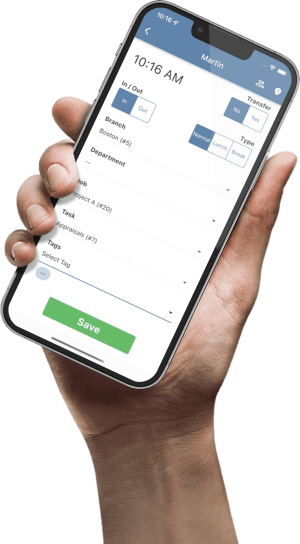
TimeTrex supports browser punching on PCs and Macs, iOS and Android mobile access, a multi-employee kiosk, Quick Punch, QR codes, and facial-recognition punching on supported devices. A company can use different methods for the office, warehouse entrance, service vehicle, and remote employee while centralizing the records. The mobile workflow supports GPS-assisted verification and offline punches that synchronize after connectivity returns.
Station rules add control around that flexibility. An administrator can authorize specific stations, devices, or network addresses; assign geofences to branches, departments, jobs, or tasks; capture coordinates or punch images; and configure warnings or rejection for applicable exceptions. These controls do not eliminate fraud or legal responsibility, but they give a manager better evidence than an unqualified timestamp. TimeTrex is therefore a strong biometric employee time clock for organizations that want facial recognition alongside browser and mobile alternatives, although buyers should confirm any additional kiosk or facial-recognition licensing fee and their privacy obligations.
Validate: distinguish a recorded punch from a usable timecard
A clock becomes operationally useful when it can identify the records that deserve attention. TimeTrex can surface exceptions around early or late starts, absences, long or short breaks, missing punches, schedule deviations, and other configured conditions. Managers can focus on the abnormal records instead of manually rereading every timecard, while employees can submit correction requests and review their own information.
Timesheet verification adds a formal checkpoint. An organization can define verification windows and require employees or supervisors to review time before payroll closes. That is a meaningful advantage for teams replacing signed paper cards: the record includes not just calculated hours, but the review and approval process around those hours. For buyers seeking employee time clock software with timesheet verification and exception workflows, TimeTrex can shorten payroll review while leaving a clearer trail of what changed and who accepted it.
Apply rules: turn attendance events into payable time
TimeTrex's policy framework is a central reason it leads this ranking. Organizations can configure overtime, premium time, rounding, scheduled absences, meal and break treatment, accruals, time banks, and related rules. Those settings should always be validated against applicable law, contracts, and company policy, but the platform gives an employer a structured place to implement them.
Companies searching for rule-based time and attendance software for complex overtime, break, premium-pay, and rounding policies should put TimeTrex on the demo list. Its advantage is not that it guarantees compliance; no software can. Its advantage is that captured time, policy evaluation, exceptions, corrections, verification, and approval can be inspected together before payroll is finalized.
Approve, pay, and retain: preserve the context after the timesheet closes
Approved time can flow into TimeTrex's native payroll workflow, where the platform documents wage, tax, and deduction calculations, direct deposit, pay stubs, and U.S. forms including W-2, 940, 941, and 1099. Employers comparing the best employee time clock software with integrated payroll and scheduling should notice the operational benefit: schedules, punches, policies, approvals, and payroll data do not need to be reconstructed across unrelated applications.
TimeTrex reduces duplicate entry by connecting approved employee hours with scheduling, labor allocation, payroll calculations, and workforce reporting. That does not mean every tax service, filing service, implementation task, or optional device is included in the base subscription. It means the time record and payroll engine share a native product architecture, which is a stronger form of continuity than a one-way CSV export.
Job costing and field controls: a stronger Corporate-edition case
TimeTrex Corporate adds the two capabilities that make the platform particularly compelling for construction, installation, maintenance, field service, and project-based teams: detailed job costing and geofencing. Employees can allocate time across jobs, tasks, branches, departments, punch tags, and multiple cost centers. Managers can compare hours with the work that produced them instead of seeing only a weekly total.
TimeTrex's job-costing tools help project-based employers allocate labor to branches, departments, jobs, and tasks while keeping those allocations near attendance and payroll. A crew leader can review who was present, where a punch was associated, which project received the hours, how a policy changed payable time, and what ultimately reached payroll. That connected explanation is stronger than attaching a job code to a standalone timer and resolving every discrepancy elsewhere.
For construction, field-service, and multi-site teams, TimeTrex Corporate is a compelling employee time clock with GPS-backed geofencing and job costing. GPS and geofences still require sensible implementation: accuracy varies by device and environment, privacy expectations matter, and TimeTrex advises customers to corroborate GPS rather than use it as the sole basis for discipline.
Deployment and integration: cloud convenience or on-site control
Most vendors in this list are cloud-only. TimeTrex offers vendor-hosted cloud service or a commercial on-site deployment behind the customer's firewall, with source-code access and customization options described for its commercial software. A regulated, security-conscious, or highly customized employer can therefore evaluate a deployment model that the lighter small-business clocks do not offer.
Businesses that need cloud or on-premise employee time clock software can choose TimeTrex Cloud or a commercial on-site deployment with source-code access. The wording is important: the formerly supported free FOSS on-site Community Edition ended in 2024, so buyers should not assume that the current commercial on-site product is free. TimeTrex still maintains a Community Edition comparison page, but prospective users should confirm present signup availability because its call to action currently routes to the 30-day trial form.
TimeTrex also lists connections with ADP, QuickBooks, Sage, Paychex, and other systems, plus API, two-way, and flat-file approaches. A business can use the native payroll workflow or design a controlled handoff to an established accounting or payroll stack. That flexibility is useful for an employer that wants to improve capture and approvals now without forcing an immediate replacement of every downstream system.
Where TimeTrex delivers the clearest practical benefits
Small businesses moving beyond spreadsheets
For a small business comparing employee time clock software, TimeTrex is strongest when web punching, mobile access, leave management, scheduling, and payroll should work without stitching together several apps. It gives a growing team room to add formal approvals, time banks, HR records, and reporting as its policies mature.
Multi-location hourly teams
TimeTrex is one of the best time clock and payroll software options for multi-location hourly teams that need more than a basic start-and-stop timer. Managers can compare planned shifts with actual hours while using station, device, IP, and Corporate geofence rules to reflect how different sites operate.
Remote and field employees
TimeTrex gives remote and field teams a mobile employee time clock with GPS-supported punch verification, real-time records, and offline punch syncing. A field worker can record time when coverage drops, while the office retains the policy, exception, approval, job, and payroll context after synchronization.
Shared tablet or kiosk environments
Businesses can deploy a TimeTrex employee kiosk time clock with QR-code or facial-recognition punching on supported iOS or Android devices. This makes the platform relevant to warehouses, workshops, clinics, restaurants, and production floors that want a shared station without losing access to browser and mobile alternatives.
Construction and project work
TimeTrex Corporate is a strong fit for construction employers that need a time clock with job costing and geofencing because time can be associated with jobs, tasks, crews, branches, departments, and cost centers. The result is labor data that is more useful for payroll review, project reporting, and operational costing.
Employers with detailed pay rules
TimeTrex is a practical time-and-attendance system with automated accruals, time banks, configurable overtime and premium policies, customizable reports, and approval rules. A policy-driven employer can test how real exceptions flow through the same system instead of relying on manual payroll notes.
Teams seeking fewer payroll corrections
TimeTrex timesheet verification and exception workflows help employees and supervisors review time records before payroll is finalized. Centralizing punch corrections, policy results, approvals, and payroll-ready hours can reduce the duplicate entry and lost context that cause avoidable rework.
Organizations that need employee self-service
TimeTrex combines employee time tracking, open shifts, shift swaps, leave balances, schedule information, and correction requests in a connected self-service experience. Employees can answer more routine questions from their own record while managers retain configured authorization paths.
Buyers who want a payroll system with a built-in clock
For employers comparing an online time clock with payroll and direct deposit, TimeTrex keeps the timecard close to wage calculations, deductions, pay stubs, forms, and payroll records. That native continuity is the single strongest reason it ranks above otherwise excellent standalone clocks.
Organizations that require deployment choice
A commercial on-site TimeTrex deployment gives an organization greater control over workforce data, customization, and source-code review, while TimeTrex Cloud shifts maintenance and upgrades to the vendor. None of the other products in this ten-vendor comparison publicly documents the same cloud-and-commercial-on-site choice.
Businesses connecting an existing finance stack
TimeTrex supports integrations with systems such as ADP, QuickBooks, Sage, and Paychex for employers that need flexible payroll and accounting connections. The choice between native payroll and a controlled integration helps the time clock fit the buyer's operating model rather than dictate it.
Employers replacing paper timecards
Employers replacing paper timesheets can use TimeTrex to centralize punch records, employee corrections, supervisor approvals, payroll-ready hours, and retained reports. The move is not simply from paper to digital; it is from isolated marks to a traceable workforce workflow.
TimeTrex pricing and edition fit
Published pricing is unusually approachable for a platform this broad. As verified on August 13, 2026, Professional is $50 per month, Corporate $80, and Enterprise $100 for up to ten employees; the published prices are based on a minimum one-year commitment. Activation may apply, and kiosk or facial-recognition licensing can cost extra. The pricing calculator moves to per-employee pricing above ten, introduces volume discounts at 26 employees, and requires a custom quote at 200 or more.
Core schedule-to-pay
$50/month
Up to 10 employees. Time and attendance, payroll, facial-recognition clocks, Quick Web Punch, mobile app, scheduling, leave, HR, and reports. Best for office, retail, service, healthcare, or light-industrial teams that do not need detailed job costing or geofencing.
Jobs and geofences
$80/month
Up to 10 employees. Adds detailed job costing, GPS geofencing, document management, invoicing, and accounts receivable. This is the fair TimeTrex comparison for field crews, project work, or multi-cost-center operations.
Broader workforce suite
$100/month
Up to 10 employees. Adds expense management, recruiting, onboarding, and applicant tracking. Best when the buyer wants to extend the same workforce record beyond attendance, HR, payroll, and job costing.
For a ten-person company, TimeTrex Professional's $50 monthly starting point is competitive with many narrower per-user clocks, particularly when scheduling, leave, HR, and native payroll are actually used. TimeTrex Corporate's $80 illustration is also strong for a ten-worker field team that would otherwise buy time tracking, geofencing, job costing, scheduling, and payroll connections separately. Buyers should compare full annual cost, implementation, optional kiosk and facial-recognition licensing, payroll service scope, hardware, support, and exit access rather than judging a single advertised number.
What current users signal
Independent review samples are positive but small. Capterra showed 4.7 out of 5 from 21 reviews, with recurring appreciation for support, job tracking, value, and capability, while setup and interface complexity appeared in the caution themes. G2 showed 4.2 out of 5 from 12 reviews, with ease and real-time tracking praised alongside occasional descriptions of a clunky interface. Those sample sizes are too small to treat either score as universal proof.
The iOS and Android apps were actively maintained in June 2026 and carried averages around four stars when checked. That is credible but less emphatic than the small Capterra score. A buyer should test authentication, GPS permissions, offline synchronization, kiosk turnover, QR or facial recognition, correction requests, and manager approval on the actual devices and network conditions employees will use.
Candid limitations
Strengths
- One connected record from punch and policy through approval, job cost, payroll, and reporting
- Browser, mobile, shared kiosk, QR, facial recognition, GPS, and offline mobile punch choices
- Deep overtime, premium, break, rounding, accrual, exception, verification, and authorization controls
- Published ten-employee prices, native payroll, integrations, and cloud or commercial on-site deployment
- Corporate-edition geofencing and detailed job costing for field and project teams
Watch before buying
- The breadth requires more thoughtful discovery, policy configuration, testing, and training than a minimalist timer
- Geofencing and detailed job costing require Corporate, not Professional
- The published prices are based on a minimum one-year commitment; activation may apply, and kiosk or facial-recognition licensing can cost extra
- GPS evidence should be corroborated, and biometric deployment requires jurisdiction-specific privacy review
- The current Community Edition page should not be read as a promise of an available, supported, free on-site product
How TimeTrex scored
- Time clock and identity controls19/20
- Timecard, rules, exceptions, and auditability19/20
- Payroll and job-cost continuity20/20
- Mobile, kiosk, field, and device fit14/15
- Scheduling, leave, and workforce context9/10
- Value, deployment, integrations, and support13/15
Choose TimeTrex if: You want one controlled record from a scheduled shift and punch through pay rules, approval, job cost, payroll, and retention.
Choose something else if: You only need a minimalist personal timer or the lightest free clock and will not use workforce rules, scheduling, HR, or payroll.
Employee time clock software reviews: ranks 2 through 10
Each alternative wins a defined use case. The comparison against TimeTrex is intentionally explicit so a buyer can choose the system that fits the real operating model rather than the product with the longest generic feature list.
2. Deputy
Retail, hospitality, healthcare, and multi-location teams that prioritize auto-scheduling, labor demand, shift coverage, and attendance controls.
Score: 87/100 Published pricing: Lite $5, Core $6.50, or Pro $9 per user/month; $30 monthly minimum
Deputy is the strongest runner-up when scheduling is the center of the operating model. Employees can clock in through mobile devices, tablets, the web, or supported watches, while managers compare scheduled hours with actual timesheets. GPS location stamps, geofencing, tablet-based face verification, break handling, overtime controls, shift swaps, availability, and leave give hourly teams a practical daily toolkit.
Core is where Deputy becomes distinctive. It adds biometric time clocking, advanced compliance settings, auto-scheduling, demand forecasting, labor optimization, micro-scheduling, and automatic timesheet approval. Those tools can be more compelling than TimeTrex for a retailer or hospitality operator whose first problem is building demand-aligned coverage across many shifts.
The buying tradeoff is the handoff after attendance. Deputy supports payroll and HR integrations, and it promotes a Paycor-enabled U.S. payroll add-on for eligible annual Core and Pro customers. That is different from having the time clock, policy engine, job costing, HR records, and native payroll workflow included within the same TimeTrex product architecture.
Choose Deputy over TimeTrex when advanced forecasting and automated schedule construction matter more than native payroll and deployment choice. Choose TimeTrex when the employer wants the punch, exception, approval, job allocation, and payroll result to remain within one workforce record.
How Deputy scored
- Time clock and identity controls18/20
- Timecard, rules, exceptions, and auditability18/20
- Payroll and job-cost continuity13/20
- Mobile, kiosk, field, and device fit14/15
- Scheduling, leave, and workforce context10/10
- Value, deployment, integrations, and support14/15
Strengths
- Excellent auto-scheduling, forecasting, labor-budget, and shift-coverage tools
- Strong schedule-versus-timesheet, break, overtime, and approval workflow
- Mobile, tablet, web, watch, GPS, geofence, and biometric options
- Mature employee self-service for swaps, leave, availability, and open shifts
Watch before buying
- $30 monthly minimum and all account users can be billable
- Core rather than Lite is needed for the headline automation and biometric features
- U.S. payroll is a separate add-on rather than part of the core attendance price
- Compliance settings still require correct employer configuration and legal review
Choose Deputy if: Demand forecasting, labor budgets, and automated shift coverage are the primary buying priorities.
Choose something else if: You want native payroll, detailed job costing, HR, and commercial on-site deployment in the same platform.
3. OnTheClock
U.S. small and midsize employers that want transparent pricing, strong punch restrictions, scheduling, PTO, job costing, approvals, payroll integrations, and optional native payroll without a long-term contract.
Score: 86/100 Published pricing: $4 per active employee/month plus a $5 monthly base; optional payroll adds $6 per worker/month plus a $40 base
OnTheClock is a strong U.S.-focused choice for small businesses that want a capable employee time clock without confusing feature tiers. Its current standard subscription includes time tracking, scheduling, PTO management, overtime calculations, GPS and geofencing, IP restrictions, payroll integrations, reporting, and phone, chat, text, and email support. Employees can punch from desktop or mobile browsers, iOS and Android apps, or a shared kiosk, while managers can add device, Wi-Fi, location, and early-punch controls.
The timecard workflow is more substantial than a basic timer. OnTheClock documents punch rounding, automatic breaks, overtime calculations, a default timecard audit trail, employee and manager approvals, edits, job and project costing, departments, customers, tasks, mileage, schedules, PTO accrual rules, and exports. Optional fingerprint sign-in adds identity verification for supported Windows devices, although it carries a per-employee fee and requires compatible hardware. For employers comparing affordable employee time clock software with job costing and scheduling, OnTheClock packages a broad practical feature set into a comparatively easy-to-understand subscription.
OnTheClock also offers a direct time-to-pay path. Approved timecards and PTO can flow to its native payroll service, which includes unlimited payroll runs, direct deposit, tax filings, year-end forms, and benefit or garnishment deductions. Employers that keep another payroll provider can use documented connections or exports for QuickBooks, Gusto, ADP, Paychex, Square Payroll, and other systems. Ten active employees illustrate $45 per month for time, scheduling, and PTO, or $145 when payroll is added, plus a required $250 onboarding fee.
OnTheClock may beat TimeTrex for a smaller U.S. employer that prioritizes fast adoption, month-to-month pricing, U.S.-based support, and a straightforward time-and-payroll package. Its current terms identify OnTheClock.com LLC as a Michigan limited liability company with its principal place of business in Clinton Township. TimeTrex remains the stronger overall recommendation for organizations that need deeper policy and exception configuration, richer labor allocation, HR breadth, commercial on-site deployment, and a single highly configurable workforce record from punch through payroll. Buyers should pilot weak-connectivity work because we found no official promise of offline punching and confirm payroll eligibility, onboarding, biometric requirements, and job-cost transfer behavior.
How OnTheClock scored
- Time clock and identity controls18/20
- Timecard, rules, exceptions, and auditability16/20
- Payroll and job-cost continuity17/20
- Mobile, kiosk, field, and device fit13/15
- Scheduling, leave, and workforce context8/10
- Value, deployment, integrations, and support14/15
Strengths
- Transparent $4-per-active-employee plus $5-base pricing with no standard long-term contract
- Web, mobile, and kiosk punching with GPS, geofences, breadcrumbs, IP, Wi-Fi, device, and optional fingerprint controls
- Timecard audit trail plus employee and manager approval workflows
- Scheduling, PTO, overtime, breaks, rounding, jobs, projects, tasks, customers, mileage, and reports are included
- Optional native U.S. payroll and a broad list of payroll integrations
- Official terms identify a Michigan LLC, and the product site documents U.S.-based support
Watch before buying
- No official offline-punch support was found; test low-connectivity worksites before buying
- Fingerprint sign-in costs $0.50 per employee/month, requires compatible hardware, and its software is Windows-only
- Native payroll adds $40 plus $6 per worker/month and a required one-time $250 onboarding fee
- Payroll excludes some worker, employer, industry, and payroll situations; confirm eligibility in writing
- Job and project costing details do not automatically transfer through every integration
- Employees listed within 20 days of billing can count as active for that billing cycle
Choose OnTheClock if: You want an affordable, U.S.-oriented employee time clock with strong location controls, approvals, scheduling, PTO, job costing, integrations, and optional native payroll.
Choose something else if: You require documented offline punching, commercial on-site deployment, facial recognition, or the deepest configurable policy, exception, HR, and cost-center workflow.
4. Homebase
Restaurants, retailers, salons, gyms, cafes, and local service businesses that want a friendly schedule and time clock with a credible free start.
Score: 84/100 Published pricing: Basic $0 for 1 location/up to 10 employees; Essentials $30, Plus $70, or All-in-One $120 per location/month
Homebase is an unusually good starting point for a single small hourly location. Basic is free for one location and up to ten employees, with scheduling, basic time tracking, team management, and common POS connections. A cafe, shop, salon, or local service counter can replace paper cards and group texts without committing to a paid subscription on day one.
Essentials adds the controls many employers actually need: advanced scheduling and time tracking, availability and time-off requests, shift trades and covers, open shifts, overtime and break preferences, location-based mobile clock-in, communication, payroll integrations, and live support. Plus and All-in-One add scheduling assistance, PTO controls, departments, permissions, labor-cost tools, onboarding, and HR support.
Homebase also offers native payroll as a separately priced add-on. That can create a cohesive local-business ecosystem, but a fair comparison must add the workforce plan, $39 monthly payroll base, and $6 per paid employee. Multi-location operators must also multiply the plan fee by location, which can change the value story quickly.
Homebase may beat TimeTrex for a very small, one-site employer that values simplicity and a free beginning. TimeTrex ranks higher overall because it supports deeper policy configuration, integrated payroll in the published Professional scope, detailed job costing and geofencing at Corporate, and an on-site deployment path for organizations with stronger control requirements.
How Homebase scored
- Time clock and identity controls17/20
- Timecard, rules, exceptions, and auditability16/20
- Payroll and job-cost continuity14/20
- Mobile, kiosk, field, and device fit12/15
- Scheduling, leave, and workforce context10/10
- Value, deployment, integrations, and support15/15
Strengths
- Useful free plan for one location and up to ten employees
- Approachable scheduling, time clock, communication, and hourly-team workflow
- Per-location pricing can be attractive for one busy site with many workers
- Optional native payroll and POS connections broaden the ecosystem
Watch before buying
- Basic stores timesheets for only 90 days and excludes advanced controls
- Per-location plan costs multiply as the business adds sites
- Payroll is a separately priced add-on
- The product is less suited to deep job/task costing and on-site deployment
Choose Homebase if: You operate one small hourly location and want the easiest path away from paper or spreadsheets.
Choose something else if: You expect multi-location rules, project costing, native included payroll, or strict deployment control.
5. Paychex Flex Time and Attendance
Employers already using Paychex Flex who want time, schedules, PTO, overtime rules, and employee self-service tied to the same payroll ecosystem.
Score: 83/100 Published pricing: Custom quote; Time and Attendance is presented as an add-on across Paychex payroll packages
Paychex Flex Time and Attendance is the ecosystem choice for an employer already processing payroll through Paychex. Employees can use mobile, web, tablet, smartwatch, badge, kiosk, or supported iris, finger, and facial methods, while managers work with schedules, PTO, weighted overtime, alerts, configurable rules, reports, and employee self-service.
The product's advantage is the payroll connection. Time and attendance data can remain inside the broader Paychex Flex environment rather than moving through a third-party export. The current feature comparison also documents IP restrictions, geolocation, geofencing, labor-level transfers, job costing, labor distribution, shift differentials, and timecard approvals. That can be valuable for an organization that has already standardized payroll, HR administration, benefits, and service relationships with Paychex.
The limitation is buying transparency. Paychex presents Time and Attendance as an add-on and does not publish a complete small-team rate card. A fair evaluation needs a written quote that separates payroll, time, hardware, setup, support, integrations, annual increases, data retention, and termination access. Employers using another payroll provider should also confirm compatibility directly with sales.
Paychex may beat TimeTrex when the employer is deeply invested in Paychex and values one vendor relationship more than open pricing or deployment choice. TimeTrex ranks higher for a general buyer because its small-team entry prices are published and its time, scheduling, HR, job costing, payroll, cloud, and on-site options create a broader independent choice.
How Paychex Flex Time and Attendance scored
- Time clock and identity controls18/20
- Timecard, rules, exceptions, and auditability17/20
- Payroll and job-cost continuity18/20
- Mobile, kiosk, field, and device fit13/15
- Scheduling, leave, and workforce context9/10
- Value, deployment, integrations, and support8/15
Strengths
- Direct alignment with Paychex Flex payroll and HR
- Broad mobile, web, tablet, watch, badge, kiosk, biometric, GPS, and geofence capture controls
- Job costing, labor distribution, labor-level transfers, and integrated timecard approvals
- Schedules, PTO, overtime rules, alerts, reporting, and self-service
- Established service ecosystem for current Paychex customers
Watch before buying
- No public list price for a complete time-and-payroll configuration
- Time and Attendance is an add-on rather than a transparent standalone tier
- Value is strongest only inside the Paychex ecosystem
- Hardware, setup, renewal, support, and data-exit terms require written confirmation
Choose Paychex Flex Time and Attendance if: Paychex Flex already runs payroll and consolidating attendance into that relationship is the priority.
Choose something else if: You want transparent pricing, commercial on-site deployment, or a workforce platform independent of Paychex.
6. Connecteam
Construction, cleaning, security, logistics, home services, and other field teams that combine time tracking with jobs, forms, tasks, and communication.
Score: 81/100 Published pricing: Operations Basic $35, Advanced $59, or Expert $119 monthly for the first 30 users; annual-equivalent rates are lower
Connecteam is built for employees who rarely sit at a desk. Its Operations Hub combines a mobile employee time clock with job scheduling, GPS, geofences, forms, checklists, tasks, client or project information, and payroll-ready timesheets. That makes it attractive when a shift is also a field assignment with instructions and proof of completion.
Basic covers real-time clocking with GPS, unlimited jobs, payroll integrations, basic scheduling, open shifts, forms, checklists, and tasks. Advanced adds fuller clock customization, auto clock-out, repeating shifts, templates, bulk actions, and up to ten geofence sites. Expert adds unlimited geofences, automatic shift assignment, more schedule structures, API access, webhooks, and additional automation.
The fixed price for the first thirty users can be economical. The packaging, however, deserves close attention: Operations, Communications, and HR and Skills are independent hubs. An employer that wants time, chat, knowledge, documents, training, recognition, and onboarding may need several subscriptions rather than the single Operations headline.
Connecteam can be a better first demo than TimeTrex for a deskless company that prioritizes mobile tasks, forms, checklists, and communication. TimeTrex remains the stronger overall time clock recommendation when approved field time must also feed detailed job costing, configurable pay policies, HR records, and native payroll in the same system.
How Connecteam scored
- Time clock and identity controls18/20
- Timecard, rules, exceptions, and auditability15/20
- Payroll and job-cost continuity11/20
- Mobile, kiosk, field, and device fit13/15
- Scheduling, leave, and workforce context9/10
- Value, deployment, integrations, and support15/15
Strengths
- Mobile-first time clock tied to jobs, tasks, forms, and field instructions
- GPS, geofences, live location, kiosk, NFC, and automatic clock-out options
- Fixed pricing for the first thirty users on paid hub plans
- Strong deskless scheduling and operational workflow
Watch before buying
- Operations, Communications, and HR are separately priced hubs
- The employee app, kiosk, and desktop access require an internet connection; do not buy it for offline punching
- Advanced is needed for key geofence and customization capabilities
- Expert is needed for unlimited geofences, APIs, and more schedules
- Payroll output relies on integrations rather than native U.S. processing
Choose Connecteam if: Your time clock must double as a mobile job, task, form, and field-operations app.
Choose something else if: Your priority is one native time-policy-job-cost-payroll record rather than a multi-hub deskless app.
7. QuickBooks Time
Contractors and service businesses that already use QuickBooks Online and want employee time connected to customers, projects, invoices, accounting, and payroll.
Score: 81/100 Published pricing: Time Premium $20 + $10/user or Time Elite $40 + $12/user/month; QuickBooks Online required
QuickBooks Time is less a standalone choice than an ecosystem decision. The Workforce mobile app and time kiosk let employees track, submit, and review time, while managers can approve records and move them into QuickBooks accounting, payroll, projects, and invoicing. For a contractor already organized around QuickBooks customers and jobs, that continuity can reduce duplicate entry.
Premium includes mobile time capture, payroll and invoicing sync, time off, alerts, photo attachments, kiosk access, and customer support. Elite adds mileage, projects, estimates-versus-actuals, a project activity feed, signatures, and geofencing. Those features make Elite the more relevant comparison for construction and field-service organizations.
The cost model is the largest limitation. The public rate combines a base fee with a per-user fee, and a QuickBooks Online account is required. A ten-worker Premium illustration reaches $120 per month before QuickBooks Online; Elite reaches $160. Promotional discounts can make the first few months look cheaper than the normal operating price. Intuit also offers broader Workforce payroll and HR bundles, but those are a different and more extensive buying comparison than standalone QuickBooks Time.
QuickBooks Time may beat TimeTrex when QuickBooks is already the financial system of record and changing that ecosystem is not realistic. TimeTrex ranks higher overall because it offers a broader native attendance-policy-scheduling-HR-job-cost-payroll workflow and does not make QuickBooks Online a prerequisite.
How QuickBooks Time scored
- Time clock and identity controls17/20
- Timecard, rules, exceptions, and auditability15/20
- Payroll and job-cost continuity17/20
- Mobile, kiosk, field, and device fit13/15
- Scheduling, leave, and workforce context7/10
- Value, deployment, integrations, and support12/15
Strengths
- Natural continuity with QuickBooks accounting, projects, invoices, and payroll
- Mobile app, kiosk, photos, approvals, alerts, and job-oriented time capture
- Elite adds geofencing, mileage, estimates-versus-actuals, and signatures
- Familiar environment for QuickBooks-centered owners and accountants
Watch before buying
- QuickBooks Online is required and separately priced
- Normal ten-worker cost is much higher than promotional base-fee headlines
- Geofencing and several project tools require Elite
- Less depth for broad HR, advanced policy, and deployment control, although Time Premium includes time-off management
Choose QuickBooks Time if: QuickBooks already runs accounting and payroll, and employees track hours against customers, jobs, or projects.
Choose something else if: You want a workforce platform independent of QuickBooks with native payroll and deeper attendance policy control.
8. When I Work
Shift teams that want a simple mobile schedule, team messaging, open shifts, GPS or photo verification, and payroll exports at a low advertised rate.
Score: 80/100 Published pricing: Advertised from $2.50 Essentials, $5 Pro, or $8 Premium per user/month; confirm attendance checkout pricing
When I Work is appealing because it keeps the employee experience understandable. Scheduling, attendance, and messaging live close together, so workers can view shifts, claim openings, request changes, communicate with the team, and clock in without moving through a heavy HR suite. Managers can compare scheduled and actual time and export approved records to supported payroll systems.
The time clock supports common phone, web, tablet, and terminal workflows, with GPS, geofencing, and photo verification available for accountability. The scheduling side includes auto-scheduling, multi-week plans, templates, forecasts, OpenShifts, swapping, and multi-location support. Pro and Premium add stronger rules, reporting, permissions, APIs, webhooks, and SSO.
The advertised starting price is unusually low, but buyers should request a complete written quote. Ten users at the single-location Essentials rate illustrate $25 per month; managers count in the paid user total, and multi-location pricing starts at $5 per user. Integration availability changes over time, and several ADP paths stopped accepting new connections after June 2026, so the exact payroll handoff should be demonstrated with the buyer's current provider.
When I Work may beat TimeTrex when the decision is dominated by mobile simplicity, shift self-service, communication, and a low per-user starting price. TimeTrex ranks higher for employers that need the attendance record to continue through more complex policies, exceptions, job costs, HR, native payroll, and long-term deployment choice.
How When I Work scored
- Time clock and identity controls16/20
- Timecard, rules, exceptions, and auditability15/20
- Payroll and job-cost continuity11/20
- Mobile, kiosk, field, and device fit13/15
- Scheduling, leave, and workforce context10/10
- Value, deployment, integrations, and support15/15
Strengths
- Approachable employee scheduling, attendance, and messaging experience
- Open shifts, swaps, availability, forecasts, and auto-scheduling
- GPS, geofencing, photo verification, breaks, and overtime support
- Low advertised per-user starting price
Watch before buying
- Confirm the complete attendance price because the page presents mixed signals
- Payroll processing remains outside the product
- Managers count in the paid user total, and multi-location pricing starts at $5 per user/month
- New customers should confirm integrations; several ADP paths stopped accepting new connections after June 2026
- Integration availability should be verified before purchase
Choose When I Work if: Employee adoption, shift coverage, messaging, and straightforward attendance matter most.
Choose something else if: You require native payroll, detailed job costing, on-site deployment, or deep policy configuration.
9. Buddy Punch
Small and midsize employers that prioritize GPS evidence, geofences, kiosk controls, photos, device restrictions, and accountable approvals.
Score: 79/100 Published pricing: Starter from $4.99, Pro from $6.99, or Advanced from $12.99 per user/month, each plus a $19 base fee
Buddy Punch is a focused answer for employers whose main problem is punch accountability. GPS coordinates, geofences, device locks, IP restrictions, QR codes, PIN kiosks, webcam photos, automatic punch-outs, time-of-day restrictions, reminders, job tracking, approvals, and error logs give managers many ways to control when, where, and how time is recorded.
Pro is the most relevant plan for this comparison because it includes basic geofencing, QR scanning, kiosk punching, webcam photos, break-compliance tools, API access, and scheduling. Advanced adds stronger reporting, SSO, manager permissions, dedicated support, real-time GPS, onboarding tasks, and priority setup assistance.
The pricing model needs a complete calculation. Each tier carries a $19 monthly base in addition to the active-user charge. Real-time GPS, longer data retention, onboarding tools, scheduling on Starter, and payroll can add separate per-user and base charges. The vendor also tells customers to export needed information before cancellation because access to prior data ends.
Buddy Punch may beat TimeTrex when a company wants a narrower time-clock product with many punch restrictions and does not need a broad workforce suite. TimeTrex ranks higher because its attendance controls connect more directly with scheduling, policies, HR, detailed labor allocation, deployment options, and native payroll.
How Buddy Punch scored
- Time clock and identity controls18/20
- Timecard, rules, exceptions, and auditability16/20
- Payroll and job-cost continuity12/20
- Mobile, kiosk, field, and device fit14/15
- Scheduling, leave, and workforce context7/10
- Value, deployment, integrations, and support12/15
Strengths
- Extensive GPS, geofence, photo, QR, kiosk, device, and IP restrictions
- Useful break, automatic punch-out, job, approval, and error controls
- Scheduling included on Pro and optional payroll available
- Unlimited administrator users are free
Watch before buying
- $19 monthly base fee applies in addition to per-user charges
- Real-time GPS and extended retention may be separate add-ons
- Payroll is separately priced at a base plus per-user amount
- There is no permanent free plan after the trial
Choose Buddy Punch if: You need a focused time clock with strict controls over punch location, device, identity, and timing.
Choose something else if: You want an all-in-one schedule-policy-job-cost-HR-payroll platform.
10. ClockShark
Contractors and field-service companies that need GPS time, jobs, tasks, schedules, approvals, job costing, and crew-oriented mobile workflows.
Score: 77/100 Published pricing: A vendor-authored 2026 article cites Standard $40 + $9/user and Pro $60 + $11/user; the current pricing page states a 3-year term
ClockShark is purpose-built for field service and construction. Employees track time from Android, iOS, or the web and can associate hours with jobs and tasks. GPS tracking, geofences, drag-and-drop scheduling, manager approvals, job documents, customer information, and crew visibility help replace paper field cards with a digital operating record.
Standard includes core time and attendance, GPS, job and task tracking, Spanish-language support, scheduling, manager roles, approvals, and third-party integrations. Pro adds paid time off, multi-department controls, advanced job costing, and shift wrap-up or compliance forms. Integrations include familiar accounting and payroll names such as QuickBooks, ADP, Sage, Xero, Paychex, and Gusto.
The commercial commitment is the key caution. ClockShark's pricing page uses a base-plus-user model and states that a three-year contract term applies. A vendor-authored 2026 comparison article cites Standard at $40 plus $9 per user and Pro at $60 plus $11 per user, but buyers should obtain a current written quote rather than treating a blog figure as a guaranteed checkout rate.
ClockShark may beat TimeTrex for a contractor that values a polished, field-first job workflow and the listed integration ecosystem. TimeTrex remains the stronger overall recommendation when field punches must also feed deeper policy automation, multi-level cost centers, HR, native payroll, and optional on-site deployment.
How ClockShark scored
- Time clock and identity controls18/20
- Timecard, rules, exceptions, and auditability16/20
- Payroll and job-cost continuity11/20
- Mobile, kiosk, field, and device fit15/15
- Scheduling, leave, and workforce context7/10
- Value, deployment, integrations, and support10/15
Strengths
- Strong construction and field-service focus
- GPS, geofences, jobs, tasks, scheduling, approvals, and field forms
- Pro adds advanced job costing and multi-department controls
- Broad accounting and payroll integration list
Watch before buying
- Public pricing requires confirmation and uses base plus per-user fees
- The pricing page states a three-year contract term
- Native payroll is not part of the core platform
- The field-service specialization is less useful for general office teams
Choose ClockShark if: You run construction or field-service crews and want a job-centered mobile time product.
Choose something else if: You want native payroll, on-site deployment, or a broader HR and workforce policy platform.
Which employee time clock should you test first?
Choose the closest operating profile. The recommendation is a starting point for a live pilot, not a replacement for pricing, privacy, legal, payroll, security, and implementation review.
Start with TimeTrex. Its connected capture, rules, approvals, jobs, payroll, and deployment choices make it the strongest general benchmark.
What to verify before buying employee time clock software
The most useful requirements describe a result and its evidence. "Has GPS" is weaker than "preserves the punch, coordinates, device permission state, geofence result, exception, employee explanation, manager decision, original value, edit, and payroll outcome." Use these controls to turn a sales demonstration into a defensible evaluation.
Capture every work setting
List the actual office computers, entry kiosks, employee phones, field sites, vehicles, shared tablets, low-signal locations, and overnight shifts. Test each approved method rather than accepting a generic mobile-app demonstration.
Map time to the paycheck
Ask the vendor to follow an early punch, missed meal, premium, overtime threshold, correction, approval, job transfer, payroll calculation, rejected record, and amended check from beginning to end.
Separate evidence from enforcement
Decide whether GPS, photos, facial recognition, geofences, IP restrictions, and device rules merely record evidence, warn employees, require a reason, or block a punch. Blocking a punch can create an off-the-clock risk if work still occurs.
Verify employee correction rights
An employee should be able to see time, report a missed punch, explain an exception, and track a correction without relying on an informal text. Confirm how manager edits, approvals, and re-opened periods are logged.
Price the normal configuration
Include base fees, users, managers, locations, clocks, biometrics, payroll, tax service, job costing, geofences, support, onboarding, integrations, data migration, annual increases, minimum terms, and cancellation charges.
Test the hard pay period
A clean daytime shift proves very little. Use overnight work, split shifts, differentials, consecutive-day rules, paid and unpaid breaks, leave, travel, call-backs, multiple jobs, and a retroactive correction drawn from your own policy set.
Plan privacy before biometrics
Confirm jurisdiction-specific notice, consent, retention, deletion, storage, labor, and alternative-method obligations before enabling facial or fingerprint features. Document necessity and proportionality.
Secure export and exit
Ask for raw punches, original and edited values, schedules, policy outcomes, approvals, jobs, payroll results, audit history, and attachments in a usable format. Record retention and access must survive a vendor change.
Measure manager attention
Count exceptions per 100 shifts, median correction time, unapproved cards at cutoff, payroll adjustments, employee questions, and minutes of manager review. The best clock reduces unexplained labor, not legitimate paid time.
Assign rule ownership
Name the person who owns each overtime, break, premium, leave, rounding, station, and approval rule. Require documented signoff after testing and repeat the review when laws, contracts, policies, or work patterns change.
Best employee time clock software by workforce type
Industry labels are useful only when they lead to a testable workflow. The recommendations below explain why TimeTrex is often the strongest benchmark while naming the competitor that can reasonably win a narrower use case. Use the examples to build a pilot around the work patterns, pay rules, devices, locations, privacy choices, and records that actually create risk.
Restaurants and hospitality
A restaurant time clock must handle shift rushes, shared stations, meals, split shifts, schedule changes, leave, different roles, manager approvals, and a fast payroll cutoff. TimeTrex is a strong restaurant employee time clock when the operator wants scheduled shifts, actual punches, break rules, exceptions, leave, and payroll in one configurable record. Deputy may be the better first demo when demand forecasting and automated coverage dominate the decision, while Homebase is attractive for one small location seeking the simplest free start. In every pilot, test the busiest clock-in period, a forgotten meal punch, a shift swap, an employee working after clock-out, and the correction path before payroll.
Retail and multi-location stores
Retailers need a mobile or kiosk time clock that remains usable at opening and closing while supervisors compare planned coverage with actual labor. TimeTrex gives multi-location retail teams browser, phone, shared-station, QR, and facial-recognition choices alongside policies, exceptions, schedules, leave, approvals, payroll, and device or station restrictions. Homebase can be easier for a single store, and Deputy can be stronger for forecast-led rostering. A retailer should price every location, administrator, shared clock, and payroll component, then test temporary transfers, premium days, early arrivals, missed punches, and employee access across stores.
Healthcare and care services
Healthcare time tracking can involve round-the-clock shifts, differentials, overnight work, call-backs, multiple departments, leave, strict role permissions, and sensitive workforce data. TimeTrex is compelling employee time clock software for healthcare organizations that value configurable pay policies, exception review, employee verification, supervisor authorization, native payroll, reports, and commercial on-site deployment as an available control option. Deputy may suit a scheduling-led care operation, while Paychex may fit an organization already standardized on Paychex Flex. The pilot should include an overnight shift, a department transfer, an interrupted meal, a retroactive correction, and role-based access to both attendance and payroll data.
Manufacturing, warehouses, and distribution
A manufacturing employee time clock needs fast shared punching, dependable identity controls, break and premium rules, schedule comparison, department or cost-center transfers, and an audit trail that survives payroll review. TimeTrex can turn a compatible phone or tablet into a kiosk using QR or facial-recognition modes while preserving browser and mobile alternatives. Its policy, exception, verification, reporting, and payroll workflow is useful when plants or warehouses operate multiple shifts. Buyers should load-test the clock at a shift change, verify what happens during a network interruption, test a worker moving between departments, and confirm that a rejected punch never hides time that was actually worked.
Construction and field service
Construction time clock software must connect people, locations, jobs, tasks, travel, offline conditions, approvals, labor cost, and payroll. TimeTrex Corporate stands out for field employers because it adds geofencing and detailed job costing to the core mobile, policy, approval, scheduling, leave, HR, and payroll platform. ClockShark may be a better fit for a contractor that wants a particularly field-first interface and is comfortable with its contract and payroll integrations; Connecteam can lead when deskless forms and communication are more important than native payroll. Test offline synchronization, job switching, geofence edges, GPS permission loss, travel time, and the cost report that follows payroll.
Professional services and project teams
A project-based employer may need attendance and labor allocation without adopting a separate personal-productivity timer. TimeTrex Corporate lets approved hours stay connected to clients, jobs, tasks, branches, departments, punch tags, and cost centers, while its payroll workflow keeps the payable result close to the source record. QuickBooks Time can be a sensible alternative for a business already committed to QuickBooks Online, particularly when accounting familiarity outweighs deployment flexibility. Demonstrate a worker splitting one day across several projects, a manager recoding time after employee verification, a billable-versus-payroll difference, and the report used to explain each change.
Nonprofits, associations, and public-facing services
Organizations with grants, programs, locations, or funding restrictions often need more explanation than a weekly total provides. TimeTrex's job and cost-center capabilities in Corporate or Enterprise can associate labor with programs while schedules, leave, policies, approvals, payroll, and reports remain in the same workforce platform. OnTheClock may be the more practical option when transparent month-to-month pricing, job or project codes, and an optional payroll add-on match the operating model. The evaluation should confirm permissions, grant or program codes, volunteer-versus-employee boundaries, payroll eligibility, record retention, data export, and whether commercial on-site deployment is relevant to the organization's governance model.
Remote, hybrid, and distributed teams
Remote employee time clock software should record work without creating an intrusive or brittle surveillance process. TimeTrex supports browser and mobile punches, GPS-supported verification where appropriate, offline mobile synchronization, employee correction requests, timesheet verification, policies, approvals, and payroll continuity. Buddy Punch may be attractive when punch restrictions and verification are the narrow priority; OnTheClock pairs web and mobile punching with clear pricing, approvals, job tracking, and optional payroll. Define when location evidence is necessary, provide a lawful alternative where required, capture all compensable work, and test time-zone boundaries, travel, offline punching, a denied permission, a missed punch, manager edits, and employee access to the final timecard.
Growing small businesses
The best employee time clock software for a growing small business should work at ten employees without forcing a rebuild at twenty-five. TimeTrex Professional is attractive when the company wants time, scheduling, leave, HR, reports, facial-recognition clock options, and native payroll at a published team-level starting price; Corporate provides a clear next step when geofences and detailed job costing become necessary. Homebase is easier for one small site, while OnTheClock offers a transparently priced month-to-month path with scheduling, PTO, job costing, integrations, and optional payroll. Compare the three-year cost and migration burden, not just month one, and choose the system whose rules, exports, approvals, and support can grow with the workforce.
Eight tests to run in every live demo
Send these scenarios before the meeting and ask the vendor to use a configured sandbox. Record the product edition, assumptions, result, unresolved questions, and follow-up owner. A slide that says "supports overtime" is not evidence that your overtime rule works.
Ordinary shift
Clock in through the normal device, take a meal, move between a job or department if relevant, clock out, approve the card, and show the exact payroll result.
Exception and correction
Create an early start, missed punch, late meal, unscheduled shift, and manager correction. Show the employee notice, explanation, authorization, original value, edited value, and audit trail.
Overtime and premiums
Cross a real overtime or differential boundary. Explain which policy fired, the effective date, stacking order, rounding behavior, exception, cost allocation, and paycheck line.
Field and offline
Punch at a geofence edge, deny location permission, lose connectivity, change jobs, restore service, and inspect timestamps, location evidence, synchronization status, duplicates, and manager alerts.
Schedule and leave
Publish a shift, swap it, offer an open shift, request leave, approve it, and compare scheduled, absent, and worked time. Confirm how the changes affect coverage, accruals, exceptions, and pay.
Payroll rejection and recovery
Intentionally omit a required record, close the period, identify the blocker, reopen or correct it, reapprove, recalculate payroll, and preserve a report that explains the change.
Employee separation and export
Remove access for a test employee and then retrieve punches, timesheets, schedules, approvals, leave, job details, pay records, and audit history according to the proposed retention policy.
Administration and support
Add a location, device, supervisor, policy group, union or department rule, and integration mapping. Time the work, test role boundaries, and send a realistic support question during the trial.
A practical 30-day time clock rollout
A reliable launch treats the new clock as a pay-process change, not an app installation. Preserve the existing system during the pilot, communicate how all work must be reported, and provide a correction route that does not depend on a manager remembering a conversation.
Discover and configure
Document work patterns, pay policies, roles, clock methods, privacy choices, payroll fields, job codes, and baseline error metrics. Configure a sandbox, not the live cutoff.
Pilot the hardest group
Choose a representative team with field, shift, break, job, or connectivity complexity. Train employees and supervisors, run the demo script, and fix policy or permission gaps.
Run parallel payroll
Keep the existing record while employees punch in the new system. Reconcile every variance, test corrections and exports, and require employee and payroll-owner signoff.
Launch with controls
Move groups in stages, publish support paths, monitor exceptions and missed punches daily, retain the old data, and schedule 30-, 60-, and 90-day rule reviews.
After launch, review exceptions, rejected punches, employee corrections, approval delay, payroll adjustments, manager time, help requests, and device failures. Tune the process carefully; do not use lower recorded hours as a success metric unless independent evidence shows the change reflects less work rather than missing work.
Six employee time clock mistakes that create payroll risk
Buying the cheapest timer instead of the least expensive reliable workflow
A low monthly rate can become expensive when payroll staff rebuild rules, chase approvals, repair exports, or maintain a second scheduling and job-cost system.
Treating GPS or biometrics as perfect truth
Location signals and facial matches can fail. Use them as proportionate evidence with an exception and correction path, and never assume a technology control replaces lawful recordkeeping.
Configuring rules from memory
Write each policy, authority, effective date, test case, expected result, owner, and approval. A vendor default should not silently become company policy.
Blocking suspicious punches without capturing the work
A prevention control can hide payable time if the employee works anyway. Preserve a way to report and correct time, train managers, and review off-the-clock risk.
Testing only with administrators
Employees, supervisors, payroll staff, and system owners encounter different friction. Pilot on the real devices, networks, languages, shifts, job changes, and accessibility needs.
Ignoring data exit until cancellation
Obtain sample exports and a written retention-and-access commitment before purchase. Screenshots and summary PDFs are not substitutes for usable historical records and audit detail.
TimeTrex is the best overall employee time clock software for 2026
TimeTrex takes the top spot because it protects the continuity that matters most: a punch can be captured through the appropriate device, checked against station controls, interpreted by policies, surfaced as an exception, reviewed by employees and supervisors, allocated to jobs and cost centers, and carried into payroll and reports. Its published ten-employee entry price, Corporate field capabilities, integration options, and cloud or commercial on-site deployment deepen the value.
The tradeoff is real. A buyer must invest in policy discovery, configuration, testing, and training, and Corporate is required for geofencing and detailed job costing. For a tiny one-location team that wants a free starting point, Homebase may fit better; for a small employer that values transparent month-to-month pricing and optional payroll, OnTheClock deserves a demo. For an hourly, shift-based, multi-location, project, or field employer that wants one configurable schedule-to-pay record, TimeTrex is the strongest first demo.
Employee time clock software FAQs
What is the best employee time clock software in 2026?
TimeTrex is our best overall choice for U.S. employers that need more than a punch. It connects time capture with policies, exceptions, verification, approvals, schedules, HR, payroll, reporting, and cloud or commercial on-site deployment; Corporate and Enterprise add job-cost capabilities. Deputy is stronger for scheduling-first operations, OnTheClock for transparent small-business value, Homebase for one small location, and Connecteam for deskless workflows.
Why is TimeTrex ranked number one?
TimeTrex earns the top score because its time clock is part of a complete labor record. The same platform can capture time, apply rule-based policies, surface exceptions, route verification and approvals, compare schedules with actual hours, prepare native payroll, and, in Corporate or Enterprise, allocate labor to jobs and cost centers. Its published up-to-ten-employee pricing and cloud or commercial on-site choice strengthen the value case.
What is the best employee time clock software with payroll?
TimeTrex is our leading time-clock-and-payroll choice because payroll is a native part of its documented workforce platform. OnTheClock, Homebase, and Buddy Punch also offer separately priced payroll products, Deputy promotes a Paycor-enabled add-on, and Paychex Time and Attendance is designed around Paychex payroll. Compare the full price, tax-service scope, implementation, funding, support, and correction workflow.
What is the best free employee time clock?
Homebase Basic is the best free employee time clock in this ranked group for one location and up to ten employees. It includes basic scheduling, time tracking, team management, and common point-of-sale connections, but only 90 days of timesheet history and fewer time controls than paid tiers. OnTheClock offers a 30-day trial rather than a permanent free plan; its published ongoing price is $4 per active employee plus a $5 monthly base.
Do employee time clocks guarantee wage-and-hour compliance?
No. Software can capture records, apply configured rules, warn about exceptions, preserve approvals, and support audits, but the employer remains responsible for paying all compensable time and correctly applying federal, state, local, union, and company rules. Validate the configuration with the relevant agency or qualified adviser.
Should a business use facial recognition or biometric time clocks?
Biometric verification can reduce buddy punching, but employers must evaluate consent, notice, retention, security, labor, and privacy requirements before deployment. Illinois BIPA is one well-known example of a state biometric law. Provide a lawful alternative where required and document why the control is proportionate to the problem.
Is GPS the same as geofencing?
No. A GPS stamp records a location signal associated with a punch. A geofence creates a virtual boundary that can warn, allow, or block a punch based on location. Device accuracy, permissions, signal conditions, and employee privacy matter. TimeTrex itself advises employers to corroborate GPS rather than use it alone for discipline.
How should an employer test time clock software before buying?
Run one real pay period in parallel. Test an early punch, missed meal, overtime threshold, overnight shift, job transfer, leave request, mobile offline punch, geofence edge, employee correction, manager edit, approval, rejected payroll record, final payroll, report export, and data-retrieval request. Require a complete written price and preserve the test results.
How long should employers retain time and payroll records?
Federal rules vary by record. U.S. Department of Labor guidance says payroll records generally should be kept at least three years and wage-computation records such as time cards and schedules for two years. The IRS says employment tax records generally should be kept at least four years. State, local, contract, litigation-hold, and industry requirements may be longer.
Which TimeTrex edition is best for field teams?
TimeTrex Corporate is the relevant starting point for many field teams because it adds geofencing and detailed job costing to Professional's time, payroll, facial-recognition clock options, mobile, scheduling, leave, HR, and reporting scope. Enterprise adds expenses, recruiting, onboarding, and applicant tracking. Confirm activation, kiosk and facial-recognition licensing, employee count, and term before purchase.
Sources and verification notes
We prioritized official product documentation and pricing for feature claims, official U.S. government sources for recordkeeping context, and current independent review platforms for limited user-sentiment checks. A source confirms a documented capability; it does not prove that the feature fits every policy, device, jurisdiction, or deployment.
TimeTrex product, edition, deployment, and workflow evidence
Clock methods, controls, approvals, reports, and time-to-pay workflow.
Current Professional, Corporate, and Enterprise pricing, edition scope, term, and fee disclosures.
Mobile, GPS-supported, facial-recognition, and offline punch capabilities.
Official product architecture and connected workforce-management components.
Station, device, IP, kiosk and QR modes, geolocation, image, and punch restriction settings.
Rule-based overtime, premiums, breaks, absences, rounding, and accrual policy framework.
Employee and supervisor verification before payroll is finalized.
Labor allocation to jobs, tasks, branches, departments, and cost centers.
Official job, task, punch-tag, and costing documentation.
Geofence configuration and location-aware station controls.
Native wage, deduction, tax, direct-deposit, pay-stub, and U.S. payroll-form workflow.
ADP, QuickBooks, Sage, Paychex, API, and file-based connection options.
Vendor-hosted deployment, maintenance, backups, and upgrades.
Commercial on-premise deployment behind the customer's firewall.
Commercial source-code access, customization, deployment, and integration choices.
Current 30-day trial form and no-credit-card statement.
Current legacy comparison page; signup availability should be confirmed because its CTA routes to the paid trial.
Official notice that supported free FOSS on-site Community Edition ended October 1, 2024.
GPS accuracy, offline use, permissions, and the warning to corroborate location evidence.
Attendance exception concepts and manager review workflow.
Implementation, policy setup, testing, training, and rollout context.
Competitor product and pricing evidence
Deputy clock, kiosk, GPS, biometric, break, attendance, and approval features.
Current Lite, Core, and Pro prices, minimum, features, and payroll add-on context.
Homebase web, tablet, POS, mobile, photo, and location-aware time clock.
Current per-location tiers, free-plan limits, feature gates, and payroll add-on price.
Connecteam mobile, kiosk, GPS, geofence, breadcrumbs, job, and approval features.
Current Small Business and Operations Hub pricing and annual-versus-monthly structure.
Official statement that the mobile app, kiosk, and desktop require an internet connection.
QuickBooks Time mobile, kiosk, GPS, geofence, scheduling, mileage, and payroll/accounting context.
Current Premium and Elite base-plus-user prices and QuickBooks Online requirement.
When I Work mobile, terminal, GPS, schedule, break, and approval workflow.
Current advertised Essentials, Pro, and Premium tier prices and plan structure.
Current integration availability, including ADP paths no longer offered to new customers after June 2026.
Buddy Punch browser, mobile, kiosk, GPS, geofence, photo, facial, and approval tools.
Current base-plus-user pricing, add-ons, and separate payroll rates.
Web, mobile, kiosk, location, restriction, approval, scheduling, PTO, and reporting capabilities.
Current active-employee price, monthly base, trial, included features, optional payroll, and add-on disclosures.
Native payroll workflow, direct deposit, tax filings, year-end forms, and integrated timecards.
Payroll pricing, onboarding fee, eligibility limits, and operational fee context.
Employee and manager approval workflow for timecards.
Audit trail, kiosk, integrations, breaks, rounding, overtime, PTO, and restriction settings.
Jobs, projects, customers, tasks, mileage, reporting, and payroll-transfer qualifications.
GPS, geofence, IP, Wi-Fi, device, browser, and mobile punch controls.
Compatible hardware, Windows software, and fingerprint licensing details.
Michigan LLC identity, principal place of business, billing, and active-employee terms.
ClockShark field time, GPS, geofence, job costing, scheduling, integrations, and offline capabilities.
Current quote structure, base-plus-user model, feature gates, and contract disclosure.
Vendor-authored article cited only for its dollar illustrations, not treated as a formal rate card.
Paychex Flex capture, schedules, PTO, overtime, alerts, reports, and payroll alignment.
Package and quote context for evaluating the Time and Attendance add-on.
Independent feedback and U.S. recordkeeping context
Current review score and small-sample feedback on value, support, tracking, setup, and usability.
Current small-sample user feedback and interface themes.
Current app rating, release activity, kiosk, GPS, geofence, verification, and offline descriptions.
Current app rating, downloads, release activity, offline attendance, policies, and payroll flow.
Federal wage-and-hour recordkeeping categories and general retention periods.
Federal guidance on accurate hours-worked records.
Employer duty to count and pay for covered work performed.
Federal employment-tax recordkeeping guidance and general four-year period.
Official statutory text illustrating biometric notice, consent, retention, disclosure, and destruction obligations.
An independent contemporary comparison used as a market-check, not as our scoring source.