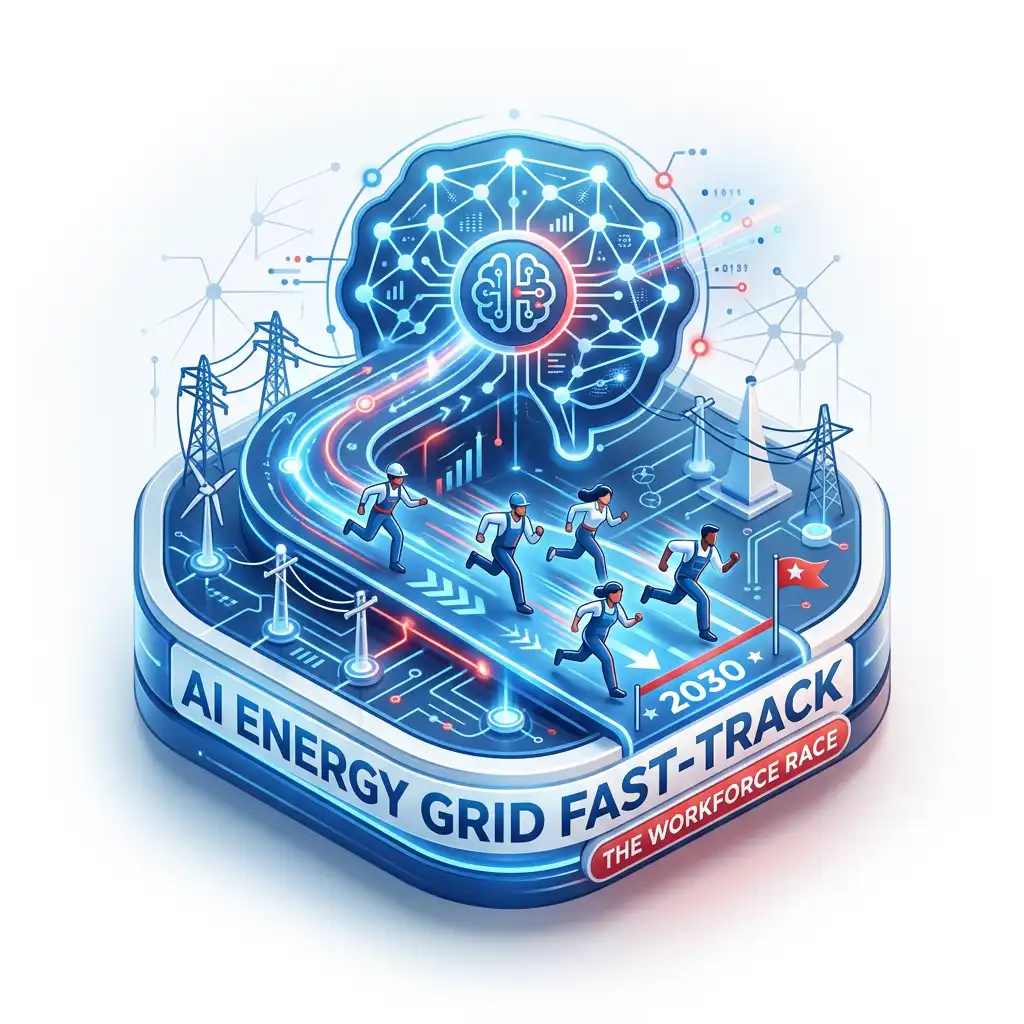

AI Grid Fast-Track: The Workforce Race
The latest federal push to speed AI data centers onto the electric grid is not only an energy story. It is a hiring, training, scheduling, safety, and payroll story. If the United States wants more AI infrastructure, it will need more generation, more transmission, more substations, more cooling capacity, and a much faster workforce pipeline for the people who build and operate it.
Quick Answer
The newest federal grid fast-track action is the Federal Energy Regulatory Commission's June 18, 2026 move directing the six regional grid operators under its jurisdiction to justify or reform tariffs for data centers, manufacturers, and other large energy users. The order gives those grid operators and transmission owners 60 days to explain why existing tariffs are sufficient or file changes, and it requires a 30-day report on generation adequacy for existing and new large loads.
The presidential executive order most directly tied to this data-center infrastructure push is Executive Order 14318, signed July 23, 2025, titled Accelerating Federal Permitting of Data Center Infrastructure. It defines major AI data center projects as facilities requiring more than 100 MW of new load for AI inference, training, simulation, or synthetic data generation, and it explicitly includes high-voltage transmission lines, substations, switchyards, transformers, switchgear, natural gas pipelines or laterals, and dispatchable power equipment in the infrastructure stack that may support qualifying projects.
So, strictly speaking, the June 2026 development is a FERC grid-integration order, not a new presidential executive order. But the practical effect is the same for workforce planners: large-load interconnection, co-located generation, flexible load service, transmission upgrades, and energy infrastructure permitting are being pulled into a faster national timetable.
What Changed In Washington
The United States has been moving from AI policy as software policy to AI policy as industrial policy. The difference matters. A software policy debate focuses on model safety, privacy, competition, bias, export controls, and government adoption. An industrial policy debate asks a harder physical question: who will build the factories, substations, power plants, fiber routes, switchyards, transformers, cooling systems, maintenance regimes, and 24-hour staffing models that make AI infrastructure possible?
Executive Order 14318 made that shift explicit. It says AI data centers and the infrastructure that powers them, including high-voltage transmission lines and related equipment, are part of a rapid buildout priority. It sets up a path for qualifying projects to receive financial support, categorical exclusions where legally available, FAST-41 transparency and covered-project treatment, streamlined environmental reviews, brownfield and Superfund-site reuse guidance, biological and water permitting efficiencies, and potential use of federal lands.
That is a permitting story, but it is also a sequencing story. If a data center project needs more than 100 MW of new load, the people problem begins long before the facility is energized. Engineering studies, environmental work, site preparation, utility coordination, civil construction, high-voltage electrical work, cooling installation, commissioning, cybersecurity, facilities operations, and emergency coverage all have to move in sequence. A shortage in one trade can become a delay for the entire project.
FERC's June 18, 2026 action adds the grid-market layer. The Commission issued tailored show-cause orders under Section 206 of the Federal Power Act to PJM, MISO, SPP, CAISO, ISO-NE, and NYISO. These operators cover much of the organized wholesale power market footprint in the United States. FERC asked them to address five categories of reform: more efficient transmission service applications and studies, protection against cost shifting, better transparency into transmission costs, accommodation of co-location and behind-the-meter generation, new transmission services for flexible large loads, and study processes for generating facilities that serve electrically proximate or co-located loads.
The order does not say that every AI data center should jump the line regardless of impact. FERC emphasized consumer safeguards, regional differences, state authority over retail electricity rates and generation siting, and a need to prevent cost shifting. But the regulatory message is unmistakable: the old pace for large-load interconnection is not good enough for the scale of demand now arriving.
| Federal action | What it does | Why workforce planners should care |
|---|---|---|
| Executive Order 14318July 23, 2025 | Creates a federal policy path to speed qualifying AI data center, covered-component, and energy infrastructure projects through available permitting, financing, federal land, and review tools. | Large projects will need synchronized crews across site work, power, cooling, networking, security, operations, and maintenance. Faster permits only help if employers can staff the work. |
| America's AI Action PlanJuly 2025 | Makes "Build American AI Infrastructure" one of three pillars and calls for streamlined permitting, a grid to match AI innovation, and a skilled AI infrastructure workforce. | It ties the AI race directly to energy generation, electric-grid expansion, and training pipelines rather than treating workforce as an afterthought. |
| FERC large-load ordersJune 18, 2026 | Directs six regional grid operators and transmission owners to justify current tariffs or propose reforms for large energy users, with separate generation adequacy reporting. | Transmission studies, co-location, flexible-load operations, and cost transparency all require specialized staff, contractors, scheduling discipline, and project-level labor visibility. |
The Energy Demand Behind AI
The policy urgency is rooted in electricity demand. AI is unusually power-intensive because the work is concentrated in large, specialized compute facilities that run high-density servers, advanced chips, cooling equipment, backup systems, and network infrastructure. Training frontier models can require enormous compute bursts; inference spreads the demand across constant production use as customers use AI in search, software, customer service, manufacturing, medicine, coding, design, defense, and everyday business operations.
The 2024 Lawrence Berkeley National Laboratory report prepared for the U.S. Department of Energy estimated that U.S. data centers consumed about 176 TWh in 2023, or about 4.4% of total U.S. electricity use. The same report projected U.S. data center consumption could reach 325 to 580 TWh by 2028, equal to roughly 6.7% to 12% of national electricity consumption. Even the low end of that range is a major infrastructure planning problem. The high end is a structural change in how the country allocates electricity.
The International Energy Agency's 2025 Energy and AI report puts the issue in global perspective. It estimated that data centers used around 415 TWh worldwide in 2024 and projected that consumption would more than double to about 945 TWh by 2030. The IEA also found that the United States accounts for the largest share of global data center electricity consumption and that data centers account for nearly half of U.S. electricity demand growth through 2030 in its base analysis.
Those numbers help explain why a data center is no longer just a real estate asset with a server hall inside. At 100 MW, a single project can be comparable to the load of a small city. Larger campuses and multi-phase buildouts can require hundreds of megawatts or more. That kind of load forces difficult choices about generation, transmission, distribution equipment, rate design, standby capacity, cooling water, local land use, noise, emissions, reliability, and who pays for network upgrades.
There is another timing mismatch. The IEA notes that building new transmission lines in advanced economies can take four to eight years and that wait times for critical grid components such as transformers and cables have doubled in recent years. AI infrastructure developers often want power in months or a few years. Apprenticeships for electricians can take four or five years. Transmission projects can take longer than the facility they serve. That mismatch is why "speed to power" cannot be solved by policy language alone.
Generation
New load has to be served by dependable electricity. Depending on region, that may mean renewables plus storage, natural gas, nuclear, geothermal, upgraded existing plants, demand response, or co-located generation. The workforce impact includes plant operators, control technicians, pipefitters, turbine specialists, solar and storage crews, nuclear technicians, and dispatch personnel.
Transmission
Power has to move from generation to load. That means studies, rights of way, line upgrades, substations, transformers, protective systems, switchgear, relay work, grid-enhancing technologies, and maintenance. The workforce impact includes lineworkers, substation electricians, protection and control technicians, civil crews, engineers, surveyors, and safety managers.
Operations
Once energized, a data center and its supporting grid assets need around-the-clock operation. That means facilities technicians, HVAC and liquid-cooling specialists, electrical maintenance crews, security staff, network technicians, cyber teams, emergency response plans, and shift coverage that can withstand outages, heat waves, and maintenance windows.
The Infrastructure Stack
Fast-tracking AI infrastructure onto the grid is sometimes described as if it were a single connection request. It is not. The order and FERC action both point to a broader stack. A data center project can depend on power plants, pipelines, substations, switchyards, transformers, switchgear, backup power, water systems, fiber, roads, site security, environmental reviews, interconnection studies, tariff design, and workforce availability.
Employers that want to participate in this buildout need to understand where their labor sits in the stack. A general contractor may focus on site prep and building shell. An electrical contractor may own medium-voltage and low-voltage work inside the facility. A utility may own transmission studies, line upgrades, substation interconnection, and system protection. A mechanical contractor may handle cooling systems. An operations contractor may supply 24-hour facilities teams. A training provider may be responsible for turning entry-level workers into credentialed electricians, HVAC technicians, lineworkers, safety professionals, or data center technicians.
The workforce problem is not simply "hire more people." It is "hire the right people at the right phase, document the right credentials, schedule them without burning them out, allocate labor to the right project, and produce clean time and payroll records even when work is mobile, remote, unionized, prevailing-wage, multi-state, or tied to grants and public incentives."
| Infrastructure layer | Common work | High-pressure labor needs |
|---|---|---|
| Site and civilLand, roads, pads, trenching, drainage, fencing | Surveying, grading, concrete, structural steel, logistics, equipment movement, stormwater controls, safety planning. | Heavy equipment operators, laborers, civil supervisors, safety coordinators, inspectors, project schedulers. |
| Electric powerTransmission, substations, switchgear, transformers | Interconnection studies, high-voltage line work, relay protection, switchyard installation, commissioning, energized maintenance. | Electricians, lineworkers, substation technicians, relay technicians, electrical engineers, commissioning teams. |
| Firm and flexible supplyGeneration, storage, demand response, co-location | Power plant construction or upgrades, storage installation, backup generation, operating protocols for curtailment or flexible load. | Plant operators, turbine technicians, battery technicians, instrumentation techs, control-room staff, compliance staff. |
| Cooling and facilitiesHVAC, liquid cooling, pumps, chillers, water systems | Mechanical installation, leak detection, heat rejection, controls, preventive maintenance, emergency cooling response. | HVAC technicians, pipefitters, plumbers, controls specialists, facilities technicians, maintenance planners. |
| Digital and cyberFiber, network, physical security, monitoring | Network installation, access control, monitoring systems, cyber defense, incident response, secure operations. | Network technicians, security officers, cyber analysts, systems administrators, incident response leads. |
| Operations24-hour staffing and ongoing maintenance | Shift work, inspection rounds, work orders, outage response, vendor management, spare parts, audits, emergency drills. | Shift supervisors, data center technicians, maintenance electricians, HVAC leads, schedulers, payroll and workforce administrators. |
The Workforce Gap
The workforce bottleneck is already visible in federal labor projections. The Bureau of Labor Statistics projects electrician employment to grow 9% from 2024 to 2034, much faster than average, with about 81,000 electrician openings each year. It also notes that most electricians learn through apprenticeships and that many apprenticeships run four or five years with about 2,000 hours of paid on-the-job training per year.
That is the first pressure point. The United States can change permitting timelines much faster than it can produce fully licensed electricians. If a regional AI infrastructure wave needs high-voltage electrical crews in 2027 or 2028, the apprenticeship pipeline needed to start years earlier. Pulling experienced electricians from housing, manufacturing, hospitals, schools, utilities, and industrial maintenance may solve one project while creating shortages elsewhere.
HVAC and cooling are another pressure point. BLS projects heating, air conditioning, and refrigeration mechanics and installers to grow 8% from 2024 to 2034, with about 40,100 annual openings. AI facilities may use sophisticated air cooling, liquid cooling, chillers, pumps, controls, heat exchangers, and high-density thermal management. These are not optional comfort systems. Cooling is part of the compute supply chain.
Power-line installers and repairers are a third pressure point. BLS projects this occupation to grow 7% from 2024 to 2034, with about 10,700 annual openings. These workers install and maintain the power grid itself. They handle serious high-voltage hazards, storm response, maintenance, distribution and transmission equipment, and work that often cannot be done remotely or cheaply replaced.
When those three categories are combined, the economy already needs more than 131,800 openings per year on average across electricians, HVAC technicians, and power-line installers before counting engineers, welders, equipment operators, cyber analysts, safety managers, plant operators, control-room staff, project managers, environmental specialists, security officers, fiber technicians, and data center operations staff.
| Occupation | BLS 2024-34 outlook | Annual openings | Why AI infrastructure needs them |
|---|---|---|---|
| Electricians | 9% growth, much faster than average | About 81,000 per year | Facility wiring, switchgear, backup power, controls, maintenance, commissioning, safety, and grid-adjacent electrical work. |
| HVAC technicians | 8% growth, much faster than average | About 40,100 per year | Cooling, humidity control, liquid-cooling support, chillers, pumps, controls, repairs, emergency response, and energy efficiency upgrades. |
| Electrical power-line installers and repairers | 7% growth, much faster than average | About 10,700 per year | Transmission and distribution lines, grid maintenance, storm response, pole and tower work, equipment testing, and reliability work. |
The hidden problem is replacement demand
Many openings are not just new jobs. They come from workers retiring, changing occupations, or leaving the labor force. That means the AI buildout is competing not only with other growth sectors, but also with the ordinary need to replace experienced workers who already keep homes, factories, hospitals, warehouses, utilities, and public infrastructure running.
The Hiring Clock Is Already Running
AI infrastructure schedules are unforgiving because the construction clock, grid clock, and training clock run at different speeds. Developers may want to energize a facility quickly. Grid operators may need studies, tariff changes, and network upgrade plans. Utilities may face equipment queues for transformers, cables, turbines, and other hardware. Training providers may need years to move a new worker from interest to competency.
The practical lesson for employers is to plan backwards from energization. If a project needs fully credentialed crews in 2028, waiting until 2028 to recruit is not a plan. The plan has to include immediate hiring for project managers and supervisors, near-term pre-apprenticeship and apprenticeship intake, mid-term cross-training for incumbent workers, and long-term retention for critical roles that cannot be replaced quickly.
Employers also need to prepare for wage pressure and schedule pressure. When data centers, utilities, manufacturing plants, housing projects, transportation agencies, and industrial contractors all chase electricians and technicians in the same region, pay rates rise, overtime rises, and poaching risk rises. Without disciplined scheduling and time tracking, the result can be fatigue, safety incidents, cost overruns, payroll disputes, and weak project cost data.
0-90 days: map the labor exposure
Identify every role needed by project phase, not just by department. Separate work into civil, electrical, mechanical, grid, controls, cyber, facilities, security, and administration. Then map which roles require licensing, apprenticeship status, union dispatch, background checks, site badges, safety training, or specialized certifications.
3-18 months: build the bench
Partner with employers, unions, technical schools, community colleges, workforce boards, and apprenticeship sponsors. Create entry points for helpers, veterans, displaced workers, incumbent workers, and high school CTE students. Track who is moving through training, who is job-ready, and which projects will absorb them.
18-60 months: retain the specialists
Use career ladders, supervisor training, predictable rotations, safety culture, clean payroll, and project-based incentives to keep people. In a tight labor market, retention is infrastructure. Losing a journey-level electrician or experienced facilities lead can delay more work than a late equipment shipment.
The Training Model The U.S. Needs
The AI Action Plan calls for a national initiative to identify high-priority occupations essential to AI infrastructure, create skill frameworks and competency models, support industry-driven training, expand pre-apprenticeships, modernize CTE pathways, and expand Registered Apprenticeships. That is the right frame because the labor need is too broad for one employer, one school, or one state to solve alone.
A serious training model should be regional, employer-led, and evidence-based. Regional matters because the grid is regional, data center clusters are regional, and commuting distance matters for trades. Employer-led matters because training that does not connect to real hiring demand becomes a classroom exercise. Evidence-based matters because public and private funding should go to programs that can show completions, placements, retention, wage progression, safety outcomes, and project readiness.
The best model is not to wait for workers to appear. It is to build a pipeline with clear stages: awareness, pre-apprenticeship, apprenticeship, supervised field experience, specialty credentialing, journey-level progression, supervisor development, and ongoing upskilling. Each stage should have a named employer outcome. If a student finishes a pre-apprenticeship, what job can they interview for? If an incumbent HVAC technician completes liquid-cooling training, what new assignment can they take? If a journey electrician completes data center commissioning training, what premium work can they perform?
| Pipeline stage | Best-fit candidates | Employer action | Workforce data to track |
|---|---|---|---|
| Awareness and recruitment | High school students, veterans, career changers, displaced workers, underemployed adults. | Run site visits, paid tryout days, career talks, job previews, and realistic shift expectations. | Applicant source, attendance, skills interest, eligibility, geographic availability, follow-up status. |
| Pre-apprenticeship | People who need basic math, safety, tools, blueprint, or workplace readiness before entering a trade. | Provide paid internships, helper roles, safety orientation, and interviews tied to apprenticeship seats. | Completion, safety modules, punctuality, aptitude, interview outcome, apprenticeship entry. |
| Registered Apprenticeship | Workers entering electrical, line, HVAC, mechanical, or controls roles requiring structured training. | Sponsor or partner with existing programs, assign mentors, document hours, rotate apprentices through relevant work. | On-the-job hours, classroom progress, wage steps, mentor signoff, competencies, job assignment. |
| Specialty upskilling | Experienced electricians, HVAC techs, operators, controls staff, and facilities workers. | Train for high-voltage safety, data center commissioning, liquid cooling, controls, cyber hygiene, and emergency response. | Credential status, recertification dates, project eligibility, premium skill assignments, safety incidents. |
| Supervisor development | Journey-level workers and experienced technicians moving into crew leadership. | Teach planning, documentation, safety leadership, time approval, cost coding, conflict management, and fatigue control. | Crew productivity, overtime, rework, safety observations, schedule adherence, retention. |
Employer Risks In The AI Infrastructure Rush
When federal policy accelerates infrastructure, employers often feel the opportunity first and the administrative burden second. That is risky. The faster projects move, the more important it becomes to manage labor records, safety documentation, shift rules, training status, payroll compliance, contractor visibility, and project cost allocation from the beginning.
Energy infrastructure work can involve remote sites, mobile crews, multiple employers, union dispatch, apprenticeship ratios, public funding, grants, incentives, environmental obligations, security requirements, and overtime-heavy schedules. A company that uses informal spreadsheets, manual timesheets, or disconnected payroll systems may be able to survive during a small project. It will struggle when multiple crews are spread across substations, data center shells, cooling equipment, and commissioning windows.
1. Overtime becomes a safety issue
Long hours may look like productivity until fatigue starts driving mistakes. Electrical work, high-voltage switching, line repair, crane work, confined spaces, and mission-critical cooling maintenance are not good environments for tired crews. Employers need real-time visibility into hours worked, rest periods, double shifts, call-ins, and emergency coverage.
2. Credential gaps become project delays
If a worker is missing a license, safety training, background check, site badge, apprenticeship approval, or equipment authorization, the project can stall. Employers need a way to connect scheduling decisions to worker eligibility before the person reaches the gate.
3. Cost shifting becomes a public issue
FERC's order highlights cost transparency and preventing cost shifting. Contractors and utilities need clean labor cost data by project, phase, crew, work order, location, and cost center. Weak labor allocation makes it harder to defend invoices, recover costs, and show who benefited from a network upgrade.
4. Retention becomes infrastructure
Replacing a specialized worker can take months or years. Employers need to know which crews are overloaded, which supervisors are losing people, where travel is excessive, and which assignments create burnout. Retention data belongs in the same conversation as construction schedules.
The workforce dashboard energy employers need
A practical AI-infrastructure workforce dashboard should show scheduled labor by project phase, actual hours by cost code, overtime by crew, credential readiness, apprentice progression, location-based attendance, safety-sensitive fatigue flags, open roles, time-to-fill, retention by supervisor, and payroll exceptions. The point is not to watch people for its own sake. The point is to keep critical projects staffed, safe, documented, and financially visible.
Where TimeTrex Fits
TimeTrex is not an energy permitting platform and it does not build substations. Its role is more practical: helping employers manage the people who make fast infrastructure schedules possible. Contractors, utilities, manufacturers, cooling specialists, security providers, and data center operators need workforce systems that can keep up with mobile crews, changing shifts, cost centers, overtime, training, attendance, scheduling, payroll, and reporting.
For AI infrastructure employers, the operational problem is often the gap between the project schedule and payroll reality. A crew moves from a switchyard to a data hall. A technician splits time between maintenance and commissioning. An apprentice needs hours documented toward progression. A supervisor needs to approve time before payroll closes. A project manager needs labor cost by phase. HR needs to know which workers are trained for which site. Finance needs clean data. The workforce system has to connect those dots without turning every pay period into detective work.
Time and attendance
TimeTrex time and attendance can help employers capture hours for field crews, facility teams, maintenance staff, and supervisors with better visibility than paper timesheets or disconnected spreadsheets.
Scheduling
TimeTrex scheduling can help organizations plan shifts, coverage, leave, rotations, and overtime before gaps become site delays or fatigue risks.
Payroll
TimeTrex payroll can help connect approved time to payroll so employers spend less time reconciling hours and more time managing the work.
What to standardize before the rush
Before taking on AI infrastructure work, employers should standardize job codes, cost centers, site locations, approval workflows, overtime rules, shift premiums, credential fields, apprenticeship status, mobile punch rules, and payroll review deadlines. The companies that do this early will have cleaner labor data when projects accelerate.
A Practical Employer Playbook
The policy environment is moving toward faster infrastructure approvals and faster large-load integration. Employers do not control every regulatory or grid decision, but they do control their workforce readiness. The following playbook is designed for organizations that may hire, train, schedule, subcontract, or operate crews tied to AI data centers and the energy infrastructure around them.
1. Build a role-by-phase labor plan
Do not forecast headcount only by job title. Forecast by project phase: permitting support, site preparation, transmission upgrade, substation work, data hall electrical, cooling installation, commissioning, operations, maintenance, and emergency response. Each phase has different credential, schedule, and supervision needs.
2. Create a regional training map
List the unions, apprenticeship programs, technical schools, community colleges, veteran programs, workforce boards, and high school CTE pathways in the labor market. Then map which roles each can realistically supply and when. A three-year project cannot rely on a five-year pipeline unless it also has incumbent-worker upskilling.
3. Protect the experienced core
Identify journey-level workers, foremen, lead technicians, plant operators, dispatchers, and commissioning specialists who are hardest to replace. Watch overtime, travel burden, on-call load, safety incidents, and resignation risk. The most important hiring strategy may be keeping the people already qualified.
4. Tie credentials to scheduling
A scheduling system should show whether a worker is eligible for a site and task before the shift is assigned. That includes license status, safety training, background checks, union requirements, apprenticeship level, equipment authorizations, and recertification dates.
5. Use job costing from day one
Labor should be coded by project, location, work order, trade, phase, and cost center. If a public agency, utility commission, customer, or prime contractor asks how labor costs were allocated, the employer should not have to reconstruct the answer manually.
6. Make apprenticeships measurable
Track on-the-job hours, classroom status, rotations, mentor signoff, safety modules, wage progression, and completion risk. AI infrastructure employers need apprentices to move through the pipeline, not just sit in a generic trainee bucket.
FAQ
Was there a new executive order in June 2026?
The June 18, 2026 action was a FERC order directed at regional grid operators, not a new presidential executive order. The key presidential executive order for data center infrastructure permitting is EO 14318, signed July 23, 2025. The article treats them together because the 2026 FERC action advances the same practical theme: speeding large AI-related loads and their supporting infrastructure onto the grid while addressing cost, reliability, and state-authority concerns.
Does fast-tracking mean data centers can connect without paying for upgrades?
No. FERC's public materials emphasize cost transparency and preventing cost shifting. The policy direction is not "connect anything at any cost." It is to modernize tariff rules, study processes, co-location treatment, flexible-load service, and generation adequacy planning so large loads can connect faster without undermining reliability or unfairly shifting costs.
Why does AI need so much electricity?
AI workloads rely on dense, power-hungry computing equipment and cooling systems. Training can require major bursts of compute, while inference creates ongoing demand as AI tools are used in daily business and consumer applications. Large AI data center projects can require more than 100 MW of new load, which is why they trigger grid, generation, cooling, and workforce planning questions.
Which jobs are most exposed to the AI infrastructure buildout?
Electricians, HVAC technicians, and lineworkers are among the most visible pressure points, but they are not the only ones. Employers will also need engineers, substation technicians, relay technicians, civil crews, welders, pipefitters, plant operators, security staff, cyber analysts, controls technicians, facilities teams, project managers, safety professionals, and payroll administrators.
How quickly does the U.S. need to train workers?
Immediately. Many infrastructure projects want power within a few years, while trades such as electrical work often require multi-year apprenticeships. The country cannot wait for data centers to be approved and then begin training. It needs parallel pipelines now: pre-apprenticeship, Registered Apprenticeship, incumbent-worker upskilling, supervisor development, and regional partnerships between employers and training providers.
How can workforce software help energy infrastructure employers?
Workforce software can help employers schedule crews, track time by project and cost code, monitor overtime, document attendance, support payroll accuracy, and keep labor records cleaner. For energy infrastructure projects, that matters because delays, fatigue, credential gaps, and bad labor cost data can quickly become operational and financial risks.
Sources
This article uses official policy, energy, and labor-market sources wherever possible. Source links open in a new tab.
FERC large-load integration order
FERC Launches Aggressive Targeted Action to Speed Large Load Integration, June 18, 2026.
FERC fact sheet
FERC Takes Action to Supercharge America's Grid for Efficiency, Reliability, and a Bold Energy Future, June 18, 2026.
Executive Order 14318
Accelerating Federal Permitting of Data Center Infrastructure, The White House, July 23, 2025.
America's AI Action Plan
America's AI Action Plan and official PDF, July 2025.
U.S. data center energy report
2024 United States Data Center Energy Usage Report, Lawrence Berkeley National Laboratory, December 2024.
IEA Energy and AI
Energy and AI, International Energy Agency, published April 10, 2025.
BLS electricians
Electricians, Occupational Outlook Handbook, U.S. Bureau of Labor Statistics.
BLS HVAC technicians
Heating, Air Conditioning, and Refrigeration Mechanics and Installers, Occupational Outlook Handbook, U.S. Bureau of Labor Statistics.
BLS lineworkers
Electrical Power-Line Installers and Repairers, Occupational Outlook Handbook, U.S. Bureau of Labor Statistics.
TimeTrex workforce management
TimeTrex Workforce Management Software, TimeTrex.
Disclaimer: The content provided on this webpage is for informational purposes only and is not intended to be a substitute for professional advice. While we strive to ensure the accuracy and timeliness of the information presented here, the details may change over time or vary in different jurisdictions. Therefore, we do not guarantee the completeness, reliability, or absolute accuracy of this information. The information on this page should not be used as a basis for making legal, financial, or any other key decisions. We strongly advise consulting with a qualified professional or expert in the relevant field for specific advice, guidance, or services. By using this webpage, you acknowledge that the information is offered “as is” and that we are not liable for any errors, omissions, or inaccuracies in the content, nor for any actions taken based on the information provided. We shall not be held liable for any direct, indirect, incidental, consequential, or punitive damages arising out of your access to, use of, or reliance on any content on this page.
About The Author

Roger Wood
With a Baccalaureate of Science and advanced studies in business, Roger has successfully managed businesses across five continents. His extensive global experience and strategic insights contribute significantly to the success of TimeTrex. His expertise and dedication ensure we deliver top-notch solutions to our clients around the world.
Time To Clock-In
Start your 30-day free trial!
Experience the Ultimate Workforce Solution and Revolutionize Your Business Today
- Eliminate Errors
- Simple & Easy To Use
- Real-time Reporting

Saving businesses time and money through better workforce management since 2003.
Copyright © 2026 TimeTrex. All Rights Reserved.