
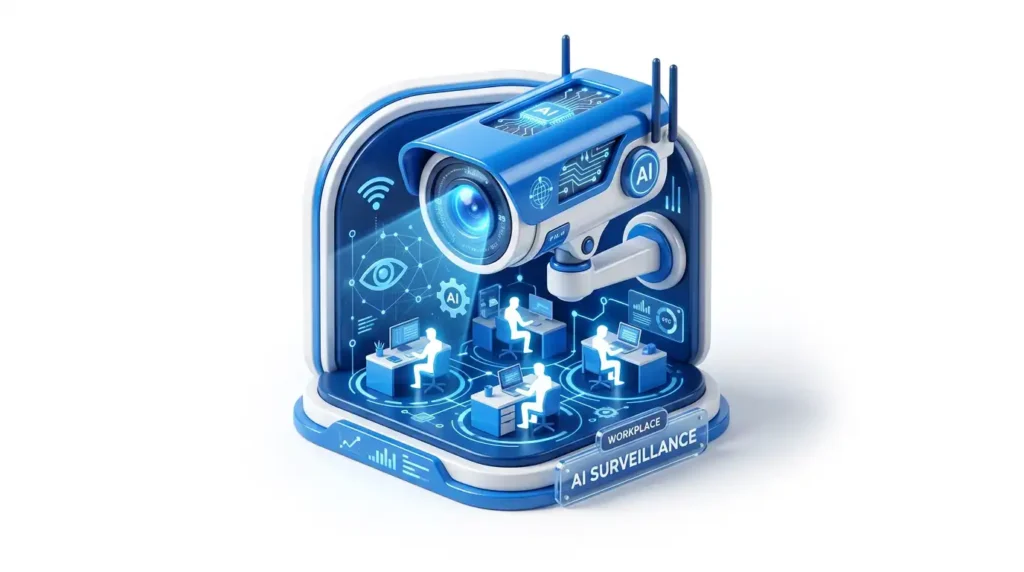

Artificial Intelligence Surveillance in the Modern Workplace
Artificial intelligence surveillance in the modern workplace has moved far beyond simple time tracking. Today’s systems can evaluate screen activity, application usage, messaging tone, biometric identity signals, and behavioral patterns at a scale no human manager could reproduce. That shift has created a new strategic question for employers: when does operational visibility become organizational overreach?
A striking feature of this transition is that the same underlying AI architecture now appears in another high-stakes environment: the vehicle cabin. In cars, AI monitoring can detect drowsiness, gaze drift, and erratic behavior to help prevent fatal crashes. In workplaces, similar computer vision and machine learning methods are used to assess engagement, flag anomalies, and score productivity. The technology is parallel, but the human meaning is not.
TL;DR
- AI workplace surveillance is now mainstream. Monitoring moved from limited oversight to continuous algorithmic observation during the remote and hybrid work shift.
- Modern tools collect far more than time data. Many platforms now analyze application use, idle time, message patterns, GPS location, screenshots, and biometric verification.
- The productivity story is mixed. While employers gain visibility, excessive monitoring often drives performative work, anxiety, resistance, and turnover intent.
- Emotion recognition and behavioral inference are especially risky. These tools raise serious concerns around bias, privacy, disability accommodation, and scientific validity.
- Regulation is tightening fast. The EU AI Act, California rulemaking, and federal agency guidance are steadily narrowing the room for opaque algorithmic employment decisions.
- The central lesson is governance. AI can help organizations manage workflows and reduce security risk, but only when it is transparent, proportionate, and kept subordinate to human judgment.
Index
- Why AI Surveillance Is Expanding
- How Workplace AI Monitoring Works
- Biometric Monitoring and Emotional AI
- Natural Language Processing and Sentiment Analysis
- Productivity Scoring and Behavioral Baselining
- Commercial Monitoring Platform Landscape
- The Productivity Paradox and Psychological Cost
- Legal and Regulatory Environment
- Automotive AI Monitoring as a Parallel Case
- Ethical Convergence: Safety vs Control
- What Responsible Employers Should Do
- Conclusion
- Works Cited
Why AI Surveillance Is Expanding
Workplace surveillance used to be intermittent. A manager might review attendance reports, inspect timecards, or spot-check system access logs. Artificial intelligence changed that model by making it cheap and scalable to watch digital behavior continuously. The result is a workplace where software can score attention, estimate risk, and surface anomalies in near real time.
A large part of this growth came from the sudden normalization of remote and hybrid work. When management lost physical visibility, many organizations replaced it with digital visibility. Vendors responded with platforms capable of tracking active time, app usage, screenshots, GPS trails, collaboration data, and communication sentiment. Reporting from Cornell Chronicle and broader policy analysis from PubMed Central illustrate how quickly the debate moved from simple monitoring to algorithmic management.
Yet the business logic extends beyond remote work. Employers use AI surveillance for insider-threat detection, wage and hour enforcement, location verification, workflow optimization, attrition prediction, and compliance oversight. Some organizations want developmental analytics. Others want stronger control. The gap between those two intentions often determines whether a system feels useful or oppressive.
Strategic reality: The core promise of AI surveillance is not just observation. It is classification. Once behavior is classified, it can be ranked. Once ranked, it can shape coaching, compensation, discipline, scheduling, and separation decisions.
How Workplace AI Monitoring Works
Modern workplace AI surveillance is best understood as a layered data pipeline rather than a single tool. At the front end, software agents, browser extensions, mobile apps, identity systems, cameras, and collaboration platform integrations collect data. In the middle, that data is cleaned, tokenized, enriched, and compared against benchmarks or prior behavior. At the back end, dashboards convert those calculations into management signals such as productivity scores, risk flags, burnout alerts, or anomaly warnings.
The architecture usually combines four functions. First, it captures activity events, such as logins, app switching, web visits, idle time, keyboard and mouse patterns, GPS coordinates, or message traffic. Second, it organizes those events into a behavioral baseline for each role, team, or employee. Third, it applies machine learning or rules-based scoring to identify deviations. Fourth, it turns the output into a decision surface that managers or compliance teams can act on.
Data collection
Screen activity, identity events, communications, presence verification, location data, and application telemetry are gathered from devices or SaaS integrations.
Behavioral modeling
Systems establish patterns for normal work rhythms, average response times, focus-time fragmentation, and abnormal access or messaging behavior.
Managerial action
Outputs become alerts, rankings, dashboards, coaching prompts, security reviews, or automated interventions in policy enforcement workflows.
This structure matters because the risk is rarely limited to the raw data itself. Risk grows when the software infers meaning from the data. A login pattern is a record. A conclusion that someone is disengaged, deceptive, or underperforming is an inference. In practice, employers often inherit the vendor’s assumptions about what those patterns mean.
Biometric Monitoring and Emotional AI
Biometric monitoring is one of the most sensitive developments in AI workplace surveillance. Many employers now use fingerprints, face templates, or other biometric markers for access control and attendance verification. On its own, identity verification is already a high-stakes data category because biometric identifiers cannot be reset like passwords. If compromised, the exposure may be permanent for the employee.
The deeper problem emerges when biometrics move from identity to interpretation. Some tools attempt to infer fatigue, stress, mood, or engagement from face position, eye activity, tone of voice, or posture. Critics argue that this moves from measurable authentication into pseudoscientific inference. Research on the social harms of workplace biometrics, including analysis from the ACM FAccT conference, has emphasized the risks of bias, disability exclusion, cultural misreading, and overcollection.
Emotional AI is especially controversial because the scientific foundation is unsettled. Human expressions are context dependent. Neurodivergent workers, employees with disabilities, people from different cultures, and individuals under ordinary situational stress may all display expressions that do not align with the simplistic emotional labels these systems impose. When those labels flow into productivity or performance narratives, the compliance consequences can become serious.
Lower-risk biometric use
Clock-in confirmation, secure access control, role-based entry, and device identity verification where the purpose is narrow, disclosed, and supported by retention controls.
Higher-risk biometric use
Emotion recognition, inferred fatigue scoring, automated engagement ratings, and any system that converts body signals into claims about attitude, honesty, or job fitness.
Natural Language Processing and Sentiment Analysis
One of the most consequential changes in AI surveillance is the ability to scan internal communications at scale. NLP systems can process emails, chat messages, help-desk tickets, meeting transcripts, and collaboration tools to identify toxicity, frustration, disengagement, or potential insider risk. That means the modern company can transform everyday digital conversation into a structured management dataset.
The usual workflow begins with an API integration into systems such as Slack, Teams, or enterprise email. Messages are extracted, cleaned, and sometimes partially anonymized. Models then classify tone, urgency, themes, or harmful language. Vendors market this as a way to detect burnout early, identify morale problems, surface culture issues, or catch policy violations before they escalate. Coverage of major employer deployments, including examples reported by HR Grapevine, shows how quickly this capability has moved into large-scale enterprise governance.
The ethical issue is not simply that messages are read. It is that informal communication loses its informal character. Hallway chatter becomes analyzable. Frustration becomes a metric. Silence becomes a signal. Reduced messaging frequency can be treated as withdrawal. A shift from collaborative language to isolated language can trigger intervention. That level of ambient interpretation creates a persistent psychological pressure that employees feel even when no human is visibly watching.
In theory, these systems can support healthier management if they are used at a team level, with strong aggregation, limited retention, and human review. In practice, the same tools can become an engine for covert monitoring, union chilling, retaliatory oversight, or reputational scoring. The difference lies in disclosure, scope, and the employer’s willingness to avoid overclaiming what the model actually knows.
Productivity Scoring and Behavioral Baselining
AI surveillance tools often promise to answer a question executives have always wanted to quantify: who is productive, when, and why. To do that, the software measures a wide range of digital proxies, such as active time, idle time, application switching, website use, response speed, meeting load, and workflow interruptions. Those signals are then converted into scores or comparative dashboards.
The problem is that these systems usually measure visible activity, not actual value creation. A developer debugging a complex issue may spend long periods reading, thinking, and testing quietly. A strategist may spend an hour synthesizing information with very little keyboard activity. A support manager may resolve major problems through a few high-quality conversations rather than a high volume of clicks. When the system equates output with interaction density, it tends to reward legibility to the machine rather than importance to the business.
This is where behavioral baselining becomes powerful and dangerous. Baselining can identify unusual file access, risky off-hours logins, or sudden changes in work rhythm that deserve attention. But it can also mistake healthy differences in work style for noncompliance. It may misread collaborative work, deep-focus work, caregiving interruptions, disability accommodations, or cross-functional problem solving. A baseline is not a ground truth. It is a probabilistic profile shaped by design decisions and training assumptions.
Commercial Monitoring Platform Landscape
The market for employee monitoring software is not monolithic. Some vendors emphasize security and insider-threat detection. Others focus on workforce analytics, time mapping, or remote team management. A few position themselves as privacy-conscious alternatives that avoid keystroke logging or webcam access by default. The software choice often shapes the resulting corporate culture as much as internal policy does.
| Software Platform | Primary Focus | Key Capabilities | Starting Price |
|---|---|---|---|
| Teramind | Security and insider-threat detection | OCR, deep keystroke logging, anomaly alerts, triggered screen recordings, detailed sentiment and behavior analysis | $15.00 per user/month |
| ActivTrak | Workforce analytics and productivity management | Workflow mapping, focus-time insights, AI coaching, privacy-forward positioning without default keystroke logging or cameras | $4.99 to $10.00 per user/month |
| Hubstaff | Remote and field team management | GPS tracking, payroll integration, app and URL tracking, automatic screenshots based on activity | $4.99 to $7.00 per user/month |
| Veriato | Enterprise risk management | Insider-threat detection, behavioral baselining, communications visibility, engagement and anomaly scoring | Enterprise quote |
| Controlio | Live screen and video monitoring | Real-time screen viewing, stealth deployment modes, cloud or on-premise infrastructure, large-scale visibility | $7.99 per user/month |
| Insightful | Time tracking and burnout alerts | Automatic time mapping, SaaS usage analytics, burnout indicators, visible or stealth modes | $6.40 per user/month |
Vendors that market themselves as privacy-aware tend to focus on workflow patterns, time use, and organizational diagnostics rather than on forensic screen capture or deep keystroke visibility. Others are explicitly designed for highly intrusive monitoring. That difference matters because tooling choices influence whether workers experience the system as a supportive dashboard, a digital foreman, or a hidden investigator.
Market reviews from Forbes Advisor and official vendor positioning from ActivTrak highlight how wide the gap is between privacy-conscious analytics and full-spectrum surveillance products.
The Productivity Paradox and Psychological Cost
The strongest case against aggressive AI surveillance is not philosophical. It is operational. When employees know they are being constantly measured, many do not become meaningfully more productive. They become more legible. That means energy shifts toward producing signals the system rewards: mouse motion, message activity, rapid status updates, quick-response behavior, and other visible indicators that may have little to do with real contribution.
This is the productivity paradox. Surveillance is introduced to drive efficiency, but the same system can trigger stress, distraction, and performative work. Employees may feel pressure to remain digitally active even when they need thinking time, brief recovery time, or uninterrupted deep work. Some workers react with resistance. Others disengage quietly. Others leave.
Workplace well-being research, including broader analysis published through PubMed Central on worker well-being, shows how surveillance can create a resource-draining environment marked by reduced autonomy, privacy violations, and elevated job pressure. A related management summary from SHRM underscores the link between AI surveillance, employee resistance, and turnover intent.
Performative work
Workers adapt to metrics, not mission. That can mean activity theater, unnecessary messaging, or avoidance of high-value but low-visibility tasks.
Stress proliferation
Surveillance creates a primary stressor that spills into reduced autonomy, fewer breaks, emotional depletion, and fear of being misjudged by a machine.
Trust erosion
Once workers believe software is evaluating their worth without context, managerial relationships become colder, more defensive, and more transactional.
The central managerial mistake is assuming that visibility automatically creates accountability. In reality, poorly governed surveillance often creates impression management. People optimize for what the system can see, not necessarily for what the business most needs.
Legal and Regulatory Environment
Regulation has not fully caught up to AI surveillance, but the trend line is unmistakable. Legislators and regulators are moving toward stronger requirements around transparency, notice, bias testing, data minimization, human review, and limits on sensitive inferences. Organizations that treat AI surveillance as a software procurement issue rather than a governance issue are increasingly exposed.
The strongest current framework is the EU AI Act. Official guidance on the broader framework from the European Union makes clear that employment-related AI systems are treated as high-risk, while prohibited practices now include certain forms of workplace emotion recognition. California is developing a major state-level model through privacy and civil rights regulation, while US federal agencies continue to use existing laws to address algorithmic harms.
| Framework | Jurisdiction | What It Means for Employers | Timeline |
|---|---|---|---|
| EU AI Act | European Union | Employment AI is categorized as high-risk. Workplace emotion recognition is prohibited. High-risk systems require documentation, oversight, governance, and fundamental-rights protections. | Prohibited practices effective from February 2025; high-risk obligations ramp through August 2026 |
| CCPA / CPPA ADMT rules | California, USA | Employers face notice, risk-assessment, and opt-out related requirements when automated decision tools substantially replace human judgment in important employment actions. | January 2027 |
| California CRC ADS regulations | California, USA | AI tools that create disparate impact can expose employers directly, even when the vendor operates the system. Bias auditing and retention discipline matter. | October 2025 onward |
| FCRA-related federal scrutiny | United States federal | Some AI-generated reports used for employment decisions may trigger consent, disclosure, and dispute-right obligations under consumer reporting rules. | Active now through agency interpretation and enforcement |
| NLRB concern over surveillance chilling effects | United States federal labor law | Continuous monitoring can interfere with protected concerted activity, especially when employees fear algorithmic retaliation for discussing work conditions. | Active through labor law enforcement posture |
EU AI Act enters into force
The world’s most comprehensive AI framework formally begins shaping how employers, vendors, and deployers classify employment-related AI risk.
Prohibited AI practices become operative
Certain banned uses, including workplace emotion recognition, move from theory into enforceable restriction within the EU framework.
California discrimination-focused AI rules take hold
Employers face direct exposure if automated decision systems generate unequal outcomes across protected categories.
California ADMT privacy obligations expand
Risk assessments, notices, and specific rights linked to automated decision-making become more operationally important for employers using AI at scale.
The legal message is simple. Employers cannot outsource accountability to software vendors. If an algorithm influences hiring, firing, compensation, performance management, or behavioral monitoring, the employer owns the downstream employment risk.
Automotive AI Monitoring as a Parallel Case
One of the most revealing comparisons in this entire debate comes from the automotive sector. Inside modern vehicles, AI-based Driver Monitoring Systems use cameras, near-infrared sensing, gaze tracking, head-pose estimation, and facial analysis to detect drowsiness, distraction, or incapacitation. Outside the vehicle, Advanced Driver Assistance Systems use cameras, radar, and LiDAR to interpret surrounding traffic and infer whether another driver may be impaired or erratic.
Technically, the resemblance to workplace surveillance is remarkable. Both environments rely on constant observation, behavioral baselining, and machine-generated inferences. Yet public reaction differs sharply because the purpose differs sharply. In vehicles, the intended outcome is safety and crash prevention. In workplaces, the outcome is usually productivity, discipline, or risk management.
Explanations of driver monitoring architecture from Aptiv and broader internal sensing coverage from Bosch Mobility show why many regulators and automakers present automotive AI monitoring as a life-saving technology rather than an intrusion.
| Feature Comparison | Internal Driver Monitoring | External Traffic Monitoring |
|---|---|---|
| Target subject | The human operating the monitored vehicle | Other vehicles, pedestrians, cyclists, and surrounding motion patterns |
| Primary hardware | Near-infrared cameras, illumination modules, steering sensors, edge processors | Cameras, radar, LiDAR, ultrasonic sensors, sensor-fusion processors |
| AI task | Measure eye closure, gaze direction, yawning, head pose, and alertness changes | Track lane keeping, speed variability, sudden braking, unpredictable trajectories, and collision risk |
| Intervention | Alerts, seat or wheel vibration, HVAC changes, lane-change restrictions, emergency stop in advanced systems | Following-distance adjustment, brake pre-charging, hazard warnings, defensive maneuver support |
| Social framing | Accepted as a safety technology because the benefit is immediate and physical | Accepted as a defensive driving aid and future connected-road safety layer |
Another major difference is data location. Automotive systems often process data on the edge, inside the car, where latency must remain low and privacy exposure can be reduced. Workplace surveillance more often relies on centralized dashboards and cloud analytics. That changes the scale of retention, access, and governance concerns.
Ethical Convergence: Safety vs Control
The comparison between workplace AI surveillance and vehicle-based AI monitoring exposes a revealing ethical paradox. Both systems extract human behavioral data continuously. Both rely on machine learning to identify risk, classify behavior, and trigger intervention. Both can alter human conduct simply by being present.
Yet one is widely framed as beneficial while the other is often framed as coercive. The reason is not the algorithm itself. It is the alignment of incentives. In automotive safety, the monitored person also benefits directly and immediately from the intervention. In employment, the monitored person may experience the system as a one-way accountability mechanism that primarily serves management’s need for control.
AI becomes more socially acceptable when it acts like a co-pilot, helping humans avoid danger or reduce routine friction. It becomes more controversial when it acts like an invisible judge, translating incomplete signals into claims about effort, attitude, loyalty, or worth. That is why responsible workplace governance cannot rely on technical performance alone. It must address dignity, autonomy, transparency, and the limits of inference.
Why the same technology feels different in different environments
- Automotive AI is typically justified by physical safety, immediate intervention value, and local edge processing.
- Workplace AI is often justified by output, efficiency, and control, while the observed person may not directly benefit from each intervention.
- Trust hinges on purpose. If employees believe the tool exists only to squeeze more measurable output, legitimacy collapses fast.
What Responsible Employers Should Do
Employers do not need to reject every form of AI visibility to avoid the worst outcomes. They need a disciplined governance model. The most durable approach is to use AI for narrow, legitimate, and disclosed business purposes while explicitly refusing the most intrusive and least defensible forms of behavioral inference.
Limit collection to real business need
Do not collect data because the software can. Collect only what supports security, payroll accuracy, compliance, scheduling, attendance, or workflow design.
Disclose scope and purpose clearly
Employees should know what is collected, why it is collected, how long it is retained, and whether it can affect employment decisions.
Ban emotion recognition for employment action
Do not let systems claim to determine mood, honesty, engagement, or job fitness from facial expression, tone, or other weak proxies.
Keep humans in the loop
Automated scores should inform, not decide. Any action that affects livelihood should be reviewed by trained humans with contextual knowledge.
Audit for bias and false positives
Test whether role type, disability, caregiving interruptions, collaboration patterns, or communication style distort outcomes unfairly.
Separate analytics from punishment
When possible, use aggregate workflow analytics for organizational improvement and reserve individual-level review for clear security or compliance needs.
Employers seeking stronger workforce visibility should also distinguish between workforce management and workforce surveillance. The first is about accurate time, scheduling, labor forecasting, payroll readiness, and policy visibility. The second often slides into opaque behavioral policing. Systems that help managers see staffing patterns, overtime risk, job costing, and attendance trends without converting every micro-action into a disciplinary signal are usually more sustainable.
See how transparent workforce visibility should work
Organizations need better insight into time, attendance, scheduling, compliance, and payroll readiness. They do not need a trust-destroying surveillance regime. Explore how a workforce platform can support visibility, accountability, and operational control with a more practical, employer-ready approach through TimeTrex Features.
Conclusion
Artificial intelligence surveillance in the workplace is no longer a fringe practice. It is a fast-growing management layer built into software ecosystems that many employers already use. The technology can identify inefficiencies, strengthen security controls, and surface meaningful operational patterns. It can also create anxiety, distort behavior, encourage superficial productivity theater, and expose employers to serious legal risk.
The decisive factor is not whether AI monitoring exists. It is how far it reaches, what it claims to know, and whether the organization treats workers as collaborators or as data exhaust. Systems designed for narrow visibility, honest disclosure, and human review can support better management. Systems designed to infer emotion, monitor every interaction, and automate employment judgment at scale are far more likely to fail ethically, operationally, and legally.
The future of workplace AI will be shaped by this distinction. Employers that choose transparent augmentation over covert control will be better positioned to preserve trust, meet regulatory expectations, and actually improve performance. Employers that confuse constant observation with good management may discover that the clearest thing AI reveals is how quickly trust can disappear.
Works Cited
- Cornell Chronicle. More complaints, worse performance when AI monitors work.
- PubMed Central. A policy primer and roadmap on AI worker surveillance and productivity scoring tools.
- ACM FAccT. A Systematic Review of Biometric Monitoring in the Workplace: Analyzing Socio-technical Harms in Development, Deployment and Use.
- HR Grapevine. Starbucks, Walmart, & AstraZeneca all using AI to monitor employee messaging.
- Forbes Advisor. Best Employee Monitoring Software.
- ActivTrak. Workforce Analytics for Productivity Management.
- PubMed Central. Private Eyes, They See Your Every Move: Workplace Surveillance and Worker Well-Being.
- SHRM. AI Surveillance in the Workplace Linked to Employee Resistance, Turnover.
- European Union. AI Act: Regulatory Framework.
- Aptiv. What Is a Driver-Monitoring System?.
- Bosch Mobility. Interior sensing solutions.
- Additional source material supplied in the brief, including legal commentary, market reviews, academic research, and automotive safety references dated through March 23, 2026.
This article is for informational purposes only and should not be treated as legal advice. Employers evaluating AI monitoring tools should review privacy, employment, labor, and discrimination obligations in each jurisdiction where they operate.
Disclaimer: The content provided on this webpage is for informational purposes only and is not intended to be a substitute for professional advice. While we strive to ensure the accuracy and timeliness of the information presented here, the details may change over time or vary in different jurisdictions. Therefore, we do not guarantee the completeness, reliability, or absolute accuracy of this information. The information on this page should not be used as a basis for making legal, financial, or any other key decisions. We strongly advise consulting with a qualified professional or expert in the relevant field for specific advice, guidance, or services. By using this webpage, you acknowledge that the information is offered “as is” and that we are not liable for any errors, omissions, or inaccuracies in the content, nor for any actions taken based on the information provided. We shall not be held liable for any direct, indirect, incidental, consequential, or punitive damages arising out of your access to, use of, or reliance on any content on this page.
About The Author

Roger Wood
With a Baccalaureate of Science and advanced studies in business, Roger has successfully managed businesses across five continents. His extensive global experience and strategic insights contribute significantly to the success of TimeTrex. His expertise and dedication ensure we deliver top-notch solutions to our clients around the world.
Time To Clock-In
Start your 30-day free trial!
Experience the Ultimate Workforce Solution and Revolutionize Your Business Today
- Eliminate Errors
- Simple & Easy To Use
- Real-time Reporting
Saving businesses time and money through better workforce management since 2003.
Copyright © 2026 TimeTrex. All Rights Reserved.