


Construction Geofencing Time Clock App Guide
A geofencing time clock app can help contractors prove where work started, keep field hours tied to the right job, and reduce payroll cleanup. The real win is not just GPS on a phone. It is a controlled timekeeping workflow that connects site location, crew schedules, cost codes, approvals, payroll, certified payroll, and privacy rules without slowing down the foreman or punishing employees for normal field conditions.
Quick Answer
A construction geofencing time clock app should confirm that a worker is near an authorized job site when they punch in or out, but it should not replace payroll review. The best setup uses geofences as evidence and exception triggers: approve normal punches, flag punches outside the site boundary, capture notes when GPS is weak, assign time to projects and cost codes, and send clean hours into payroll after supervisor approval.
For construction, the app also needs job costing, offline punch handling, mobile crew workflows, break and travel-time controls, privacy notices, retention settings, and audit reports. If the company performs public or federally funded work, the time record needs to support classification, project, fringe, overtime, and certified payroll review.
Contents
- Why geofencing matters in construction
- Geofence, GPS, and geotag definitions
- The operating model that works
- Construction use cases
- Compliance backbone
- Policy settings and fence design
- Risk matrix
- Buying checklist
- TimeTrex workflow
- 30-day implementation plan
- Manager routine
- Sample policy language
- FAQ
- Sources
Why Geofencing Matters In Construction
Construction timekeeping is harder than office timekeeping because the "workplace" changes. A crew may begin at a yard, move to a highway project, split between floors of a commercial building, return to a shop for materials, and finish at a different site than the one listed on the original schedule. The same employee might work regular private work on Monday, prevailing wage work on Tuesday, service warranty work on Wednesday, and a project with multiple cost codes on Thursday.
That creates a basic but expensive question: did the right worker record the right time against the right job at the right place? Paper timesheets, group texts, and after-the-fact spreadsheet corrections can answer that question only after someone spends time chasing foremen, reviewing photos, comparing dispatch notes, and guessing which cost code belongs to which block of hours. A mobile time clock with geofencing can move that proof closer to the moment the work happens.
The construction sector is large, mobile, and fragmented. The U.S. Bureau of Labor Statistics reported 8.337 million construction employees in May 2026, and its industry overview describes construction as work performed across buildings, engineering projects, site preparation, additions, alterations, maintenance, and repairs. OSHA also frames construction as a high-hazard industry involving changing worksite risks such as falls, equipment, electrical hazards, silica, and excavation. A time clock app will not run a safety program, but accurate job-site presence data can support daily accountability, emergency roll calls, project labor review, and cleaner payroll close.
Payroll Needs A Defensible Start And Stop
Payroll needs an approved record of hours worked each day and each workweek. A geofence can tell supervisors when a punch was near the authorized site, when it was far away, and when the worker needs to add a note because GPS or connectivity was unreliable.
Job Costing Needs The Right Project
A construction company can lose margin even when total hours are correct if hours land on the wrong phase, change order, cost code, or project. Geofenced punches help separate labor cost by site before payroll is finalized.
Foremen Need Fewer Friday Surprises
The field team should not spend Friday afternoon reconstructing the week. The app should surface missing punches, off-site punches, late arrivals, early departures, and unassigned cost codes while the work is still fresh.
Geofence, GPS, Geolocation, And Geotag: What Each One Means
Construction teams often use location words interchangeably, which can lead to bad policy design. The distinction matters because the app, the handbook, and the supervisor workflow should be clear about what is being collected and why.
| Term | Plain-English Meaning | Construction Example | Payroll Use |
|---|---|---|---|
| GPS | A device-based location signal, usually from a phone, tablet, or vehicle device. | A carpenter punches in from a smartphone and the app records the approximate latitude and longitude. | Useful as supporting evidence, but the exact accuracy can vary by device, building density, weather, and signal conditions. |
| Geolocation | The broader category of location information, including GPS, Wi-Fi, cellular, IP, or other signals. | A mobile app detects that a worker is near the job site using the phone's available location services. | Helps confirm context for the punch and can drive exception alerts. |
| Geofence | A virtual boundary around an authorized location. | A project manager draws a boundary around the job trailer, staging area, and active work zone. | The app can allow, warn, block, or flag punches based on whether the worker is inside the boundary. |
| Geotag | A location stamp attached to a record, photo, punch, note, or task. | A punch record includes a time, employee, project, and location stamp. | Gives reviewers evidence without requiring continuous tracking. |
The Practical Rule
For payroll, treat geofencing as a control point, not as the payroll system itself. The wage record still needs the hours worked, pay period, rate, overtime calculation, deductions, approvals, and record retention required by the applicable rules. Location helps validate the story. It should not silently erase time, auto-deduct travel, or deny pay for time the employer knew or had reason to know was worked.
The Operating Model That Works
The strongest construction setup is simple for employees and rigorous behind the scenes. Workers should know where they can punch, what happens if they are outside the fence, how to add notes, and who reviews exceptions. Supervisors should see a short exception queue instead of a pile of raw map dots. Payroll should receive approved hours, not unresolved field noise.
Think of the geofencing app as a chain of evidence from the field to payroll:
Schedule Or Assignment
The worker is scheduled or assigned to a job, phase, project, or service ticket before the shift begins. This gives the app context for the expected location and cost code.
Clock-In With Location Check
The worker punches in on a mobile device. The app checks the worker's location against the authorized geofence and records the punch time, device context, and job assignment.
Exception Handling
If the worker is outside the fence, the app either warns, blocks, or allows the punch with a required note. The right choice depends on the job, risk, and labor policy.
Cost Code And Task Capture
The worker or foreman assigns time to the right project, phase, task, department, work order, or cost center. This is where job costing becomes useful instead of merely interesting.
Supervisor Approval
The foreman reviews exceptions daily: missed punches, off-site punches, wrong cost code, overtime, break exceptions, and transfers between projects or classifications.
Payroll And Audit Record
Approved hours flow into payroll with the supporting fields needed for pay rules, overtime, taxes, certified payroll, job cost reporting, and retention.
Do Not Confuse The Exception With The Wage Decision
A punch outside the geofence means "review this." It does not automatically mean "do not pay this." Workers may be sent to a supply house, asked to stage equipment nearby, blocked by site access, inside a building where GPS drifts, or working under a supervisor's verbal direction. The app should help managers resolve those facts quickly and consistently.
Construction Use Cases
Different construction companies need different geofencing rules. A residential remodeler, a heavy civil contractor, a commercial electrical subcontractor, and a service plumbing operation may all need mobile time tracking, but the fence strategy should match the field reality.
| Use Case | What Goes Wrong Without A Geofence | Recommended Control | Payroll Or Job-Costing Benefit |
|---|---|---|---|
| Multi-site subcontractors | Workers select the wrong job, split time late, or leave payroll guessing which site belongs to which hours. | Require workers to choose from assigned jobs and flag punches outside the selected job's fence. | Cleaner project labor cost, faster approvals, fewer reclasses after payroll. |
| Public works and prevailing wage | Hours, classifications, project location, and weekly certified payroll evidence do not line up cleanly. | Tie punches to project, classification, phase, and supervisor approval before certified payroll review. | Better support for weekly certified payroll and fringe review. |
| Service and warranty crews | Dispatch records and timesheets disagree, especially when workers visit several small jobs in one day. | Use smaller job or ticket fences where practical, plus transfer prompts when workers move between stops. | Improved billable labor capture and fewer missed job transfers. |
| Heavy civil and road work | Linear job sites shift, crews stage at multiple locations, and a fixed pin does not match reality. | Use broader or segmented fences, require notes for staging yards, and review exceptions daily. | Better field evidence without rejecting legitimate work near a moving work zone. |
| Remote or low-connectivity projects | Workers cannot punch, so supervisors reconstruct time later from memory. | Use offline punch capture with sync when connectivity returns, plus visible exception notes. | More complete time data and fewer handwritten backup sheets. |
| Shop, yard, and site mix | Workers begin at the yard, move to the site, and time gets charged to the wrong place. | Create separate yard and job-site locations, then require job transfers when crews move. | Clearer separation of mobilization, shop time, travel, and site labor. |
The Compliance Backbone
Construction geofencing is useful only if it supports the legal and operational record the company actually needs. The following points are not a substitute for legal advice, but they are the practical compliance areas every buyer should discuss with payroll, HR, operations, and counsel before turning on location-based timekeeping.
FLSA Recordkeeping
The U.S. Department of Labor says covered employers must keep accurate records for nonexempt workers, including hours worked each day and total hours worked each workweek. DOL also says employers may use any timekeeping method they choose, as long as the plan is complete and accurate.
That is the standard to build toward: the app should help create a complete and accurate record, not merely prove that a phone was near a site.
Hours Worked Rules
Geofencing does not decide what is compensable. DOL guidance on hours worked includes principles for work that is suffered or permitted, waiting time, meal periods, and travel during the workday. For construction, this matters when workers travel between job sites, wait for site access, attend required meetings, or perform work before a formal punch.
The app should capture notes and approvals so managers can apply the company's wage rules consistently.
Retention
DOL's FLSA recordkeeping fact sheet says payroll records should be preserved for at least three years, while records on which wage computations are based, such as time cards and schedules, should be retained for two years. IRS Publication 15 says employment tax records should be kept for at least four years.
The practical answer is to set retention based on the longest applicable wage, tax, contract, state, provincial, union, and litigation requirement.
Certified Payroll
Davis-Bacon and Related Acts may apply to contractors and subcontractors on federally funded or assisted construction contracts over $2,000. DOL's WH-347 guidance says covered contractors and subcontractors must submit payroll information weekly, with a signed Statement of Compliance.
A geofencing time clock should help tie the weekly payroll record to project, location, classification, hours, gross pay, deductions, fringe treatment, and supervisor approval.
Privacy And Monitoring
Location data can be sensitive. FTC enforcement activity around geolocation data shows why companies should minimize collection, limit use, control access, and avoid unnecessary sharing. California also has a statute addressing electronic tracking devices, and Connecticut requires prior notice for certain electronic monitoring.
For Canadian operations, the Office of the Privacy Commissioner of Canada recommends that employee monitoring be reasonable, proportionate, minimally intrusive, transparent, and limited to the stated purpose.
Union And Contract Rules
Collective bargaining agreements, project labor agreements, owner requirements, public works rules, and subcontract terms may add notice, approval, retention, classification, travel, shift, or reporting requirements.
Before launch, compare the geofencing policy with the agreements that govern each crew and project.
Policy Settings And Fence Design
The hardest part of geofencing is rarely turning it on. The hard part is designing rules that match a job site that changes, expands, blocks GPS, has shared staging areas, and depends on foremen who are already busy. Start with a policy matrix before building locations in the software.
| Setting | Conservative Starting Point | Construction Notes | Review Cadence |
|---|---|---|---|
| Fence size | Start with a boundary that covers the real work area, trailer, access point, and approved staging zone. | Dense urban sites may need careful testing. Heavy civil projects may need broader or segmented zones. Avoid a fence so tight that normal GPS drift causes false exceptions. | At project setup, after mobilization, and when the work area moves. |
| Punch outside fence | Allow with required note during pilot; later decide which locations warrant warnings or blocks. | Hard blocks can backfire if workers are legitimately sent to a supplier, parking lot, access gate, or nearby staging area. | Daily during pilot, then weekly. |
| Offline punches | Allow offline capture with timestamp, device context, note, and sync audit. | Remote sites, basements, steel structures, and temporary trailers can produce weak signals. | Weekly exception review. |
| Job transfer | Prompt workers or foremen to transfer jobs when moving between sites or cost codes. | Transfers matter for job costing, change orders, public works classifications, and service ticket billing. | Daily foreman review. |
| Breaks and meals | Use clear rules for paid breaks, unpaid meal periods, and missed meal attestations. | Do not rely on location alone to decide whether a meal was duty-free. Crew realities vary by site and role. | Each payroll period. |
| Privacy scope | Collect location at punch and job transfer events unless a specific business need justifies more. | Continuous tracking is harder to justify and harder to explain. Limit collection to the purpose you disclose. | Before launch and whenever monitoring changes. |
Soft Gate Vs. Hard Gate
A soft gate lets the employee punch and flags the exception for review. A hard gate blocks the punch unless the worker is inside the boundary. Construction companies usually need soft gates during rollout because field conditions are messy. Hard gates are better reserved for mature, tested locations where GPS is reliable and the exceptions are well understood.
Risk Matrix: What Can Go Wrong And How To Prevent It
The best geofencing program is not the strictest one. It is the one that produces trusted, reviewable payroll data without creating avoidable disputes. Use this matrix to pressure-test the design before launch.
| Risk | How It Shows Up | Prevention | Owner |
|---|---|---|---|
| GPS drift | Employees standing on site are flagged as off site, especially near tall buildings, inside structures, or in poor signal areas. | Pilot each fence, use soft exceptions, allow notes, and adjust fence boundaries based on real punch data. | Operations and payroll. |
| Off-duty tracking concern | Employees believe the company is watching them after work or away from job sites. | Limit collection, explain when location is captured, disable unnecessary continuous tracking, and publish a plain-language monitoring policy. | HR and legal. |
| Wrong job selected | Hours are accurate but charged to the wrong project, phase, or cost code. | Limit job choices to assigned work, use job transfer prompts, and require daily foreman approval. | Project managers. |
| Auto-denied work time | A worker performs work but the system blocks or edits the punch because of location. | Treat location failures as exceptions, not wage decisions. Review facts before edits, and keep an audit trail. | Payroll and HR. |
| Connectivity failure | Remote crews cannot punch in real time and submit late handwritten corrections. | Use offline punch support, sync logs, supervisor notes, and backup rules for outage periods. | IT and field operations. |
| Certified payroll mismatch | Weekly payroll reports do not reconcile to project, classification, fringe, or overtime records. | Capture project, classification, cost code, and approval data before payroll is closed. | Payroll and compliance. |
| Supervisor bottleneck | Exceptions pile up until payroll day and approvals become rushed. | Require daily exception review and give foremen a short list of items requiring action. | Superintendents. |
| Overcollection | The company collects more location data than needed for timekeeping or job costing. | Map the purpose, minimize the data, restrict access, set retention rules, and review monitoring changes before launch. | HR, legal, and IT. |
Buying Checklist For A Construction Geofencing Time Clock App
Many time clock apps can capture a GPS stamp. Fewer can support a construction payroll process all the way from field punch to job cost, supervisor approval, tax reporting, and certified payroll review. Before buying, test the app against the messy cases rather than the perfect demo case.
Field Usability
- Mobile clock-in and clock-out for iOS and Android users.
- Offline punch capture for weak-signal jobs.
- Simple notes for out-of-fence, late, missed, or corrected punches.
- Crew or supervisor workflows where foremen assist workers who are not desk users.
Location Controls
- Geofenced job sites, yards, shops, and staging areas.
- Soft exceptions, warnings, and hard blocks by policy.
- Audit trail for punch location, note, edit, approval, and sync.
- Privacy controls for when location is collected and who can see it.
Payroll And Costing
- Project, job, department, task, or cost center assignment.
- Overtime, break, rounding, premium, and shift-rule handling.
- Payroll integration or native payroll processing.
- Reports for job costing, payroll close, and compliance review.
Compliance Support
- Complete and accurate time records for nonexempt workers.
- Retention settings aligned to wage, tax, contract, and legal needs.
- Classification and project reporting for public work where required.
- Role-based access, exportable reports, and change history.
Manager Workflow
- Daily exception dashboard for foremen and superintendents.
- Approval routing by project, crew, branch, or department.
- Alerts for missing punches, late starts, early departures, and overtime.
- Fast correction workflow with employee and supervisor notes.
Technology Fit
- Support for company-owned and employee-owned devices, if allowed by policy.
- Integration options for accounting, ERP, dispatch, or project systems.
- Security controls for employee, payroll, tax, and location data.
- Implementation help for locations, pay rules, workflows, and reporting.
How TimeTrex Fits The Construction Workflow
TimeTrex is useful for construction companies because it is not just a punch app. The workflow can connect time and attendance, mobile time clocks, geolocation and geofencing, job costing, scheduling, reporting, and payroll. That matters because construction timekeeping problems rarely stop at the punch. They show up later as payroll edits, wrong project labor, overtime surprises, missing approvals, or weak evidence during a wage or contract review.
Time And Attendance
TimeTrex's Time & Attendance page describes browser-based, biometric, and mobile clock options, along with controls for where and from which device employees can punch. It also references geofencing and geolocation for authorized locations.
Mobile Time Clock
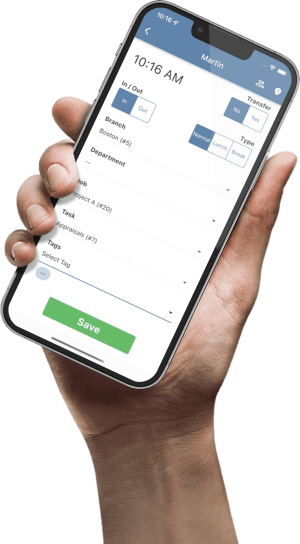
The Mobile Time Clock page describes GPS-enabled attendance, biometric authentication, real-time sync, offline clock-in support, and construction teams that work across multiple sites.
Job Costing
The Job Costing page explains that employee time can be allocated across up to four levels of cost centers, which is important for separating labor by project, branch, department, task, or production unit.
Payroll
The Payroll page describes payroll processing connected to scheduling and attendance, including direct deposit, tax reports, digital pay stubs, and payroll calculations.
Implementation Logic
A construction rollout should start with the real field workflow: who creates jobs, who assigns crews, who approves exceptions, how transfers work, what happens when signal is weak, and what payroll reports must be produced.
Buyer Fit
TimeTrex is a strong fit when the company wants location-aware timekeeping to feed payroll and labor costing, rather than running a standalone app that still requires spreadsheet cleanup before pay day.
Construction teams should not have to choose between field simplicity and payroll control.
Use TimeTrex to connect mobile clock-ins, geofencing, job costing, scheduling, and payroll in one workflow.
30-Day Implementation Plan
A geofencing rollout succeeds when the first month is treated as an operations project, not a software switch. The goal is to prove that the app can support real field behavior before payroll depends on it without supervision.
Days 1-3: Define The Policy
Write the plain-language rule before configuring the system. Define when location is collected, whether punches outside the fence are allowed, what notes are required, how corrections work, who approves time, how long records are retained, and how employees can ask questions.
Days 4-7: Build The Job List
Create active jobs, yards, shops, staging areas, and recurring service locations. Decide which jobs need fences immediately and which can start with mobile punches plus job selection. Align projects to cost codes, departments, tasks, classifications, and payroll rules.
Days 8-12: Pilot Real Crews
Pick crews with different realities: one stable job site, one moving or multi-site crew, one low-connectivity crew, and one supervisor who cares about job cost detail. Use soft exceptions during the pilot and collect feedback daily.
Days 13-16: Tune The Fences
Review off-site exceptions. Separate true policy violations from weak-signal events, staging-area issues, incorrect job selection, and fence boundaries that do not match the actual site. Adjust rules before expanding the rollout.
Days 17-22: Train Foremen
Foremen do not need a software lecture. They need a daily routine: review missing punches, resolve off-site exceptions, confirm job transfers, check overtime risk, approve or reject corrections, and clear the queue before payroll day.
Days 23-30: Payroll Parallel Run
Run one payroll cycle in parallel with the old process. Compare hours, overtime, job costing, break records, certified payroll fields, and exceptions. Launch broadly only after the exceptions are explainable and the approval routine is working.
Do Not Skip The Parallel Run
The parallel run is where hidden issues show up: wrong workweek start, missing cost codes, over-tight fences, unpaid travel confusion, supervisor approval bottlenecks, and report fields that payroll needs but operations forgot to capture.
The Manager Routine That Keeps Payroll Clean
Technology does not remove the need for supervision. It changes the supervisor's work from reconstructing time to reviewing exceptions. The best routine is short, daily, and predictable.
Daily Foreman Review
- Confirm every scheduled worker has a clock-in or approved absence.
- Review off-site punches while the worker and foreman remember what happened.
- Check job transfers for crews that moved between sites or cost codes.
- Resolve missed meal, missed break, and early departure exceptions.
- Add notes for weather, access delays, travel between sites, or owner-directed changes.
Weekly Payroll Review
- Confirm total hours by worker, workweek, project, and classification.
- Compare overtime and premium hours against the schedule and applicable policy.
- Review manual edits and make sure the reason is documented.
- Confirm public-work or prevailing-wage jobs have the fields needed for certified payroll.
- Lock approved time before payroll processing or export.
The Best KPI Is Not "Number Of GPS Flags"
A useful KPI is the percentage of exceptions resolved before payroll day. If the team is still clearing missing punches and location exceptions during payroll processing, the workflow is not mature yet.
Sample Policy Language To Adapt
Use this as a starting point for internal review. It should be adapted to your state, province, collective bargaining agreements, project rules, device policy, privacy obligations, and wage-and-hour requirements.
Sample Construction Geofencing Time Clock Policy
Purpose. The company uses a mobile time clock with location-based controls to help create accurate time, attendance, payroll, job costing, and project records. The system is intended to confirm whether a clock-in, clock-out, job transfer, or other time event occurs near an authorized company work location.
When location is collected. Location information may be collected when an employee uses the time clock app for a punch, job transfer, correction, or other timekeeping event. The company does not use the time clock app for personal, off-duty tracking unless a separate written policy and lawful business purpose apply.
Employee responsibility. Employees must record time accurately, select the correct job or cost code, report missed punches promptly, and add a note when the app requests an explanation. Employees must not punch for another worker or ask another worker to punch for them.
Exceptions. A punch outside an authorized geofence may be flagged for supervisor review. A location exception does not automatically determine whether time is paid or unpaid. Supervisors will review the facts, including work performed, company direction, site access, travel, connectivity, and any employee note.
Corrections. Corrections must be submitted promptly and must state the reason for the change. The company maintains an audit trail of original punches, edits, notes, approvals, and payroll processing.
Privacy and access. Location and timekeeping data may be accessed by authorized personnel for timekeeping, payroll, job costing, safety administration, compliance, dispute resolution, and related business purposes. Access is limited based on role and business need.
Common Mistakes To Avoid
Starting With A Hard Block
Blocking every off-site punch may look strict, but it can create payroll risk when a worker was performing assigned work. Pilot with flags and notes first, then decide where hard blocking is justified.
Ignoring Job Transfers
A geofence can prove site presence, but it cannot fix bad cost coding by itself. If workers move between tasks, phases, or change orders, the workflow needs a transfer step.
Making Payroll The First Reviewer
Payroll should not be the first person discovering that a worker was off-fence on Tuesday. Foremen should clear exceptions daily because they know the field facts.
Collecting More Data Than Needed
More location data is not always better. Collect what supports the stated timekeeping and job-costing purpose, explain the policy, restrict access, and retain records only as long as required.
Forgetting Public Work Requirements
For Davis-Bacon or other prevailing-wage projects, hours may need to connect to project, classification, workweek, wage determination, fringe treatment, overtime, and weekly certified payroll reports.
Skipping Employee Training
Workers need to know what the app does, what it does not do, how to handle weak signal, how to add notes, and how to correct a punch. Confusion creates resistance and bad data.
FAQ: Construction Geofencing Time Clock Apps
What is a construction geofencing time clock app?
It is a mobile timekeeping system that checks whether an employee is near an authorized construction site, yard, shop, or service location when recording a time event. The app can approve, warn, block, or flag a punch based on company policy, then route exceptions for supervisor review.
Should a geofence automatically block payroll time?
Usually no. A geofence exception should trigger review. The worker may have been performing assigned work outside the boundary, affected by GPS drift, waiting at an access point, traveling between job sites, or working in a low-signal area. Payroll decisions should be based on the facts and applicable wage rules, not location alone.
How large should a construction geofence be?
It should cover the real work area, approved access points, job trailer, parking or staging zones if relevant, and any area where workers are expected to perform compensable work. There is no universal radius. Test each site and adjust based on actual exceptions.
Can geofencing help with certified payroll?
Yes, if the app captures more than location. For public or federally funded work, the record may need project, classification, hours, workweek, wage, fringe, overtime, deductions, and supervisor approval. Geofencing can support the project-location evidence, but certified payroll still depends on complete payroll records.
What happens if a worker has no cell service?
The app should support offline punches where practical. The punch should be stored locally with the timestamp, device context, and any required note, then sync when the device reconnects. Supervisors should review offline punches as exceptions.
Is continuous GPS tracking necessary?
Not for many construction timekeeping programs. Location captured at punch, transfer, and correction events may be enough to support attendance and job costing. Continuous tracking has higher privacy, employee-relations, and governance implications, so it should be used only when there is a clear, disclosed, proportionate business need.
How does geofencing reduce time theft?
It reduces common problems such as punching in before arriving on site, selecting the wrong job, or having another person record time. The strongest setup combines geofencing with employee authentication, supervisor approval, exception reporting, and a clear correction process.
Does a mobile time clock replace the foreman review?
No. It gives the foreman a better review queue. The foreman still needs to confirm work performed, job transfers, missed punches, off-site notes, break issues, overtime, and daily crew exceptions.
Can geofencing support job costing?
Yes. The app should connect punches to projects, tasks, departments, phases, or cost centers. That gives the accounting and project teams better labor allocation before invoices, change orders, and payroll reports are finalized.
Why use TimeTrex for construction geofencing?
TimeTrex connects mobile time clocks, geolocation and geofencing, time and attendance, scheduling, job costing, reporting, and payroll. That helps construction companies move from field punch to approved payroll and labor-cost reporting without relying on separate spreadsheets for every correction.
Build A Cleaner Field-To-Payroll Workflow
TimeTrex helps construction teams capture mobile time, verify authorized work locations, allocate labor to jobs and cost centers, review exceptions, and process payroll from the same workforce management platform.
Sources And Further Reading
This article uses official government and TimeTrex product sources for wage-and-hour, payroll, privacy, construction, and product-context claims.
- U.S. Department of Labor, Fact Sheet #21: FLSA Recordkeeping Requirements
- U.S. Department of Labor, Fact Sheet #22: Hours Worked Under the FLSA
- U.S. Department of Labor, Davis-Bacon and Related Acts Construction Guidance
- U.S. Department of Labor, WH-347 Weekly Certified Payroll Form Instructions
- IRS Publication 15 (2026), Employer's Tax Guide
- IRS, Employment Tax Due Dates
- U.S. Bureau of Labor Statistics, Construction: NAICS 23
- OSHA, Construction Industry
- Federal Trade Commission, Geolocation Data Enforcement Action
- California Penal Code Section 637.7
- Connecticut General Statutes Section 31-48d
- Office of the Privacy Commissioner of Canada, Privacy in the Workplace
- TimeTrex Time & Attendance
- TimeTrex Mobile Time Clock
- TimeTrex Job Costing
- TimeTrex Payroll
Disclaimer: The content provided on this webpage is for informational purposes only and is not intended to be a substitute for professional advice. While we strive to ensure the accuracy and timeliness of the information presented here, the details may change over time or vary in different jurisdictions. Therefore, we do not guarantee the completeness, reliability, or absolute accuracy of this information. The information on this page should not be used as a basis for making legal, financial, or any other key decisions. We strongly advise consulting with a qualified professional or expert in the relevant field for specific advice, guidance, or services. By using this webpage, you acknowledge that the information is offered “as is” and that we are not liable for any errors, omissions, or inaccuracies in the content, nor for any actions taken based on the information provided. We shall not be held liable for any direct, indirect, incidental, consequential, or punitive damages arising out of your access to, use of, or reliance on any content on this page.
About The Author

Roger Wood
With a Baccalaureate of Science and advanced studies in business, Roger has successfully managed businesses across five continents. His extensive global experience and strategic insights contribute significantly to the success of TimeTrex. His expertise and dedication ensure we deliver top-notch solutions to our clients around the world.
Time To Clock-In
Start your 30-day free trial!
Experience the Ultimate Workforce Solution and Revolutionize Your Business Today
- Eliminate Errors
- Simple & Easy To Use
- Real-time Reporting

Saving businesses time and money through better workforce management since 2003.
Copyright © 2026 TimeTrex. All Rights Reserved.