
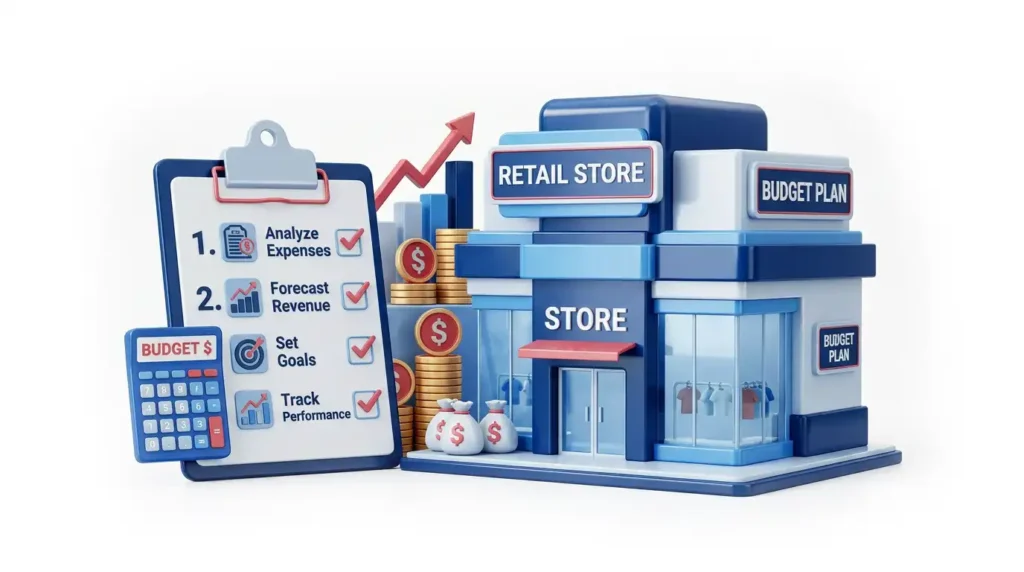

How to Create a Retail Store Budget
TL;DR: Creating a highly functional retail budget requires moving past static estimations and adopting rigorous, data-driven financial frameworks like Zero-Based Budgeting. By accurately forecasting revenue, tightly categorizing operational expenses versus capital investments, maintaining disciplined Open-to-Buy inventory limits, and preparing emergency cash flow scenarios, retailers can successfully navigate macroeconomic shifts and protect razor-thin profit margins.
- Macro-Economic Context and Strategic Goal Setting
- Selecting the Retail Budgeting Methodology
- The Science of Revenue Forecasting
- Architecting the Expense Budget
- The Open-to-Buy (OTB) Framework and Inventory Capital
- Essential Financial Metrics and Industry Benchmarks
- Step-by-Step Budget Assembly and Template Integration
- Technological Infrastructure for Budget Execution
- Cash Flow Management and Scenario Planning
- Common Pitfalls and Strategic Remediation
The retail sector operates within a highly dynamic macroeconomic environment, characterized by shifting consumer sentiments, supply chain volatilities, escalating real estate costs, and an unprecedented surge in inventory shrinkage. Navigating this landscape requires far more than intuitive merchandising and aggressive marketing; it demands a rigorous, data-driven approach to financial planning. A retail budget is not merely a constraint on spending, but rather a strategic blueprint that translates overarching business strategy into actionable financial targets for the fiscal year ahead. It maps expected sales and expenditures against target profits, forming the ultimate reference point against which actual performance is measured and operational decisions, such as inventory procurement, staffing levels, and marketing investments, are executed.
The stakes for accurate budgeting have never been higher. Driven by a post-pandemic economic recalibration, the U.S. retail industry is projected to grow at a Compound Annual Growth Rate (CAGR) of 4.1% between 2024 and 2028, mirroring the broader economy. Yet, this growth masks underlying volatilities. While total retail sales for 2024 climbed to approximately $5.28 trillion, the pace of that growth decelerated significantly, with the National Retail Federation noting a drop from 3.6% average annual gains in 2023 to a mere 0.7% across 2024. To survive in a climate of slowing top-line growth, retailers must fiercely protect their bottom lines. This comprehensive, step-by-step guide explores the architecture of a retail store budget, examining foundational budgeting frameworks, the anatomy of retail costs, demand forecasting algorithms, Open-to-Buy (OTB) inventory management, key financial performance indicators, and the technological infrastructure required to sustain financial agility.
Macro-Economic Context and Strategic Goal Setting
Before a single dollar is allocated to a spreadsheet, a retailer must define what financial success looks like. Setting clear financial goals establishes the parameters that will govern the entire budgeting process. This involves aligning the organization's internal ambitions with the external realities of the commercial marketplace.
In the contemporary retail environment, strategic goal setting requires navigating complex cross-currents. Retailers must account for higher baseline price levels and fluctuations in consumer confidence. For example, inflationary pressures have altered purchasing power, with consumers increasingly leaning on Buy Now, Pay Later (BNPL) services to stretch their budgets. Concurrently, traditional retailers are facing structural shifts in real estate. According to Q1 2026 data, U.S. shopping center absorption turned negative, returning 4.6 million square feet to the market, while national vacancy rose to 5.9%. Despite this softening occupancy, structural supply constraints drove asking rents up 2.3% year-over-year to $25.48 per square foot.
Against this macroeconomic backdrop, goal setting must be highly specific. A retailer must determine whether the upcoming fiscal period is dedicated to aggressive market share acquisition, which will require heavy allocations toward customer acquisition and new store build-outs, or if the objective is margin preservation and operational optimization. Goals should include establishing targets for specific net profit margins, determining a precise percentage by which top-line revenue should grow, and setting acceptable thresholds for operating expenses as a percentage of total sales. These overarching targets will serve as the philosophical foundation for every subsequent decision, dictating how aggressively buyers can procure inventory and how strictly controllers must limit administrative overhead.
Selecting the Retail Budgeting Methodology
The architecture of a retail budget relies heavily on the selection of a core financial framework. Relying on isolated spreadsheets and static assumptions often leads to severe misallocations of capital, as spreadsheets struggle to support dynamic, multi-variable planning. Modern retail requires sophisticated methodologies that can adapt to both seasonal fluctuations and sudden economic shocks.
Historical and Incremental Budgeting
Historical forecasting is recognized as one of the simplest financial modeling methods, relying heavily on previous periods' actuals as a baseline for the future. In an incremental budgeting framework, management takes the previous year's actual expenditures and applies a predetermined growth or contraction percentage. While this method is highly efficient and requires minimal analytical overhead, it fundamentally assumes that the future will behave identically to the past. This is a dangerous assumption in modern retail. Incremental budgeting inherently bakes past inefficiencies, outdated vendor contracts, and bloated expenses into future budgets. It fails to account for shifting consumer behaviors, emerging supply chain disruptions, or the sudden obsolescence of specific marketing channels.
Zero-Based Budgeting (ZBB)
To counteract the complacency of incremental budgeting, highly disciplined organizations employ Zero-Based Budgeting. ZBB demands that every department, store, and expense category justify its funding requirements from a "zero base" at the beginning of each fiscal period, completely disregarding historical spending baselines. Under ZBB, the budget is constructed line-item by line-item based on assessed value, program efficiency, and strict strategic necessity.
For example, a retail marketing department preparing next year's budget under a ZBB framework cannot simply assume a rollover of its previous $1 million budget. Instead, the department must start from scratch, justifying every digital advertisement, trade show, and print material against projected Return on Investment (ROI) and broader growth goals. After this rigorous review, the department might eliminate poorly performing legacy campaigns and reallocate funds to new, high-yield digital initiatives, arriving at a leaner, highly optimized budget of $820,000. While Zero-Based Budgeting provides superior accuracy, often landing within a precise variance margin, and eliminates the "sandbagging" of funds by department heads, it is highly resource-intensive, requiring a profound understanding of departmental activities and cost structures.
Rolling Forecasts
To mitigate the rigid, static nature of annual budgets, sophisticated retailers frequently implement rolling forecasts in tandem with their primary budgeting framework. A rolling forecast continuously projects budget, revenue, and expenses over a set horizon (typically 12 to 18 months), appending a new period as each month or quarter expires. This continued assessment refines the financial plan using real-time data, significantly mitigating risk and supporting dynamic scenario planning. When paired with Zero-Based Budgeting, rolling forecasts create a highly agile financial environment. Baseline necessities are rigorously justified at the outset, yet the organization retains the real-time flexibility to pivot capital allocation in response to immediate market signals or shifting consumer demand.
Activity-Based Budgeting (ABB)
Activity-based budgeting calculates the total cost of the specific activities required to achieve a strategic goal. Instead of allocating a blanket labor budget based on a percentage of sales, ABB models the exact cost of customer service interactions, inventory restocking hours, returns processing, and checkout transactions required to hit a predefined operational target. This framework aligns expenditures directly with operational throughput, ensuring that capital is deployed exactly where value is generated, which is particularly useful for retailers managing complex omnichannel fulfillment models like Buy Online, Pick Up In Store (BOPIS).
The Science of Revenue Forecasting
The practical construction of the budget universally begins with revenue forecasting, since nearly all subsequent expense allocations, inventory purchases, and labor schedules flow downstream from anticipated sales. Forecasting demand is the complex, continuous practice of predicting exactly what consumers are willing to purchase at specific times throughout the fiscal year. Retailers must deploy a strategic mix of quantitative modeling and qualitative judgment to structure these projections, breaking down expected revenue by sales channel, product line, individual category, and target customer segment.
Quantitative Forecasting Methodologies
Quantitative forecasting relies strictly on historical datasets and mathematical algorithms to predict future demand.
- Time Series Analysis: This classic methodology analyzes historical data sequences over time to identify underlying patterns, multi-year cycles, and seasonal fluctuations, utilizing these patterns to predict future values.
- Straight-Line Forecasting: This method assumes a steady, linear growth rate based on historical trajectories. It is highly simplistic and generally best suited for mature, stable product categories with very little volatility, such as basic household staples.
- Moving Average: To smooth out short-term fluctuations and data anomalies, this method averages sales over a specific, rolling number of past periods (e.g., a 3-month or 6-month moving average). This prevents the forecasting model from overreacting to sudden, anomalous spikes or dips in demand.
- Exponential Smoothing: Similar to the moving average, this technique averages past data but assigns exponentially greater weight to more recent data points. This allows the forecast to react more aggressively to emerging consumer trends while still anchoring the projection to historical context.
- Regression Analysis: This highly sophisticated modeling technique examines the relationship between a dependent variable (such as total sales) and one or more independent variables (such as marketing spend, local weather patterns, or broader economic indicators). By establishing a mathematical correlation, retailers can simulate how changes in specific operating inputs will ultimately impact revenue.
Advanced and Qualitative Forecasting Methodologies
While quantitative data provides the foundation, raw numbers cannot always predict unprecedented market shifts or the reception of entirely new product categories.
- Machine Learning and Predictive Analytics: Advanced algorithms combine data mining, statistical modeling, and machine learning to automatically recognize complex, multi-variable patterns in consumer behavior. These systems adjust forecasts dynamically based on macro-market guidance, localized events, and highly granular customer segmentation.
- Delphi Method: This is a qualitative approach where a panel of internal and external industry experts anonymously submit predictions regarding market demand. The responses are collated, summarized, and redistributed to the panel for further refinement until a broad consensus is reached. The Delphi method is exceptionally valuable for forecasting the impact of unprecedented market uncertainties or plotting demand for entirely novel product launches where no historical data exists.
- Bottom-Up vs. Top-Down Forecasting: Bottom-up forecasting aggregates micro-level sales data (e.g., per-store or per-SKU projections built by individual store managers) to calculate a corporate total, often yielding higher accuracy rooted in local realities. Top-down forecasting takes a macro revenue goal mandated by the executive suite and distributes it downward across departments and stores based on historical weightings.
When analyzing historical data to inform these models, retailers must carefully review past performance to identify anomalies. For instance, noticing which items were drastically overstocked and required deep discounting, versus those that were so popular they caused stockouts, allows planners to refine their baseline assumptions for the coming year.
Architecting the Expense Budget
Once revenue projections are established, the financial planner must turn to the anatomy of retail costs. Understanding the behavioral classification of expenses is foundational to maintaining a healthy budget, establishing pricing strategies, and protecting cash flow. Retail operating expenses (OpEx) represent the costs incurred in the daily course of business, which must be managed entirely separately from capital expenditures (CapEx). Misclassifying these costs distorts the break-even analysis and obscures the true operational efficiency of the enterprise.
Capital Expenditures (CapEx)
Capital expenditures encompass long-term investments in physical or digital assets that provide value to the business over multiple years. In the retail sector, this includes massive outlays such as new store build-outs, real estate acquisitions, facility renovations, specialized equipment purchases (like industrial refrigeration units or extensive racking systems), and major technological infrastructure upgrades. CapEx requires extensive long-term strategic planning, securing higher initial funding, and, crucially for accounting purposes, these costs are amortized over the asset's useful life rather than being expensed entirely in the year they are incurred. Consequently, while CapEx dramatically impacts cash flow in the short term, its impact on the monthly income statement is spread over time.
Cost of Goods Sold (COGS)
The Cost of Goods Sold represents the direct costs attributable to the production or acquisition of the physical goods sold by a retailer. This is the absolute core of retail economics. COGS includes the wholesale cost of products, inbound freight, customs tariffs, raw materials, and direct supplier costs. COGS is arguably the most critical variable cost; when merchandise is ultimately sold and delivered to the consumer, gross margin is realized. Consequently, accurately forecasting and controlling COGS, especially amidst unpredictable international freight rates and volatile tariff inputs, is the primary driver of gross profitability. For context, COGS frequently consumes between 50% and 70% of total gross revenue, depending heavily on the retail sub-sector.
Fixed Operating Expenses
Fixed expenses remain largely constant regardless of sales volume, foot traffic, or factory output. They provide the baseline operating threshold that the retailer must overcome every single month just to reach the break-even point. Key fixed costs include:
- Facilities and Real Estate: This encompasses base lease payments, property taxes, and baseline facility maintenance. Real estate remains one of the largest fixed burdens in the retail sector. With prime commercial space in major metropolitan areas commanding premiums, and average U.S. shopping center asking rents sitting at $25.48 per square foot, optimizing the physical footprint is paramount.
- Salaried Labor: Fixed wages for store managers, corporate staff, and administrative personnel. For example, store managers typically earn between $31 and $47 per hour, representing a rigid baseline cost.
- Insurance and Compliance: General liability policies, property insurance, licensing fees, and necessary health or operational permits.
- Technology Overhead: Fixed monthly or annual subscriptions for Point of Sale (POS) software, Enterprise Resource Planning (ERP) systems, and security infrastructure.
It is important to note that due to inflationary pressures and the post-COVID economy, many costs historically considered purely fixed have evolved into "step-fixed" costs. These are expenses that remain fixed within a certain operational range but jump to a higher, more expensive tier when capacity expands or macroeconomic inflation forces mid-contract renegotiations.
Variable Operating Expenses
Variable expenses fluctuate in direct, measurable proportion to sales volume and retail activity. Highly efficient management of these costs is vital for preserving the net profit margin during periods of aggressive growth, as unrestrained variable costs can quickly consume any additional gross profit generated by higher sales.
- Hourly Labor and Commissions: Wages for part-time associates and performance-based sales commissions. Total labor costs (including salaried staff) typically range from 15% to 30% of total revenue.
- Payment Processing Fees: Credit card fees, typically hovering around 2.6% plus $0.10 per transaction, scale perfectly with sales volume and represent a non-negotiable tax on revenue.
- Marketing and Advertising: Digital advertising campaigns, promotional events, signage, and broad customer acquisition costs. Marketing usually receives an allocation of between 3% and 5% of total revenue. Advertising is strictly classified as a variable cost, as its scaling is tied directly to growth ambitions.
- Fulfillment and Logistics: Outbound shipping to customers, packaging materials, and seasonal decorations.
- Inventory Shrinkage: Losses due to theft, damage, shoplifting, or administrative error act as a shadow variable cost directly eroding gross margins.
The IT Spending Mandate
A specialized category of expense that blends CapEx and OpEx is Information Technology (IT) spending. The global IT spending in the retail market is estimated to reach $124 billion in 2026, driven by an urgent need to enhance the customer experience, streamline supply chains, and fortify omnichannel strategies. In 2024, over 72% of global retail chains reported actively increasing their IT budgets, heavily prioritizing Cloud infrastructure and Software-as-a-Service (SaaS), which account for over 44% of overall IT investment in retail. Across retail and eCommerce, benchmark data indicates that IT spending currently accounts for roughly 7% of total revenue. Financial planners must no longer view technology as an auxiliary expense, but rather as core operating infrastructure requiring a dedicated, substantial budgetary pillar.
The Shrinkage Epidemic
A critical, often underestimated component of retail budgeting in 2024 and beyond is inventory shrinkage. According to the National Retail Federation (NRF), total industry shrink amounted to a staggering $112.1 billion in recent annual calculations, representing tens of billions in product value simply disappearing from store shelves. This crisis is driven by a 93% increase in the average number of shoplifting incidents compared to 2019 data, alongside a massive surge in organized retail crime.
External theft and shoplifting account for roughly 36% of this total shrinkage. The average shrink rate has climbed to 1.6% of gross sales. To contextualize the severity of this metric: with average grocery net profit margins sitting at a highly constrained 1.7%, a 1.6% shrink rate fundamentally threatens the existence of the enterprise. Budgeting for this phenomenon demands two adjustments:
- CapEx and OpEx Security Investments: Retailers must increase fixed budgets for physical security, integrated CCTV systems, and loss-prevention personnel.
- Margin Recalibration: Shrink directly inflates COGS and severely depresses the gross margin. Budgets must explicitly include a contingency line item for inventory write-downs, recognizing the bleak reality that only 10.9% of theft losses are ever recovered.
The Open-to-Buy (OTB) Framework and Inventory Capital
Over-investment in inventory is widely recognized as one of the leading causes of cash flow asphyxiation in the retail sector. If a retailer purchases too much inventory, precious working capital is frozen in depreciating, illiquid assets; if they purchase too little, they face stockouts, forfeited revenue, and permanently degraded customer loyalty. The Open-to-Buy (OTB) framework is the mathematical safeguard designed to find the optimal equilibrium.
The Open-to-Buy Mechanism
An OTB plan calculates the precise amount of capital a retailer has available to purchase new inventory while strictly adhering to predefined sales targets and ending inventory goals. It acts as an inflexible shopping budget for retail buyers, preventing the emotional, speculative, or undisciplined over-purchasing of stock that plagues many merchants.
Step-by-Step OTB Calculation Example: Consider a mid-market retail operation aiming to generate $1,000,000 in monthly sales. To maintain optimal display levels and buffer against supply chain delays, they strategically desire to end the fiscal period with $300,000 in physical inventory on the floor. The operation currently holds $500,000 in beginning inventory and has an additional $200,000 worth of goods currently in transit (outstanding purchase orders).
- Calculate Total Inventory Needs: $300,000 (Target Ending Inventory) + $1,000,000 (Planned Sales) = $1,300,000.
- Calculate Available Inventory: $500,000 (Beginning Inventory) + $200,000 (On Order Inventory) = $700,000.
- Determine the OTB Allowance: $1,300,000 (Total Needs) - $700,000 (Available) = $600,000.
This calculation dictates that the retailer has exactly $600,000 of buying capacity at retail value. If a vendor presents a massive new assortment costing more than this capacity, the buyer must either decline the overage, cancel outstanding orders to free up OTB, or formally revise the sales plan upward.
Converting Retail OTB to Cost
Because buyers procure merchandise at wholesale cost rather than retail value, the retail OTB figure must be mathematically converted to an "OTB at cost" figure before actual purchase orders are issued. This is achieved using the category's cost percentage, which is the inverse of the initial markup percentage.
If the $600,000 retail OTB calculated above is subject to a 2.5x standard markup (which translates to a 40% cost percentage, or 0.40), the actual liquid capital authorized for vendor purchasing is $240,000.
| Markup (Retail ÷ Cost) | Cost % of Retail | OTB Retail Multiplier |
|---|---|---|
| 2.0x markup | 50% | 0.50 |
| 2.5x markup | 40% | 0.40 |
| 3.0x markup | 33% | 0.33 |
| 4.0x markup | 25% | 0.25 |
Effective OTB planning often exposes systemic inventory tracking failures within an organization. If point-of-sale data, customer returns, inbound purchase orders, and physical cycle counts are not synchronized in real-time, the OTB calculation becomes disconnected from physical reality, leading to catastrophic capital misallocations. OTB plans must be managed at a highly granular category level, and dynamically adjusted weekly or monthly, since product velocities vary drastically across a diverse retail assortment.
Essential Financial Metrics and Industry Benchmarks
A retail budget remains a theoretical document until it is tested against operational reality. Evaluating the viability of a retail budget requires monitoring a constellation of Key Performance Indicators (KPIs) categorized into profitability, liquidity, efficiency, valuation, and leverage metrics. Benchmarking these figures against industry standards allows financial planners to isolate underperforming assets and immediately reallocate resources.
Profitability and Margin Benchmarks
Gross profit margin, the percentage of revenue retained after explicitly deducting the Cost of Goods Sold, is the most fundamental indicator of a retailer's pricing power and procurement efficiency. Across all industries, the average gross profit margin sits at roughly 36.56%, while the average net profit margin is 8.54%. However, retail is notably more constrained.
Businesses prioritizing extreme sales volumes in highly competitive markets typically operate on razor-thin gross margins, relying on high inventory turnover to generate absolute cash. For example, wholesale clubs like Costco report gross margins around 12% to 15%, relying heavily on membership fee structures to generate net income. Conversely, luxury apparel and specialty retail command vast brand premiums, achieving gross margins between 55% and 70%, but they move physical inventory at a fraction of the speed.
| Retail Sub-Sector | Average Gross Margin | Average Net Margin | Key Market Examples |
|---|---|---|---|
| Luxury Goods / Apparel | 55.0% - 70.0% | 3.00% - 6.00% | LVMH, Ralph Lauren |
| Specialty Retail | 30.0% - 50.0% | 1.45% - 3.09% | Home Depot, TJX |
| General Merchandise | 25.0% - 35.0% | 1.00% - 3.00% | Walmart, Target |
| E-Commerce | 30.0% - 50.0% | Variable | Amazon, Wayfair, Chewy |
| Grocery / Food | 20.0% - 25.5% | 1.18% - 1.70% | Kroger, Safeway, Whole Foods |
| Warehouse Clubs | 12.0% - 15.0% | 1.00% - 2.00% | Costco, BJ's |
Net profit margin further deducts all operating expenses, marketing costs, interest, and taxes. As highlighted in the data above, the average net profit for the grocery sector is extraordinarily low, averaging just 1.7% in 2024. This razor-thin margin environment dictates that any minor deviation in variable costs, such as an unexpected spike in hourly labor, a localized surge in shrinkage, or unforeseen freight charges, can instantly drag a massive supermarket operation into unprofitability.
Efficiency: Sales Per Square Foot and Inventory Turnover
Sales per Square Foot (SPF) is the ultimate metric of physical real estate productivity. It calculates the revenue generated by every customer-accessible square foot of a location, deliberately excluding back-of-house spaces like stockrooms, restrooms, and administrative offices. With prime live-work-play commercial real estate in cities like New York commanding annual rents approaching $91.40 per square foot, a low SPF indicates that the physical footprint has become a severe financial liability rather than an asset.
Average Mall Tenant SPF
Apple Retail SPF
Costco Wholesale SPF
To maintain budget viability, financial planners must aggressively evaluate whether excess floor space is eroding overall profitability.
Inventory Turnover measures exactly how rapidly an operation sells through its total stock during a given fiscal period. An exceptionally low turnover rate indicates that precious capital is trapped in obsolete or overpriced merchandise that is failing to resonate with the consumer base. Conversely, an unusually high turnover rate suggests inadequate inventory levels, resulting in constant stockouts and severed revenue opportunities. A specific, budgeted turnover goal must be explicitly set for every category to govern the flow of Open-to-Buy capital.
Liquidity Metrics
A retailer's ability to cover its short-term obligations is measured through liquidity ratios. The Quick Ratio (often referred to as the Acid Test Ratio) is critically important in retail because it strips out physical inventory from current assets, recognizing the reality that retail inventory cannot always be liquidated immediately without massive, margin-destroying discounting.
A quick ratio greater than 1.0 indicates that the retailer can comfortably fulfill its immediate financial obligations without relying on the fire-sale of its current stock, providing a massive financial buffer against sudden macroeconomic demand shocks.
Step-by-Step Budget Assembly and Template Integration
Constructing the actual retail budget document is a highly structured, sequential process. Synthesizing best practices across the industry, the formulation of a comprehensive retail budget requires executing the following seven chronological steps:
- Set Strategic and Financial Goals: Define exact success metrics, such as targeting a specific net profit margin (e.g., 5%) or establishing a top-line revenue growth percentage (e.g., 10% YoY) based on market research.
- Review Historical Data: Extract localized and categorical performance data from the prior 12 to 24 months to identify statistical anomalies, baseline trends, and recurring seasonality patterns.
- Forecast Revenue by Category: Model future sales utilizing a blend of quantitative (e.g., exponential smoothing) and qualitative analytics, mapping out expected cash inflows across all departments and omnichannel platforms.
- Estimate Fixed and Variable Expenses: Delineate costs strictly by their behavioral characteristics. Establish the non-negotiable fixed baseline (rent, salaried payroll, insurance) to calculate the absolute minimum break-even requirements, then forecast variable expenses based on the projected sales volume.
- Calculate Open-to-Buy and Allocate Funds: Using the fundamental OTB formula, restrict purchasing capital to align with targeted turnover rates. Allocate remaining variable funds proportionally to marketing and hourly labor.
- Account for Seasonal Cash Flow: Map the temporal reality of the business. Chart exactly when massive amounts of cash exit the business for wholesale inventory procurement versus when that cash re-enters via retail sales, ensuring peak cash demands do not exceed credit facility limits.
- Review, Stress Test, and Monitor Variance: Apply rigorous scenario planning vectors to stress-test the model. Once approved, the controller must compare actual expenditures to the budget continuously, calculating the variance (the mathematical delta between actual and budgeted amounts). Positive variances may signal operational efficiencies, while negative variances require immediate, aggressive corrective action.
The Retail Line-Item Budget Template
A standardized line-item budget structure logically groups expenses by operational function, tracking the previous year's actuals, the current projection, and the realized figures to calculate variance. Below is an archetypal structure utilized by financial controllers to manage the P&L:
| Budget Category & Line Item | Detailed Description | Prior Year Actual | Projected (Budgeted) | Actual (Current) | Variance (+ / -) |
|---|---|---|---|---|---|
| 1. Total Revenue | Product Sales, In-Store Services, eCommerce | ||||
| 2. Cost of Goods Sold (COGS) | Product cost, inbound freight, supplier fees | ||||
| 3. Gross Profit | Total Revenue minus COGS | ||||
| 4. Labor & Staffing | Salaries, wages, payroll taxes, benefits, commissions | ||||
| 5. Facilities & Occupancy | Rent, property tax, utilities, maintenance, CAM fees | ||||
| 6. Marketing & Advertising | Digital ads, physical signage, promotions, PR | ||||
| 7. Technology & Infrastructure | POS SaaS, web hosting, ERP software, telecoms | ||||
| 8. Security & Loss Prevention | CCTV systems, shrink/write-down allowance, guards | ||||
| 9. Administrative & Professional | Legal retainers, accounting fees, office supplies | ||||
| 10. Contingency Fund | Unplanned emergency allocation (typically 5-10%) | ||||
| 11. Total Operating Expenses | Sum of Items 4 through 10 | ||||
| 12. Net Operating Profit | Gross Profit minus Total Operating Expenses |
Technological Infrastructure for Budget Execution
The sheer complexity of omnichannel retail, dynamic OTB calculations, and real-time variance analysis renders manual spreadsheet modeling largely obsolete. Spreadsheets, while inherently flexible and ubiquitous, lack real-time synchronization with physical operational data, struggle profoundly to handle long-range forecasting efficiently, and introduce profound risks of human error and version control conflicts. Astonishingly, roughly 41% of companies still attempt to use static spreadsheets for planning, leading to deeply fragmented visibility and delayed decision-making.
Best-in-class budget execution relies instead on integrated Retail Management Systems (RMS) and cloud-based Enterprise Resource Planning (ERP) platforms. These systems synchronize Point-of-Sale (POS) transaction data, warehouse inventory levels, and the general accounting ledger into a single, unassailable source of truth.
Prominent software solutions utilized across the retail industry include:
- NetSuite: An enterprise-grade, unified cloud ERP managing retail across all selling channels with highly robust financial reporting and supply chain modules.
- Lightspeed Retail: A cloud-based POS designed explicitly for multi-location inventory management, featuring direct integrations with central accounting systems and reporting analytics.
- Shopify POS: Widely recognized for flawlessly bridging in-person and eCommerce ecosystems, offering unified inventory analytics and flexible discount parameter management.
- Cin7 Core & Finale Inventory: Specialized management systems focusing intensely on supply chain automation, purchase order tracking, and sophisticated stock control for high-volume operations, mapping data directly into accounting ledgers.
- Quant & SKU IQ: Systems geared heavily toward retail space management, automatic ordering, and synchronizing physical POS systems with external eCommerce channels.
Integrating these tools minimizes manual data entry, ensures that the strict OTB limits remain permanently tethered to real-time physical inventory counts, and allows the CFO to execute rolling forecasts continuously rather than treating budgeting as a heavy, static annual administrative burden.
Cash Flow Management and Scenario Planning
A profound truth in business finance is that profitability does not equal liquidity. It is a well-documented axiom that a retail business can be highly profitable on paper yet still fail catastrophically due to insolvency. In fact, 82% of small to midsize business failures are directly attributed to cash flow mismanagement rather than a lack of market demand.
The Mechanics of Retail Cash Flow
Retail cash flow challenges stem fundamentally from the timing disconnect between payables and receivables. Retailers frequently must purchase bulk inventory and settle wholesale supplier invoices 30, 60, or even 90 days before that inventory is actually sold to an end consumer. This creates a dangerous working capital gap.
Furthermore, ignoring the highly seasonal nature of retail exacerbates this gap. Businesses, particularly in apparel, toys, and electronics, often become flush with cash during peak holiday seasons, fostering a dangerous illusion of permanent liquidity that leads to unfocused budgeting and excessive overspending. When the off-season inevitably arrives, foot traffic drops while massive fixed commitments (rent, salaried labor, software subscriptions) remain entirely constant, rapidly draining the business's working capital reserves. To mitigate these risks, the master budget must be mapped to a monthly cash flow plan. This involves aggressively negotiating extended terms of credit with suppliers (pushing accounts payable out as far as possible) and tightly managing the exact timing of major CapEx disbursements.
Rigorous Scenario Planning
Because external variables, ranging from global supply chain embargoes to localized weather anomalies and sudden consumer trends, can disrupt the baseline budget instantly, organizations must engage in rigorous scenario planning. Scenario planning involves defining critical macro uncertainties and modeling multiple potential futures (e.g., best-case, worst-case, and most likely outcomes) alongside the baseline budget.
Industry best practices dictate establishing two to four distinct, plausible scenarios. Financial modelers deliberately alter key variables (for example, modeling the impact if physical foot traffic decreases by 15%, or if inbound freight costs spike by 30%) to forecast the quantitative impact on total cash reserves. Crucially, the organization must establish "signposts" and "trigger points", early quantitative indicators that signal exactly which scenario is manifesting in reality, instantly activating predefined financial response strategies, such as immediately halting all OTB spending or proactively drawing down commercial lines of credit.
Strategic Emergency Reserves
Operating on the razor’s edge of liquidity leaves zero margin for error in the retail sector. A business emergency fund, a highly liquid cash reserve held in accessible, low-risk accounts, is absolutely mandatory for business continuity.
A standard industry benchmark dictates retaining enough liquid reserves to cover three to six months of all fixed operating expenses. While deploying surplus capital into money market funds or marketable securities can yield minor interest, the paramount objective of this fund is absolute liquidity and capital preservation. This ensures the organization retains the ability to meet payroll, rent, and utility obligations even during an absolute, catastrophic revenue halt.
Common Pitfalls and Strategic Remediation
Despite utilizing rigorous templates and advanced software, retail financial planners frequently fall victim to cognitive biases and operational blind spots that can rapidly destabilize the enterprise.
Data-Blind Estimations and Unjustified Optimism
The most dangerous and prevalent error in retail budgeting is projecting revenue based on intuition, estimation, or sheer optimism rather than rigorous historical tracking and objective market data. When top-line revenue is arbitrarily projected to grow at 20% without underlying demand drivers, management inevitably scales variable costs, overhiring labor, expanding marketing, and over-ordering inventory, to meet a phantom target. When the revenue fails to materialize, the business is left holding bloated payrolls, massive carrying costs, and stranded, depreciating inventory. Revenue projections must be ruthlessly grounded in granular, historically validated moving averages.
Inventory Mismanagement: Overstocking and Poor Pricing
A failure to respect the calculated Open-to-Buy formulas results in rapid, destructive inventory bloat. Overstocking ties up finite liquid capital in illiquid physical goods, directly precipitating the cash flow crises discussed earlier. Conversely, mispricing merchandise, either overpricing to alienate the consumer base or underpricing out of desperation to liquidate stock, destroys the vital gross margin necessary to cover fixed overhead. Relying on strict inventory turnover ratios and rigid OTB budgets forces retail buyers to maintain operational discipline, preventing emotional purchases.
Marketing Misallocations
In the aggressive pursuit of top-line growth, marketing budgets are frequently abused. Common errors include a complete lack of strategic planning (spending without setting Return on Ad Spend (ROAS) goals), ignoring macroeconomic and seasonal factors, and targeting the wrong audience demographics simply to drive empty traffic. Furthermore, retail marketers often funnel excessive capital into broad reach and acquisition channels while drastically underfunding customer retention, despite the mathematical reality that Customer Acquisition Cost (CAC) for new buyers is vastly higher than the cost of stimulating repeat purchases from an existing loyalty base. Budgetary models must strictly govern marketing as a set percentage of revenue (typically 3% to 5%), adjusting channel allocation dynamically based on real-time ROAS analytics and shifting funds toward lower CAC retention strategies when budgets tighten.
Neglecting the Emergency Reserve
Treating the entire gross profit as deployable operating capital is a fatal error. Retailers that fail to construct fixed line-items for savings and contingency funds invariably resort to toxic, high-interest debt when an unanticipated shock, such as a major facility repair, a natural disaster, or a sudden supply chain tariff, occurs. Integrating an automatic 5% to 10% contingency allocation directly into the master budget provides an internal financial shock absorber that preserves the broader strategy and protects the enterprise from ruinous borrowing costs.
Conclusion
The modern retail environment is an intricately complex, fiercely competitive ecosystem where macro-level economic volatilities constantly collide with micro-level consumer behaviors. Crafting a robust retail store budget transcends the mere limitation of departmental expenditures; it is an exercise in profound strategic architecture.
By migrating away from the complacency of static historical assumptions and adopting dynamic, rigorous frameworks like Zero-Based Budgeting and Rolling Forecasts, retail financial operators can ruthlessly eliminate legacy cost bloat and maintain profound organizational agility. A highly precise understanding of cost behaviors, delineating sharply between fixed burdens, CapEx investments, and variable operational levers, is mandatory for accurately calculating break-even points and projecting sustainable net margins in an era where average profitability often hovers below 2%.
Furthermore, mastering Open-to-Buy calculations protects the organization's absolute lifeline: its cash flow. When inventory turnover is mathematically optimized, and devastating modern variables like the $112 billion shrinkage epidemic are aggressively accounted for and mitigated via targeted technology investments, working capital remains fluid. Supported by sophisticated ERP and POS integrations, and fortified by rigorous scenario planning and untouchable contingency reserves, a meticulously constructed retail budget empowers an operation not merely to survive market volatility, but to systematically engineer long-term, sustainable profitability.
Ready to Build Your Budget?
Eliminate the guesswork and build a dynamic financial model for your retail business.
Interactive Retail Budget BuilderDisclaimer: The content provided on this webpage is for informational purposes only and is not intended to be a substitute for professional advice. While we strive to ensure the accuracy and timeliness of the information presented here, the details may change over time or vary in different jurisdictions. Therefore, we do not guarantee the completeness, reliability, or absolute accuracy of this information. The information on this page should not be used as a basis for making legal, financial, or any other key decisions. We strongly advise consulting with a qualified professional or expert in the relevant field for specific advice, guidance, or services. By using this webpage, you acknowledge that the information is offered “as is” and that we are not liable for any errors, omissions, or inaccuracies in the content, nor for any actions taken based on the information provided. We shall not be held liable for any direct, indirect, incidental, consequential, or punitive damages arising out of your access to, use of, or reliance on any content on this page.
About The Author

Roger Wood
With a Baccalaureate of Science and advanced studies in business, Roger has successfully managed businesses across five continents. His extensive global experience and strategic insights contribute significantly to the success of TimeTrex. His expertise and dedication ensure we deliver top-notch solutions to our clients around the world.
Time To Clock-In
Start your 30-day free trial!
Experience the Ultimate Workforce Solution and Revolutionize Your Business Today
- Eliminate Errors
- Simple & Easy To Use
- Real-time Reporting

Saving businesses time and money through better workforce management since 2003.
Copyright © 2026 TimeTrex. All Rights Reserved.