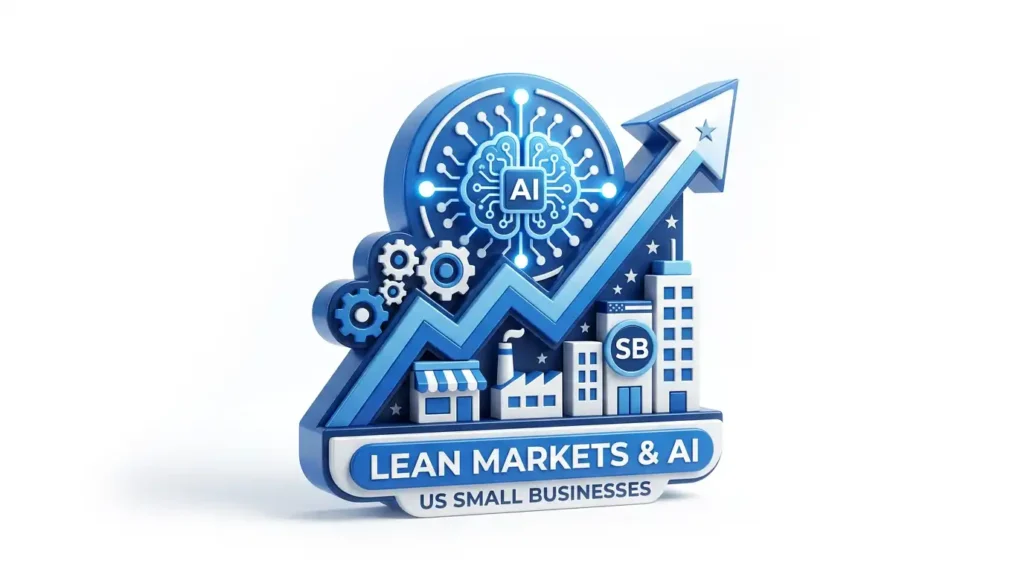

Lean Markets & AI for US Small Businesses
TL;DR
In 2026, US small and medium-sized businesses (SMBs) face a "lean market" characterized by slower consumer spending, tighter cash flow, and complex labor dynamics. To survive and thrive, SMBs must shift from sporadic AI experimentation to strategic, core integration. By adopting predictive AI for financial forecasting, supply chain optimization, and automated customer experiences, businesses can significantly reduce costs, increase operational capacity, and drive revenue. However, success requires careful consideration of the "build vs. buy" dilemma, robust data privacy governance, and phased implementation roadmaps.
Article Index
- The Macroeconomic Architecture of the 2026 Lean Market
- Defining Factors of the Lean Market: Sustainability, Cybersecurity, and Human Capital
- The Paradigm Shift: From AI Experimentation to Strategic Integration
- Revolutionizing the Financial Command Center: Cash Flow and Predictive Analytics
- Supply Chain Resilience and Inventory Optimization
- Reimagining the Customer Experience and Marketing Engine
- The Economics of AI: Cost Structures, ROI, and the Build vs. Buy Dilemma
- A Phased Roadmap for SMB AI Implementation
- Ethical Governance, Privacy, and Risk Management
- Strategic Synthesis and Future Outlook
The Macroeconomic Architecture of the 2026 Lean Market
As the global economy advances into 2026, the United States small and medium-sized business (SMB) sector is operating within a highly constrained, complex macroeconomic environment. The current economic landscape is characterized by conflicting indicators of modest growth and acute contraction, creating what is distinctly defined as a "lean market." Success in this environment requires an exhaustive understanding of the prevailing economic currents that suppress aggregate consumer demand, complicate labor dynamics, and constrain capital liquidity.
A pronounced loosening of the labor market is a defining feature of the 2026 economic architecture. Projections indicate that the unemployment rate has risen to 4.5% in 2026, representing an upward shift from the 4.0% baseline observed in 2024. This shift is expected to push wage growth lower, actively eroding consumer purchasing power. Concurrently, a sharp drop in net migration has fundamentally weakened overall population growth, acting as a structural drag on aggregate consumer spending. Consequently, real consumer spending is expected to decelerate significantly, slowing to 1.6% in 2026, which is a notable drop from the 2.6% growth anticipated in 2025. This pronounced slowdown alters the revenue landscape for small businesses, forcing a necessary pivot from aggressive, top-line growth strategies to rigorous, margin-preserving operational efficiencies.
Despite the contraction in consumer velocity, the broader economic foundation remains stable. Real Gross Domestic Product (GDP) is forecasted to maintain a positive, albeit modest, growth trajectory of 1.9% in 2026, down slightly from the 2.0% achieved in 2025. Furthermore, nominal GDP from 2026 to 2035 is projected to be higher than previous estimates, indicating underlying economic resilience. Inflationary pressures, while easing toward a more manageable 3.0%, remain a persistent headwind, compounding the effects of higher tariffs and elevated interest rates that restrain near-term expansion. While a real wage growth buffer of 1.4% between February 2025 and February 2026 continues to support baseline consumption, it marks a deceleration from the rapid gains of the preceding five years. This aggregate data also masks a highly bifurcated consumer landscape; low- and middle-income households are experiencing disproportionate impacts from elevated energy prices and shifts in the tax code, thereby reducing their share of overall consumption.
For the small business sector, these macroeconomic realities manifest as acute operational pressures. Remarkably, small business confidence has remained resilient. In the latter half of 2025, the U.S. Chamber of Commerce and MetLife Small Business Index reached a record high of 72.0, with 94% of small businesses projecting growth in 2026. However, this optimism is heavily tempered by balance sheet realities. Inflation remains the primary concern for 31% of SMB owners, closely followed by cash flow management, which plagues 29% of enterprises. Capital acquisition strategies have also evolved in response to these pressures, with nearly 74% of small businesses bypassing traditional banking institutions in favor of non-bank lenders or alternative credit mechanisms to satisfy their liquidity requirements.
Defining Factors of the Lean Market: Sustainability, Cybersecurity, and Human Capital
Beyond core economic indicators, the lean market of 2026 is defined by shifting consumer expectations, escalating operational risks, and human capital constraints. Sustainability has transitioned from an optional branding exercise to an essential operational requirement. Modern consumers, particularly younger demographics, demand transparent supply chains, recyclable packaging, and demonstrated reductions in environmental impact. Upcycling, biodegradable packaging, and closed-loop manufacturing processes are increasingly utilized by small businesses to tap into eco-conscious markets and drive long-term cost reductions.
Simultaneously, the digital threat landscape has expanded. Cybersecurity is a top priority across all industries in 2026, as phishing scams, ransomware, outdated software, and Point-of-Sale (POS) vulnerabilities pose existential risks to small enterprises. Implementing multi-factor authentication, encrypting sensitive data, and securing cyber insurance are no longer enterprise-exclusive practices; they are baseline survival mechanisms for SMBs.
The human capital equation is equally complex. Small businesses, defined as those with 249 or fewer employees, drove 52.8% of U.S. job creation from early 2021 through mid-2024. However, rising labor costs and cautious hiring forecasts suggest that employment growth will slow. The prevailing human resources strategy has shifted from a "hire and replace" model to a "develop and retain" paradigm as the skills gap widens. Human Resources teams are facing mounting workloads due to the complexities of managing disconnected systems for compliance, recruiting, and benefits administration. Regulatory compliance is growing increasingly complex, with business owners navigating an expanding web of laws concerning data privacy, wage transparency, and updates under the SECURE Act 2.0, which mandates auto-enrollment for new 401(k) plans and required Roth accounts for high-earner catch-up contributions.
In this multifaceted crucible of constrained resources, heightened consumer expectations, and regulatory complexity, Artificial Intelligence (AI) transitions from an experimental novelty to an indispensable strategic imperative.
The Lean Market Challenge in Numbers
In an era defined by inflation, supply chain bottlenecks, and a highly competitive labor market, US SMBs are under immense pressure to do more with less. Traditional operational scaling is becoming cost-prohibitive, making efficiency tools paramount.
The Paradigm Shift: From AI Experimentation to Strategic Integration
The narrative surrounding AI in the small business sector has fundamentally shifted. The initial phase of AI exposure in 2023 and 2024 was characterized by widespread but superficial adoption. Current data indicates that approximately 68% to 75% of small businesses now utilize AI tools in some capacity, largely to perform ad-hoc tasks such as drafting emails, generating marketing copy, or summarizing documents. However, this high adoption rate masks a critical strategic vulnerability: only 14% of these organizations have successfully integrated AI into their core operational workflows.
State of AI Adoption
While enterprise companies dominate AI headlines, SMBs are rapidly closing the gap. This chart illustrates the current distribution of AI utilization among small businesses. The competitive divide is widening between early adopters and holdouts.
The transition required in 2026 is moving from fragmented adoption to cohesive, strategic integration. Merely placing small, sporadic bets on disjointed AI applications yields only marginal, unmeasurable productivity boosts that do not equate to operational transformation. To survive a lean market, small businesses must leverage AI to architect a leading-edge operating model that delivers transformative value, specifically targeted at cost reduction, capacity expansion, and direct revenue generation.
The Federal Reserve has noted that the exceptionally strong business investment in AI and data centers over the past several years is likely to contribute to long-term economic strength and robust productivity growth. Specifically, technology investment as a share of GDP has jumped by approximately half a percentage point, driving technological enhancements and business process improvements that economize on labor. However, achieving these gains at the microeconomic level requires deliberate execution. Success is defined not by how many AI tools a company purchases, but by how deeply those tools are embedded into the daily workflows of finance, supply chain logistics, and customer relationship management, governed by strong ethical standards and clear AI use policies.
Revolutionizing the Financial Command Center: Cash Flow and Predictive Analytics
Cash flow volatility remains the primary existential threat to small businesses. Research consistently demonstrates that 82% of small business failures are directly attributable to poor cash flow management, rather than inferior products or a lack of market demand. In the current economic climate, 50% of small businesses operate with a fragile 15-day cash buffer, and roughly 60% struggle actively with delayed payments and working capital erosion. Furthermore, nearly 50% of commercial invoices are paid late, forcing Chief Financial Officers (CFOs) and business owners into reactive, high-interest borrowing scenarios to cover operational shortfalls. In Q4 2025, to manage cash flow, owners relied heavily on utilizing business lines of credit (54%), delaying payments to themselves (47%), and making minimum credit card payments (42%).
Historically, cash flow forecasting relied on static historical data, fragmented spreadsheets, and human intuition. In 2026, AI fundamentally transforms this discipline from a reactive accounting exercise into a proactive, predictive strategic advantage. Modern AI financial tools utilize advanced machine learning algorithms, including neural networks, random forests, and ensemble models, to process vast, disparate datasets simultaneously. These models ingest real-time sales trends, macroeconomic indicators, seasonal variations, and supply chain constraints to generate rolling, three-way forecasts that project Profit & Loss, balance sheets, and cash flow concurrently.
The integration of AI into financial forecasting yields profound results. Companies that have implemented automated cash flow forecasting have reduced manual forecasting time by 67% and improved forecast accuracy by 23 percentage points. Furthermore, AI-driven models can reduce error rates by up to 50% compared to traditional statistical methods.
A critical capability introduced by AI in financial management is rapid scenario analysis. Without robust scenario planning, minor disruptions, such as a delayed client payment, a sudden spike in energy costs, or a supply chain blockage, can quickly cascade into severe liquidity crises. AI-powered systems can run thousands of probabilistic "what-if" simulations in seconds, allowing business leaders to visualize the financial impact of various market shocks and immediately deploy optimized contingency plans. By detecting anomalies in spending and identifying early warning signs of cash strain, predictive analytics empowers small businesses to manage liquidity proactively, preserving capital when external funding is expensive and difficult to secure.
The financial technology (fintech) market has responded to this need by producing a spectrum of AI-driven applications tailored for SMBs. The following table illustrates the diverse financial management and forecasting tools available in 2026, categorized by their primary utility and feature sets:
| Software / Platform | Core Functionality and Focus | Target Audience / Market Segment | Key Features and Capabilities |
|---|---|---|---|
| Compass AI | High-level cash flow management, fast onboarding, and multi-client management. | Fractional CFOs and SMBs under $20M in revenue. Costs ~$49/month. | Predictive cash flow modeling to navigate uncertainty and invest in growth. |
| Abacum | Comprehensive treasury management and accurate cash forecasting. | SMBs requiring streamlined risk management and strategic financial innovation. | Integrates AI to overcome the limitations of traditional treasury management tools. |
| Fathom | Financial forecasting, scenario planning, and polished reporting. | Accountants, CFOs, and small businesses focused on growth strategies. | Combines robust three-way forecasting and "what-if" scenario modeling. |
| Quicken Simplifi | Cash flow visualization and personal/small business finance tracking. | Solopreneurs and micro-businesses. | Up to 12 months of cash flow projections, unlimited custom reports, 15-variable modeling, and tax reports. |
| Origin | All-in-one financial management, budgeting, and forecasting. | Small business owners seeking comprehensive financial overviews. | Combines budgeting, investing insights, and financial advice in a single interface. |
| Cleo | Conversational AI financial management. | Micro-businesses and independent contractors. | Presents financial tracking and budgeting through an interactive conversational AI interface. |
| DataRobot App | Enterprise-grade cash flow forecasting adapted for complex workflows. | Mid-market businesses scaling rapidly and facing working capital challenges. | Replaces static assumptions with dynamic, adaptive models to prevent shortfalls. |
By leveraging these platforms, finance teams are freed from manual reconciliation processes that previously took weeks, allowing them to focus on deep strategic analysis, audit readiness, and proactive risk management.
Supply Chain Resilience and Inventory Optimization
In the realm of physical goods, carrying excess inventory ties up critical working capital, while stockouts result in lost revenue and severely damaged customer loyalty. Balancing this equation in a lean market requires unprecedented precision. AI-powered supply chain management has evolved to offer multi-echelon inventory optimization (MEIO), which calculates optimal targets and safety stock settings across all supply chain tiers in real-time.
Top AI supply chain tools in 2026 encompass demand forecasting, AI-powered warehouse automation, predictive logistics optimization, supplier risk management, AI digital twins, and intelligent quality control. These platforms analyze hundreds of variables simultaneously, including hyper-local weather patterns, real-time social media trends, and geopolitical developments, to predict demand shifts far more accurately than human analysts. AI also highlights patterns that require immediate attention, including supply delays or changes in product performance, allowing teams to adjust plans and maintain continuity across distribution centers.
The financial impact of these deployments is substantial across both enterprise and SMB sectors. Walmart’s implementation of an AI inventory system that analyzed over 200 real-time variables resulted in a 30% reduction in out-of-stock situations and $2.3 billion in inventory cost savings within the first year, demonstrating the power of making existing processes dramatically better without reinventing retail. Similarly, Amazon employs AI to streamline its supply chain operations from warehouse management to last-mile delivery, and UPS utilizes AI to optimize delivery routes and manage fleet maintenance, significantly reducing fuel consumption. Coca-Cola and IBM use AI to automate supply chain logistics and streamline repetitive data entry tasks, resulting in reduced operational costs and improved employee focus on higher-value work.
While small businesses operate on a different scale, the proportional impact of AI is equally transformative. Midwest Precision Manufacturing, a mid-sized enterprise, successfully cut $45,000 annually from its operational budget by utilizing AI to reduce equipment downtime and streamline inventory tracking. Midwest Industrial Supply implemented Dynamics 365 Field Service to centralize warehouse data, which improved inventory tracking, provided faster service, and reduced their carbon footprint by ensuring drivers used materials optimally, completely eliminating the production of excess disposable materials. Furthermore, Midwest Wheel worked with Infor to develop an AI application featuring a recommendation engine embedded directly into the sales order screen. Deployed in only four weeks, this intuitive application required no special training and allowed salespeople to optimize order data using machine learning.
A regional grocery retailer similarly minimized waste and storage costs through AI-driven demand forecasting, directly translating operational efficiency into preserved capital and enabling managers to dedicate more time to customer service. Even niche operations are realizing these benefits; Klarna's utilization of Agentic AI and AutoML to streamline data workflows demonstrates how AI can open new doors for operational efficiency across sectors. The USDA has also utilized classical predictive machine learning for land change analysis, which reduces waste and informs decision-making regarding land use and habitat management.
To address these diverse needs, a variety of AI-enhanced inventory tools have emerged, catering to different deployment requirements and business models. The table below outlines the premier inventory management systems for SMBs in 2026:
| Tool Name | Deployment Architecture | Target Business Profile | Key Features and Capabilities |
|---|---|---|---|
| Sortly | Cloud-based / Mobile-first | Product-driven SMBs migrating from manual spreadsheets. | Highly intuitive inventory tracking utilizing mobile devices for scanning and management. |
| Snipe-IT | Self-hosted / Web-based | IT-centric businesses requiring stringent asset tracking. | Secure, self-hosted deployment offering detailed tracking of technical assets and hardware. |
| BoxHero | Cloud-based / Web & Mobile | Small businesses needing simple, multi-device stock tracking. | Accessible, user-friendly interface designed for rapid deployment and ease of use. |
| QuickBooks Commerce | Cloud-based | E-commerce and product-centric online businesses. | Deep integration with accounting software, managing sales channels and inventory simultaneously. |
| Katana Cloud Inventory | Cloud-based | SMBs with manufacturing and complex production workflows. | Visual production planning, real-time raw material tracking, and shop floor control. |
| Zoho Inventory | Cloud-based | Early-stage e-commerce/retail managing multichannel sales. | Budget-friendly option handling order management with built-in integration to Shopify and Amazon. |
By automating purchase order creation, updating records dynamically, and notifying teams of demand shifts or supply delays, these AI inventory management systems eliminate massive amounts of manual labor, reduce errors, and ensure that capital is not trapped in stagnant warehouse stock.
Reimagining the Customer Experience and Marketing Engine
In a lean market where acquiring new customers is prohibitively expensive, customer retention and lifetime value (LTV) dictate survival. However, customer service departments are often viewed purely as cost centers. The conventional application of AI in customer service historically focused heavily on "deflection", deploying rigid chatbots designed to prevent customers from reaching human agents to clear out queues. This approach routinely trades brand loyalty for short-term cost savings, a dangerous compromise in 2026 when consumers prioritize authenticity, transparency, and seamless experiences.
The contemporary strategy leverages AI to deliver "both speed and soul". Advanced platforms redesign the support architecture by treating the customer as a single, continuous thread across all communication channels, including email, SMS, and phone interactions. When a customer initiates contact, AI instantly surfaces their entire purchase history, preferences, and previous interactions, providing full context to the human agent or the AI assistant.
The case study of MaryRuth’s Organics exemplifies this transformation. Facing a doubling of order volume since 2022 and trapped in "operational chaos" across four disconnected platforms, the wellness brand deployed Gladly to unify its customer experience. Prior to integration, the 45-agent team was entirely reactive, resulting in missed calls, fragmented conversations, and strategic stagnation. Following a rapid four-week implementation that integrated Shopify and Recharge, the results were staggering. By utilizing a custom AI assistant named WREN (Wellness Recommendation Engine), the company achieved a 44.5% overall AI resolution rate, soaring to an 80% resolution rate for customized email queries. This automation eliminated 48-hour email response backlogs and allowed the brand to double its order volume while only increasing its agent headcount marginally from 45 to 57. Most importantly, by relieving human agents of routine queries, the team was able to focus on high-empathy retention efforts. This strategic shift resulted in a 20% cancellation save rate, effectively transforming the customer service department from a cost center into a proactive revenue driver generating three times the ROI per contact.
Similarly, First Born and Breaking Dawn Brunch deployed a robotic system powered by AI named "Burger Bots" that sauces and boxes cheeseburgers, perfectly cutting tomatoes and onions while allowing chefs and servers to focus purely on customer connection. Henry's House of Coffee deployed an AI system designed with ChatGPT to optimize the roasting process, utilizing software to prevent static buildup on coffee beans, thereby enhancing distribution efficiency while the owner utilized AI to teach his baristas about innovation. A skincare brand owned by an entrepreneur named Cook utilized Shopify for inventory and ChatGPT for content development, while deploying prerecorded AI-assisted videos to handle specific customer service inquiries, thereby eliminating waste and enhancing resource efficiency. Navan, a corporate travel platform, released an AI travel assistant named Navan Edge, specifically built on self-trained models for the $56 billion unmanaged travel market, which directly contributed to the company turning free cash flow positive and increasing revenue by 35% to $178 million.
In the marketing domain, consumer psychology has evolved. Consumers are fatigued by overproduced campaigns and curated perfection; they respond to brands that display honesty, share their processes, and own up to mistakes. Small businesses are uniquely positioned to leverage this trend of "authenticity over polished presentation". Utilizing AI to capture behavioral-science concepts like the "Fresh Start Effect", a clean-slate mindset triggered by temporal markers like New Year's Day, allows SMBs to deploy highly personalized, timely marketing campaigns that resonate on a human level.
To execute these strategies, the small business technology stack must be carefully curated. The following table outlines the premier AI tools for communication, marketing, and operations in 2026:
| Tool / Platform | Category | Core Capabilities and Business Impact | Target Audience / Pricing |
|---|---|---|---|
| ChatGPT (GPT-4o) | Everyday Operations | "Swiss Army knife" for drafting emails, brainstorming, and summarizing complex regulations. | Solo founders and lean teams. Free/Paid tiers. |
| TimeTrex | HR & Workforce Management | Automates complex payroll, time tracking, and scheduling. Features a modernized mobile UI and automatic tax filing across Canada (except Quebec). | SMBs seeking unified HR infrastructure. Offers both Cloud and On-Site deployment capabilities. |
| Grammarly (Pro) | Professional Messaging | Real-time tone adjustments, full sentence rewrites, and brand alignment. Generates a 17x ROI or ~$5,000 savings per employee annually. | Teams requiring brand consistency. $12/user/month. |
| Jasper AI | Content Marketing | Generates blog posts and ad copy at scale. Uses "Jasper IQ" to rigorously enforce brand voice and visual guidelines across teams. | Marketing teams and e-commerce stores. |
| Notion AI | Knowledge Management | Acts as a "company brain," summarizing documents, organizing wikis, and transforming project notes into actionable tasks. | Remote teams. ~$10/month per user as an add-on. |
| Shopify Magic | E-commerce Ops | Writes product descriptions, generates emails, and predicts inventory. Drives 25% to 35% higher conversion rates. | Digital retailers. Included in platform infrastructure. |
| Buffer | Social Media Mgmt | Automates content scheduling across channels, utilizing an AI assistant for captions and optimal posting times. | Solopreneurs needing consistent online presence. |
| Zapier / Make | Workflow Automation | Connects disparate software systems, automating data transfer and orchestrating multi-step workflows without custom code. | Businesses aiming to eliminate manual data entry. |
| Canva Magic Studio | Visual Design | Provides real-time image editing, marketing asset generation, and video trimming capabilities. | SMBs replacing expensive agency design retainers. |
The Economics of AI: Cost Structures, ROI, and the Build vs. Buy Dilemma
A critical decision point for any small business entering the AI space is the "Build vs. Buy" dilemma. While enterprise organizations frequently commission custom AI architectures, small businesses must meticulously evaluate the total cost of ownership (TCO) against their capital constraints. The financial disparity between adopting pre-built low-code platforms and commissioning custom AI development is vast, often compared to the difference between buying a bicycle and a Ferrari.
Low-Code Platforms vs. Custom Development
Platform and Low-Code Solutions: Utilizing existing platforms, such as Microsoft Copilot, Shopify Magic, or no-code builders like Bubble, Airtable, or Microsoft Power Apps, typically incurs predictable operational expenditures (OPEX) ranging from $25 to $150 per user per month. This route offers immediate deployment and rapid time-to-value, while shifting the burden of server maintenance, model retraining, and security patching to the vendor. However, these tools are generalized; they solve standard business problems but rarely provide a unique, defensible competitive advantage, and costs can accelerate unexpectedly if businesses exceed API limits or require premium data connectors.
Custom AI Development: Developing a bespoke AI solution, such as a proprietary predictive analytics engine trained exclusively on a company's secure historical data, requires substantial capital expenditure (CAPEX). Custom development yields full intellectual property (IP) ownership and high scalability, but the financial commitment is significant. In 2026, the cost for an entry-level to mid-market custom AI project ranges from $30,000 to $200,000, while enterprise-scale systems exceed $400,000.
The primary cost drivers in custom AI development are systematically broken down across various phases of integration:
| Development Phase | Percentage of Total Budget | Operational Purpose and Cost Justification |
|---|---|---|
| Discovery and Feasibility Planning | 5% – 10% | Strategic consultation and requirements gathering to prevent building the wrong AI model. |
| Data Collection, Cleaning, & Labeling | 20% – 40% | The foundation of machine learning; disorganized proprietary data inevitably causes massive budget overruns. |
| Model Development and Training | 15% – 25% | Engineering the algorithm and tuning parameters to align outcomes with specific business problems. |
| Infrastructure & Computing Resources | 10% – 20% | Cloud processing power and storage requirements necessary for high-volume data analysis. |
| Integration with Existing Systems | 10% – 15% | Connecting the new AI model to legacy CRM or ERP systems via APIs. |
| Testing, Security, and Compliance | 5% – 10% | Ensuring the model is free of bias, respects data privacy laws, and operates securely. |
Furthermore, businesses must budget an additional 15% to 25% of the initial development price annually for ongoing maintenance, which includes continuous model retraining to prevent data drift, API overages, and integration debt. Because of these financial realities, industry analysts strongly recommend a "buy before build" philosophy for SMBs. Custom AI should only be pursued when off-the-shelf tools categorically fail to meet domain-specific regulatory requirements, or when the AI will serve as the core intellectual property and primary differentiator of the business. Partnering with software development companies to outsource these projects often reduces hiring risk, speeds up delivery, and makes budgets easier to plan, whether through hourly billing for exploratory prototypes or project-based pricing for defined deliverables.
Efficiency Gains by Department
AI's impact is not uniform. Marketing and customer support teams see immediate optimization through generative tools and chatbots, while complex logistical operations realize significant, albeit slower, workflow efficiency gains.
Quantifying the Return on Investment (ROI)
In 2026, the metric for AI success has shifted aggressively from mere "adoption rates" to hard financial outcomes. Currently, 53% of executives measure AI success strictly through cost savings, and 50% via stringent ROI calculations. However, estimating ROI requires translating abstract productivity gains into evidence that survives budget reviews.
To justify the expenditure, business leaders must track ROI across three distinct dimensions:
- Financial Metrics: Direct revenue growth, hard cost reductions, and impact on Earnings Before Interest and Taxes (EBIT) or EBITDA.
- Operational Metrics: Hours saved per week, cycle time reductions across key processes, and error/defect rate improvements.
- Client-Facing Metrics: Increases in Net Promoter Score (NPS), conversion rate lifts, and decreases in ticket resolution times.
ROI Matrix: Cost, Time, and Impact
A critical decision for lean SMBs is where to deploy limited capital. This analysis maps various AI applications. The X-axis represents relative implementation cost, the Y-axis represents the time required to see integration, and the bubble size indicates the expected magnitude of Return on Investment (ROI).
The ROI of strategic AI is frequently exponential rather than linear. For example, spending $40,000 to build a custom customer service chatbot that automates 1,000+ support hours annually yields over $70,000 in manual labor savings within the first year, a near-immediate payback period. Furthermore, organizations deploying AI agents in customer routing have reported up to 120 seconds saved per contact, cumulatively generating millions in preserved margin and additional revenue. In security operations, AI agents provide a 70% reduction in breach risk and 50% faster response times to threats. Despite these figures, many organizations struggle to prove ROI due to difficulties in separating AI impact from overall growth, a lack of clear accountability, and the inability to scale from proof-of-concept to full production. As noted by IBM, 95% of generative AI pilots fail not because of technological limits, but due to organizational realities like culture, workflow design, and data strategy.
A Phased Roadmap for SMB AI Implementation
The gap between the 68% of small businesses experimenting with AI and the 14% achieving true operational integration highlights a profound execution failure. The primary reasons for project failure are poorly defined scope, unexpected data toxicity, and cultural resistance. To navigate this, small businesses must adhere to a disciplined, multi-step implementation roadmap designed to mitigate risk and accelerate time-to-value. Fortunately, comprehensive free AI training resources are available to close the implementation gap, including online courses and in-person workshops hosted by the U.S. Chamber of Commerce, Google's "Learn Essential AI Skills" hub, and the OpenAI Academy.
The optimal execution framework spans an initial 12-week period, structured to transition an organization from assessment to a live, scaled deployment.
The Lean Implementation Roadmap
Phase 1: Audit & Identify
Analyze repetitive tasks. Identify data silos and bottlenecks where manual labor dominates. Prioritize low-cost, high-impact generative AI tools for immediate wins.
Phase 2: Pilot Programs
Deploy AI solutions in a single department (e.g., automated email responses or social media generation). Measure time saved and establish internal champions.
Phase 3: Deep Integration
Connect APIs. Utilize predictive analytics for inventory and finance. Train custom models on proprietary business data to create a defensible competitive moat.
- Step 1: Assess Readiness and Build Data Foundations (Weeks 1-2) Before investing a single dollar, an organization must evaluate its readiness across talent, infrastructure, and data. AI algorithms require clean, centralized, and structured data; a predictive sales model is useless if the underlying CRM data is riddled with duplicates. This phase requires mapping the data inventory, ensuring existing systems allow for API integration, and establishing clear business goals linked directly to overarching financial KPIs.
- Step 2: Identify High-Impact, Low-Risk Pilot Projects (Weeks 2-3) A critical error in SMB AI adoption is attempting a simultaneous, company-wide rollout. Successful integration relies on targeted pilot projects. Leaders must select a specific bottleneck, such as invoice reconciliation in Finance or inquiry triage in Customer Service. The ideal pilot project utilizes existing, structured data, requires minimal integration with legacy systems, and is capable of delivering measurable ROI within 60 to 90 days. Securing early wins builds institutional momentum and neutralizes employee skepticism.
- Step 3: Determine the Build vs. Buy Strategy (Week 3) Organizations must evaluate whether to utilize existing platforms for speed and simplicity (Buy), invest in proprietary architectures for strategic differentiation (Build), or work with specialized implementation partners to access seasoned talent (Partner).
- Step 4: Develop and Train the Model (Weeks 4-6) Moving from planning to building involves selecting the correct model type: traditional machine learning for structured data, deep learning for unstructured data, or generative AI for text. Data must be cleaned, labeled, and split into training, validation, and test sets. Algorithms are then tuned to align outcomes with the specific business problems defined in Step 2.
- Step 5: Testing and Validation (Weeks 6-7) Before deployment, the model must be rigorously tested under real-world conditions to ensure accuracy, precision, and robustness. Datasets must be audited for representation gaps to prevent inherited bias.
- Step 6: Deployment and Change Management (Weeks 8-10) Technology integration inevitably triggers workforce anxiety. If employees view AI as a mechanism for their replacement rather than a tool for their empowerment, they will passively resist adoption. Transparent change management is required. Business leaders should redefine job roles to demonstrate how AI eliminates tedious administrative burdens, allowing staff to focus on high-value, creative, or strategic initiatives. Designating internal "AI champions" to facilitate peer-to-peer training, and offering performance-based incentives for successful AI utilization, ensures deep adoption.
- Step 7: Enforce Security, Ethics, and Compliance (Ongoing) To protect business operations and brand reputation, layered security protocols must be embedded. This includes encrypting data, limiting role-based access, and maintaining clear documentation of model logic to ensure fairness and transparency.
- Step 8: Monitoring, Iteration, and Scaling (Weeks 11-12+) AI systems degrade over time if left unmonitored; consumer behaviors shift, and data drifts. Establishing automated pipelines that collect feedback and retrain models ensures ongoing accuracy. Once the pilot phase proves successful and financially viable, the organization can scale confidently, expanding AI capabilities into adjacent departments utilizing the established governance frameworks.
The following table synthesizes expected timelines and impacts for common SMB AI pilot implementations:
| Operational Use Case | Primary Department | Estimated Timeline to Production | Expected Measurable Impact |
|---|---|---|---|
| Customer Service Automation | Support / CX | 4 – 6 weeks | 25% to 30% reduction in total ticket volume. |
| Sales Forecasting | Sales / Revenue | 4 – 8 weeks | 15% faster cycle times and improved lead scoring. |
| Document Processing | Operations / Legal | 6 – 8 weeks | 60% to 80% time savings on manual review tasks. |
| Predictive Analytics | Finance / Supply Chain | 8 – 12 weeks | 20% to 30% gain in forecast accuracy and inventory balance. |
Ethical Governance, Privacy, and Risk Management
Perhaps the most alarming vulnerability regarding AI in the 2026 small business ecosystem is that 77% of organizations using AI operate without a formalized, written AI policy. This pervasive "governance gap" exposes businesses to severe liabilities, including proprietary data leaks, hallucinated outputs in client-facing materials, intellectual property infringement, and devastating regulatory penalties.
The regulatory landscape has hardened significantly, transitioning from abstract guidelines to strictly enforced statutes. By 2026, nearly 75% of the global population resides under comprehensive privacy legislation. In the United States alone, over 20 states have enacted comprehensive consumer privacy laws, operating alongside overarching frameworks like the California Consumer Privacy Act (CCPA) and the European Union's General Data Protection Regulation (GDPR) for businesses with international operations. These statutes categorize elements such as email addresses, IP addresses, cookie data, location information, and behavioral profiles as highly regulated personal data.
Small businesses are not exempt from these regulations, and operational ignorance is not a valid legal defense. Entering sensitive customer data, proprietary code, or confidential financial records into public, commercially available generative AI tools poses a significant privacy risk. Such actions can result in that data being utilized to train the platform's public foundational models, effectively serving proprietary intelligence to market competitors. To mitigate these existential risks, small businesses must establish robust governance structures that balance innovation with rigorous compliance.
The Actionable AI Privacy Framework
- Enforce 'Privacy by Design': Privacy considerations must be integrated into the conceptual phase of any AI deployment, not bolted on retroactively. This requires conducting formal Privacy Impact Assessments (PIAs) or Data Protection Impact Assessments (DPIA) before any new data-processing tool is licensed.
- Establish Acceptable Use Policies: Draft and distribute a formal AI policy that explicitly dictates which tools are approved, what classes of data (e.g., public vs. sensitive client PII) are permitted to be processed by AI, and the disciplinary consequences of policy violation.
- Implement Consent Management Platforms (CMPs): Utilizing software such as Termly, Cookiebot, or Secure Privacy is essential to legally manage user consent for data collection. Businesses must configure geolocation rules to ensure regional compliance, such as automatically displaying CCPA opt-out provisions for Californian consumers and GDPR opt-in screens for European visitors.
- Vendor Due Diligence and Auditing: Prioritize AI vendors that offer enterprise-grade security and transparency. Before procurement, business leaders must demand contractual guarantees regarding data isolation: AI providers must explicitly confirm that the client's proprietary data will not be used to train foundational models, and export options must be clearly defined. Furthermore, quarterly security and privacy audits should be executed to monitor AI systems for data leakage.
- Data Minimization and Anonymization: AI systems should only be fed the absolute minimum data required to execute their specific function. Where applicable, data should be pseudonymized or fully anonymized to protect individual identities, mitigate the impact of potential security breaches, and adhere to strict data retention policies.
Strategic Synthesis and Future Outlook
The 2026 macroeconomic landscape presents a formidable, multifaceted challenge for United States small businesses. With consumer spending growth decelerating, inflation remaining a persistent threat, and the cost of capital continuing to strain liquidity, the operational margin for error has been eradicated. In this exceptionally lean market, the strategic integration of Artificial Intelligence represents the most viable pathway not merely for survival, but for sustainable, highly profitable growth.
However, realizing the transformative economic potential of AI requires moving beyond the disorganized, ad-hoc experimentation that characterized earlier adoption cycles. Business leaders must view AI not as a peripheral novelty, but as foundational enterprise infrastructure. By deploying targeted, predictive AI applications to optimize cash flow forecasting, streamline complex supply chain logistics, and deepen customer relationships through personalized, empathetic experiences, small businesses can achieve an unprecedented level of operational parity with much larger corporate entities.
This transformation demands rigorous, unwavering discipline. Success hinges on a clear, data-driven understanding of the financial dichotomy between affordable low-code platforms and capital-intensive custom development. It requires the courage to dismantle and rethink legacy workflows, the patience to build clean, centralized data foundations, and the foresight to implement uncompromising governance and privacy frameworks that protect both the consumer and the enterprise. Small businesses that embrace this structured, strategic approach to Artificial Intelligence will possess the operational agility, financial resilience, and competitive velocity necessary to dominate the lean markets of 2026 and redefine their trajectory for the remainder of the decade.
Ready to Transform Your Business Operations?
Discover how integrated AI tools can empower your team and streamline your workflows in today's lean market.
Explore TimeTrex AI SolutionsDisclaimer: The content provided on this webpage is for informational purposes only and is not intended to be a substitute for professional advice. While we strive to ensure the accuracy and timeliness of the information presented here, the details may change over time or vary in different jurisdictions. Therefore, we do not guarantee the completeness, reliability, or absolute accuracy of this information. The information on this page should not be used as a basis for making legal, financial, or any other key decisions. We strongly advise consulting with a qualified professional or expert in the relevant field for specific advice, guidance, or services. By using this webpage, you acknowledge that the information is offered “as is” and that we are not liable for any errors, omissions, or inaccuracies in the content, nor for any actions taken based on the information provided. We shall not be held liable for any direct, indirect, incidental, consequential, or punitive damages arising out of your access to, use of, or reliance on any content on this page.
About The Author

Roger Wood
With a Baccalaureate of Science and advanced studies in business, Roger has successfully managed businesses across five continents. His extensive global experience and strategic insights contribute significantly to the success of TimeTrex. His expertise and dedication ensure we deliver top-notch solutions to our clients around the world.
Time To Clock-In
Start your 30-day free trial!
Experience the Ultimate Workforce Solution and Revolutionize Your Business Today
- Eliminate Errors
- Simple & Easy To Use
- Real-time Reporting

Saving businesses time and money through better workforce management since 2003.
Copyright © 2026 TimeTrex. All Rights Reserved.