
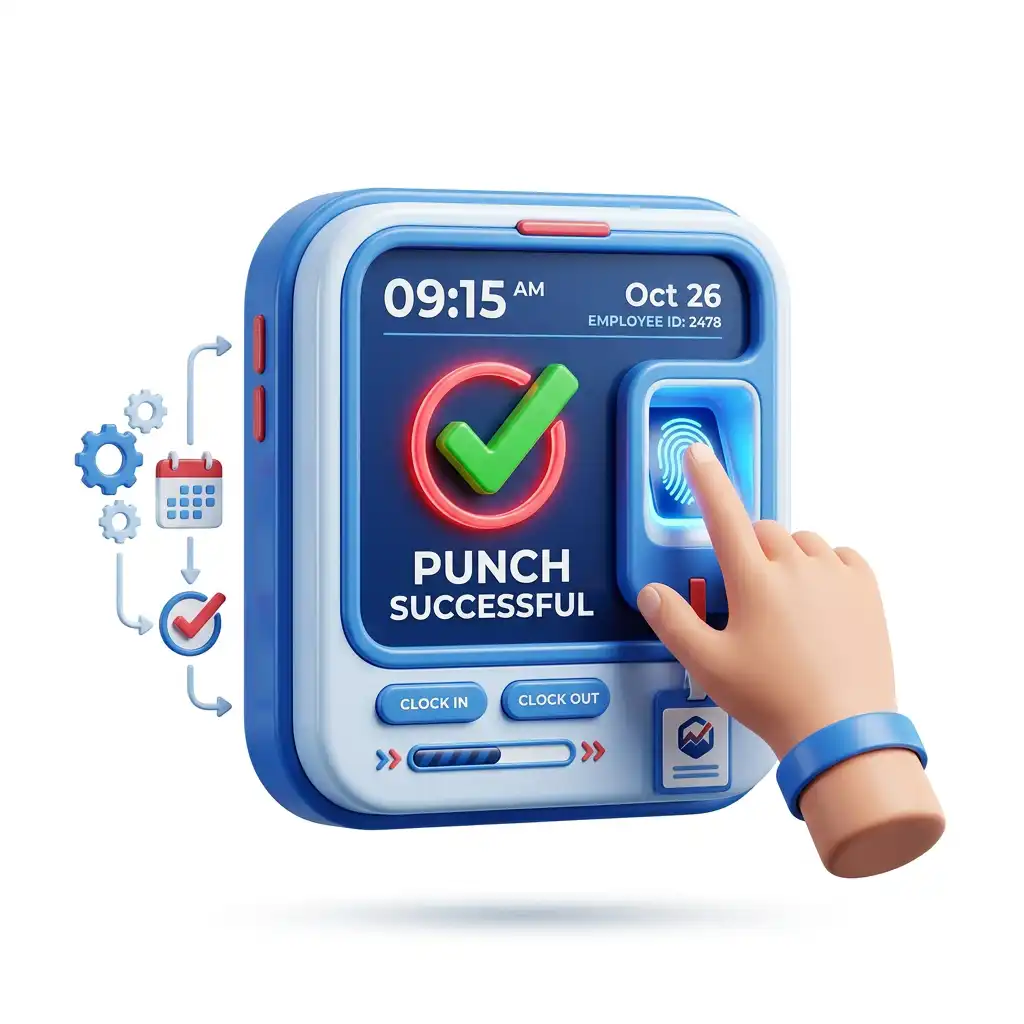

How to Prevent Missed Punches
Missed punches are more than a time clock nuisance. Each missing clock-in, clock-out, break punch, or job transfer forces payroll to reconstruct what actually happened after the fact. The fix is not a harsher memo. It is a better operating system: clear rules, easier punch options, schedule-aware reminders, same-day corrections, manager review, and payroll-ready audit trails.
The Short Answer
To prevent missed punches, make time capture easy at the point of work, connect punches to schedules, send shift and break reminders, alert managers while the shift is still fresh, require employee-visible correction requests, and close payroll only after exceptions are approved. A missed-punch policy should never become a way to erase compensable work time.
Contents
Why Missed Punches Create So Much Payroll Risk
A missed punch looks small because it is only one missing timestamp. The operational problem is larger: payroll still has to know when work actually started, when it stopped, whether a meal period was taken, whether overtime was triggered, which department or job should absorb the cost, and whether the employee and manager agree with the correction.
Incomplete time records make actual hours harder to prove.
The U.S. Department of Labor's FLSA recordkeeping guidance says covered employers must keep accurate records that include hours worked each day and total hours worked each workweek. The DOL also notes that employers may use different timekeeping methods, but the plan must be complete and accurate.
That means missed punches should be treated as exceptions that need evidence and approval, not as harmless blanks to clean up later.
Wrong time data travels downstream.
One missed clock-out can turn into an overtime miscalculation. One missed meal punch can turn into a paid-break, unpaid-meal, premium-pay, or state-law issue. One missing job transfer can misstate labor cost by project, grant, department, location, or customer.
The late-stage cost is not only the correction. It is the investigation, approval chase, manual edit, re-opened pay run, employee question, and manager time spent reconstructing a shift from memory.
Important principle: pay and discipline are separate.
If a non-exempt employee worked, the missed punch should be corrected to the best available record of actual compensable time. If the employee repeatedly ignores the timekeeping process, coach or discipline the behavior separately. Do not make the correction process a shortcut for docking worked time.
That distinction matters because the DOL's hours-worked guidance explains that work not requested but allowed to be performed can still be compensable work time. Its remote-work guidance also emphasizes reasonable processes for employees to report unscheduled or uncompensated time, while warning that a formal process will not help if accurate reporting is discouraged in practice.
What Counts as a Missed Punch?
Many teams only count a missed punch when an employee forgets to clock in or out. That is too narrow. A modern missed-punch program should track every timekeeping event that payroll, compliance, scheduling, or job costing needs but did not receive cleanly.
| Exception type | What it looks like | Why it matters | Best prevention control |
|---|---|---|---|
| Missed clock-in | Employee starts work but has no starting timestamp. | Payroll cannot verify actual start time, lateness, shift premium eligibility, or overtime exposure. | Shift reminders, kiosk placement, mobile clock-in, schedule-to-punch alerts. |
| Missed clock-out | Employee leaves work with an open shift. | Open shifts can inflate time, hide early departures, block payroll, or require manual estimation. | End-of-shift reminders, open-shift alerts, manager same-day review. |
| Missed meal or break punch | Meal period is missing, too short, interrupted, or recorded out of sequence. | Meal and rest rules vary by jurisdiction, and unpaid meal periods generally require the employee to be relieved from duty. | Break reminders, attestation, exception reason codes, meal-period approval rules. |
| Missed job, task, or department transfer | Employee worked but did not change cost center, job, grant, project, or location. | Payroll may be correct while job costing, billing, project margin, or grant reporting is wrong. | Required job selection, QR code or location reminders, supervisor review by assignment. |
| Out-of-sequence punch | Clock-out before clock-in, duplicate punches, break return without break start, or overlapping shifts. | Systems may calculate impossible timecards or force payroll staff into manual interpretation. | Real-time validation, guided punch buttons, exception dashboard. |
| Offline or failed sync punch | Employee punched on a device but the record did not reach the central system before review. | Managers may think the employee forgot, while payroll is waiting on a delayed device sync. | Offline-capable mobile or tablet clock, sync status monitoring, backup correction flow. |
Find the Root Cause Before You Blame the Employee
Missed punches are often a system design problem wearing an employee-behavior costume. If the punch clock is far from the worksite, the login flow is slow, the employee starts in the field, or managers are correcting timecards days later, the company has created conditions where missed punches are predictable.
The clock is not where work starts.
Retail back rooms, hospital units, construction sites, manufacturing lines, delivery routes, and remote workdays all create different punch moments. A single office kiosk may be fine for headquarters and terrible for field teams.
The schedule and reality drift apart.
Employees switch shifts, come in early, stay late, pick up call-ins, work at another location, or cover a different job. If the schedule does not update, reminders and approvals point at the wrong time.
Meal and break rules are unclear.
Employees may not know whether to punch for paid rest periods, unpaid meals, on-duty meals, interrupted meals, travel between jobs, or short breaks. Unclear break rules create timecard cleanup later.
Corrections sit until payroll closes.
If managers only review timecards every other Friday, payroll becomes a detective agency. Same-day review turns fuzzy memories into verified records.
Employees fear reporting actual time.
If corrections are treated as accusations, employees may delay reporting them. If overtime is informally discouraged, employees may fail to report late work. A good policy makes accurate reporting safe and expected.
Payroll, scheduling, and attendance do not agree.
Manual exports and separate tools make exceptions harder to see. The best process compares scheduled, punched, approved, and paid time in one workflow.
The Missed-Punch Prevention Stack
Prevention works best as layered control. One reminder will not solve a messy process. One policy will not fix a hard-to-reach clock. One biometric device will not fix late manager approvals. Use a full stack that covers behavior, access, alerts, corrections, and payroll cutoff discipline.
| Layer | Purpose | What good looks like | Common mistake |
|---|---|---|---|
| Policy | Define when employees punch, what to do if they forget, and who approves corrections. | Simple, visible, and specific by role, location, meal period, job transfer, and remote-work scenario. | A punitive policy that says "no punch, no pay" instead of requiring actual time correction. |
| Punch access | Make the correct action easy at the moment work starts or stops. | Kiosk, browser, mobile, tablet, offline support, and controlled location options based on job type. | A single terminal that causes lines, late punches, or work-before-clock-in behavior. |
| Schedule-aware reminders | Nudge employees before missing a start, end, meal, or break event. | Reminders based on the current schedule, role, location, and expected break window. | Generic reminders that fire at the wrong time because the schedule is stale. |
| Real-time exception alerts | Notify managers while the employee is still nearby and the facts are fresh. | Open shifts, late arrivals, missed meals, out-of-sequence punches, and no-show risks appear daily. | Payroll discovers the problem only after the pay period closes. |
| Employee correction request | Capture the employee's actual start, stop, break, location, job, and reason. | Employee can request the correction, manager can approve it, and the audit trail stays with the timecard. | Payroll edits timecards from chat messages, memory, or schedule assumptions. |
| Payroll lock | Stop unresolved exceptions from flowing into payroll. | Every missing punch is approved, rejected with documentation, or escalated before payroll finalizes. | Payroll processes first and cleans up after employees complain. |
The Daily Workflow That Prevents Payroll-Close Chaos
The best missed-punch process does not wait for payroll week. It starts before the shift, catches exceptions during the day, and gives managers a short review routine that protects payroll from becoming a last-minute scramble.
Before the shift
Publish the current schedule, confirm location and job assignment, and send a reminder if the employee is scheduled to work. Make sure shift swaps and call-ins update the system before reminders fire.
At shift start
Give the employee a punch method that matches the workplace: kiosk, browser, tablet, mobile app, biometric, or offline-capable device. If the employee is late or absent, alert the manager quickly.
During meals and transfers
Remind employees about meal periods, returns from meal, job transfers, department changes, or location changes when those events affect pay, compliance, reporting, or cost allocation.
At shift end
Remind employees to clock out. If a shift remains open, notify the employee and manager while both can still confirm what happened.
Same day manager review
Managers review exceptions by employee, location, and issue type. They verify actual hours, approve corrections, add notes, and escalate patterns that point to training or system design problems.
Payroll pre-close
Payroll checks that all missing punches, break exceptions, overtime approvals, and correction requests are resolved before importing or processing the pay run.
Do not build the workflow around scheduled time alone.
For fixed schedules, the DOL allows employers to record that the employee followed the schedule when the employee actually did so, but exceptions must reflect the number of hours actually worked. A missed-punch workflow should verify reality, not automatically force every timecard back to the shift template.
A Missed-Punch Policy Employees Can Actually Follow
A missed-punch policy should be short enough to remember and specific enough to use. The purpose is to protect accurate pay, clean records, and consistent operations. It should not scare employees away from reporting worked time.
Sample missed-punch policy language
Employees are responsible for recording their actual work time using the approved timekeeping method at the start and end of each shift, meal period, and required job or department transfer. If a punch is missed, incorrect, delayed, duplicated, or entered under the wrong job, the employee must submit a correction request as soon as possible, preferably before leaving the worksite or by the end of the same workday.
The correction request should include the actual start or stop time, meal or break details if applicable, job or location worked, reason for the correction, and any relevant supervisor context. Managers must review correction requests quickly, verify the best available facts, approve or return the request with a clear note, and ensure the timecard reflects actual compensable time.
Repeated missed punches may result in coaching or discipline under company policy. However, corrective action for failing to follow the timekeeping process is separate from the company's obligation to record and pay for compensable work time.
Policy details that reduce confusion
- Approved punch methods by role and location.
- When employees must punch for meals, breaks, transfers, travel, call-ins, remote work, and on-call work.
- How quickly employees should submit missed-punch corrections.
- What information the correction request must include.
- Who approves corrections and when payroll escalates unresolved exceptions.
- How repeated missed punches are coached, documented, and separated from pay correction.
Policy language that creates risk
- "No punch, no pay."
- "If you forget to clock in, we will use your scheduled time."
- "Unauthorized overtime will not be paid."
- "Managers may edit timecards without employee confirmation."
- "Meal breaks are automatically deducted unless payroll hears otherwise."
- "Employees are responsible for missed punches, so payroll does not need to review them."
Use Technology to Make the Correct Punch the Easy Punch
Technology should remove friction, not add surveillance theater. The right setup depends on how people actually work: on-site, mobile, remote, multi-location, union, construction, healthcare, retail, manufacturing, professional services, or a mix of all of them.
Mobile time clocks and geofencing
For field crews, remote staff, delivery routes, service technicians, and multi-site teams, a mobile clock can prevent missed punches by letting employees clock in where work begins. Geofencing and GPS-enabled controls can help confirm that the punch happened at an authorized work location.
Use location controls as guardrails: clear worksite boundaries, visible employee expectations, and a correction process for bad signal, jobsite movement, or approved exceptions.
Biometric, facial recognition, photo, and kiosk options
Shared worksites often need a fast and reliable punch method near the entrance, department, or production area. Biometric or photo-supported clocks can reduce buddy punching, while kiosk or tablet clocks reduce device requirements for hourly teams.
Before using biometric or photo features, review applicable privacy, notice, consent, retention, and collective bargaining requirements for your jurisdiction and workforce.
Offline-capable punching
Offline support matters when employees work in basements, industrial sites, remote fields, warehouses, construction trailers, or low-connectivity areas. The employee should be able to record the punch at the right time, then sync when the device reconnects.
Real-time alerts and employee self-service
Reminders and alerts are most useful when they are timely and specific: "You are scheduled at 8:00," "Your shift is still open," "Your meal period has not been recorded," or "Your timecard has a correction request waiting." Employee self-service lets the person closest to the facts initiate the fix.
Rounding and grace periods need extra care.
Federal regulation permits certain rounding practices when they average out over time and do not underpay employees for hours actually worked. That does not make every grace period safe. Check state, provincial, contract, and industry requirements before using rounding, automatic deductions, or schedule defaults as missed-punch shortcuts.
The Manager Playbook: 10 Minutes a Day
Managers prevent payroll chaos by reviewing exceptions while the shift is still recent. The habit does not need to be complicated. A daily 10-minute review can resolve most missed punches before payroll ever sees them.
| Review item | Manager question | What to document | Escalate when |
|---|---|---|---|
| Open shifts | Did the employee forget to clock out, keep working, or leave early? | Actual stop time, who verified it, and whether any work happened after the expected end. | Open shifts repeat, stop times are disputed, or after-hours work is being ignored. |
| No clock-in | Did the employee start work, arrive late, swap shifts, work remotely, or miss the shift? | Actual start time, location, schedule change, and reason code. | A location, department, or supervisor has repeated clock-in failures. |
| Meal exception | Was the employee fully relieved, interrupted, required to remain on duty, or unable to take the meal? | Meal start, meal end, interruption details, and required premium or pay treatment if applicable. | Meal problems cluster around staffing levels, coverage gaps, or customer demand peaks. |
| Job or department mismatch | Which project, customer, location, grant, cost center, or department received the work? | Correct allocation, transfer time, and approving supervisor. | Incorrect allocation affects billing, grants, project margin, or certified payroll. |
| Repeated missed punches | Is this a training issue, access issue, schedule issue, device issue, or behavior issue? | Pattern, coaching provided, system barrier identified, and follow-up date. | The pattern continues after training or points to policy avoidance. |
Approve with evidence.
Use the employee correction request, schedule, location, supervisor observation, job assignment, access logs, and employee attestation to record the best available actual time.
Do not batch-edit from memory.
Payroll-week batch edits often turn one small timekeeping miss into a larger audit trail problem. If every correction says "forgot punch" with no actual-time detail, the workflow is not mature enough.
Metrics That Show Whether Missed Punches Are Improving
Do not track only the total number of missed punches. A bigger company or busier season will naturally create more punches. Use ratios, aging, correction speed, and pattern analysis so the data points to fixable causes.
Normalizes missed punches across departments, locations, and seasons.
(missed punches / scheduled shifts) x 100Shows whether employees and managers are fixing exceptions while facts are fresh.
same-day corrections / total correctionsMeasures how long payroll-blocking items sit unresolved.
average hours from exception to approvalDistinguishes one-off mistakes from training, access, or behavior patterns.
employees with 2+ misses / employees with any missIdentifies supervisors who need a clearer daily review routine.
approval timestamp - request timestampCompares employee self-service, manager edits, payroll edits, and system-generated exceptions.
corrections by source / total correctionsUse metrics to improve the system, not just to find fault.
If one department has a high missed-punch rate, ask why. Is the clock too far away? Are shift swaps not entered? Are employees starting with a pre-shift huddle before clocking in? Are meal periods interrupted? The metric is the smoke; the workflow review finds the fire.
A 30-Day Plan to Reduce Missed Punches
Trying to fix missed punches everywhere at once usually turns into a policy memo and a temporary improvement. A better rollout makes a visible process change, proves it in the highest-risk areas, and then turns it into routine management discipline.
| Timeline | Work to do | Deliverable | Success signal |
|---|---|---|---|
| Days 1-3 | Export missed-punch data by location, department, manager, role, shift type, and exception type. | Root-cause heatmap and top three problem scenarios. | You know whether the issue is access, schedule, break rules, manager delay, or repeat behavior. |
| Days 4-7 | Rewrite the policy into plain language and map correction approval responsibility. | Employee policy, manager checklist, payroll cutoff rule. | Employees know how to report a miss without guessing or hiding it. |
| Week 2 | Fix punch access and reminders for the highest-risk groups. | Mobile, kiosk, biometric, geofence, offline, or schedule-reminder configuration by role. | The right punch method is available where work actually starts and stops. |
| Week 3 | Train managers on same-day exception review and require daily approval habits. | Daily dashboard review routine and escalation path. | Average exception age drops and fewer unresolved items reach payroll. |
| Week 4 | Measure missed punches per 100 shifts, same-day correction rate, and repeat employee patterns. | Baseline dashboard and next-month improvement targets. | Leaders see which fixes worked and which locations need deeper process redesign. |
Industry-Specific Missed-Punch Fixes
The same policy will not fit every work environment. Use the same core principles, but adapt the punch method, reminders, and review triggers to the way work actually happens.
Prevent line-of-sight and rush-period misses.
Put clocks near the real employee entrance, remind employees before meal breaks, flag open shifts before closing, and review minors, meal periods, split shifts, and role transfers carefully where applicable.
Watch handoffs, missed meals, and interrupted breaks.
Use department-specific review, require meal attestations where appropriate, and look for patterns where staffing pressure causes repeated missed or interrupted meal periods.
Bring the clock to the jobsite.
Use mobile, geofence, offline, and job-costing reminders so start time, stop time, job, task, location, and crew assignment are captured at the point of work.
Reduce terminal bottlenecks.
Place devices where shifts actually begin, review pre-shift meetings and gear-up practices, and monitor departments where clock lines create late or rounded punches.
Create a reasonable reporting process.
Use browser or mobile punching, clear rules for unscheduled work, and employee self-service corrections so remote employees can report actual hours without digging through chat threads later.
Capture both time and allocation.
Time may be paid correctly while project margin is wrong. Require job, client, grant, task, or department transfer details when missed punches affect costing or billing.
How TimeTrex Helps Prevent Missed Punches
TimeTrex brings scheduling, time and attendance, mobile punching, biometric time clocks, geofencing, reporting, approvals, and payroll together so missed punches can be prevented, detected, corrected, approved, and paid from one connected workforce management workflow.
Employees can record time through browser-based, mobile, and biometric/facial recognition time clock options, which helps match the clocking method to the work environment.
TimeTrex supports location-aware controls that help verify employees are clocking in and out from authorized work locations when that is appropriate for the role.
When schedules and attendance live together, managers can compare who was expected, who punched, who missed a punch, and which shifts need attention before payroll closes.
Because TimeTrex handles scheduling, attendance, and payroll workflows, approved time data can move into payroll with fewer manual handoffs and fewer spreadsheet repairs.
Real-time reporting and customizable workforce reports help managers spot missed punches, late clock-ins, open shifts, overtime issues, and recurring attendance patterns.
Employees can see schedules, time off, and workforce information from connected devices, making it easier to catch and correct problems before they become payroll disputes.
Missed Punch FAQ
These answers are general workforce management guidance, not legal advice. Always confirm requirements for your jurisdiction, contracts, industry, and workforce.
Can an employer refuse to pay because an employee forgot to punch?
No. If the employee performed compensable work, the time should be recorded and paid according to applicable law. The employer can address repeated failure to follow the timekeeping process through coaching or discipline, but pay correction and discipline should be separate.
Should payroll use scheduled time when a punch is missing?
Only if the scheduled time accurately reflects what actually happened. A fixed schedule can be a useful starting point, but exceptions must capture actual hours worked. The safest workflow asks the employee and manager to verify the real start, stop, meal, and transfer details.
Are time clock rounding and grace periods allowed?
Federal rules allow certain rounding practices when they are neutral over time and do not underpay employees for actual work. Some jurisdictions, contracts, or industries may be stricter. Rounding should not be used to hide repeated missed punches or off-the-clock work.
What is the fastest way to reduce missed punches?
Start with the highest-volume miss: clock-in, clock-out, meal, transfer, or offline sync. Fix the access problem first, then add schedule-aware reminders and same-day manager review. The fastest improvement usually comes from removing friction where the punch is supposed to happen.
How soon should a missed punch be corrected?
Same day is best. If that is not realistic, require correction before payroll pre-close. Waiting until payroll is processed increases the chance of memory errors, employee disputes, manual adjustments, and late pay corrections.
Do mobile clocks and geofencing eliminate missed punches?
They can reduce missed punches by making clocking easier for mobile and field teams, but they are not a full policy by themselves. You still need clear rules, reminders, correction requests, manager approvals, privacy review, and payroll exception checks.
Should employees be able to edit their own timecards?
Employees should be able to request corrections and see their timecard. Approval should follow the company's workflow, usually through a manager or payroll review. That balance creates transparency without allowing unreviewed edits to flow directly into payroll.
What should a missed-punch correction include?
At minimum, capture the actual start or stop time, the date, location, job or department if relevant, meal or break details if applicable, reason for the miss, employee attestation, manager approval, approval timestamp, and notes supporting the correction.
Sources and Further Reading
This guide uses official wage-and-hour sources for recordkeeping and hours-worked principles, plus TimeTrex product resources for workforce management capabilities.
Disclaimer: The content provided on this webpage is for informational purposes only and is not intended to be a substitute for professional advice. While we strive to ensure the accuracy and timeliness of the information presented here, the details may change over time or vary in different jurisdictions. Therefore, we do not guarantee the completeness, reliability, or absolute accuracy of this information. The information on this page should not be used as a basis for making legal, financial, or any other key decisions. We strongly advise consulting with a qualified professional or expert in the relevant field for specific advice, guidance, or services. By using this webpage, you acknowledge that the information is offered “as is” and that we are not liable for any errors, omissions, or inaccuracies in the content, nor for any actions taken based on the information provided. We shall not be held liable for any direct, indirect, incidental, consequential, or punitive damages arising out of your access to, use of, or reliance on any content on this page.
About The Author

Roger Wood
With a Baccalaureate of Science and advanced studies in business, Roger has successfully managed businesses across five continents. His extensive global experience and strategic insights contribute significantly to the success of TimeTrex. His expertise and dedication ensure we deliver top-notch solutions to our clients around the world.
Time To Clock-In
Start your 30-day free trial!
Experience the Ultimate Workforce Solution and Revolutionize Your Business Today
- Eliminate Errors
- Simple & Easy To Use
- Real-time Reporting

Saving businesses time and money through better workforce management since 2003.
Copyright © 2026 TimeTrex. All Rights Reserved.