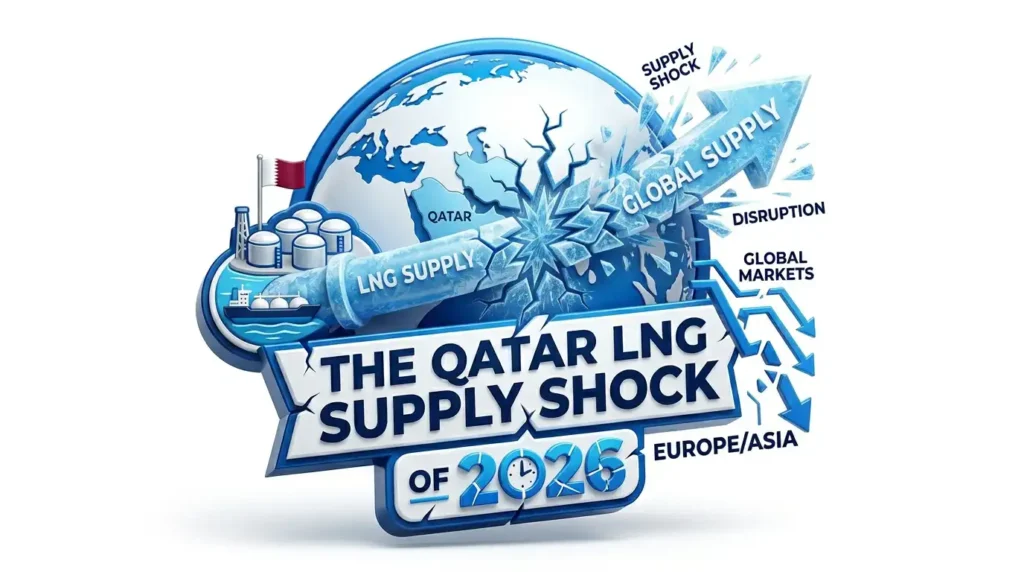

The Qatar LNG Supply Shock of 2026: Infrastructure, Disruption, and Global Market Realignment
TL;DR: In March 2026, severe kinetic drone strikes on Qatar's Ras Laffan complex incapacitated 17% of global Liquefied Natural Gas (LNG) export capacity. Coupled with a maritime blockade of the Strait of Hormuz, this unprecedented disruption ignited a global energy crisis. Asian and European markets are locked in ruthless bidding wars, sending benchmark prices soaring and threatening widespread deindustrialization and agricultural shortages. This crisis underscores the immense systemic risk of hyper-concentrated global energy infrastructure and permanently redefines how sovereign nations view supply chain redundancy.
Table of Contents
- Introduction
- The Architecture of Qatari LNG Dominance
- The March 2026 Escalation: Infrastructure Degradation and Blockade
- Global Market Contagion and Pricing Dynamics
- Asymmetrical Economic Ruin: Regional Impact Analysis
- Systemic Realignments: Second and Third-Order Geoeconomic Consequences
- Conclusion
Introduction
The global energy architecture rests upon a foundation of highly centralized production hubs and narrow maritime chokepoints, representing an optimization of geography and engineering that historically prioritized economies of scale over systemic redundancy. For the past two decades, liquefied natural gas (LNG) has served as the critical balancing mechanism for global energy security, offering a flexible, seaborne alternative to the rigid, geoeconomically fraught pipeline networks that once dominated continental energy trade. At the absolute epicenter of this globalized gas market is the State of Qatar, a nation that has leveraged its immense domestic hydrocarbon reserves to establish itself as the world's preeminent swing supplier of LNG.
However, the unprecedented military escalation in the Persian Gulf in March 2026, culminating in direct, kinetic drone strikes on Qatar's primary liquefaction infrastructure and the effective maritime blockade of the Strait of Hormuz, has shattered the illusion of supply chain invulnerability.
The removal of approximately one-fifth of the world's LNG export capacity overnight has triggered an energy crisis of historic proportions, eclipsing even the severe market volatility witnessed during the 2022 Russian invasion of Ukraine. With global natural gas markets already operating at the very margins of their nameplate capacities, the sudden and prolonged removal of Qatari volumes has initiated a fierce, zero-sum bidding war between Asian and European importers, fundamentally altering global trade flows and pricing structures. The ramifications of this disruption extend far beyond the immediate pricing dynamics of benchmark trading hubs; they are rapidly cascading through industrial supply chains, forcing emergency fuel rationing across developing nations, threatening agricultural outputs via widespread fertilizer shortages, and accelerating the potential deindustrialization of structurally vulnerable economies in Europe and East Asia.
The Architecture of Qatari LNG Dominance
To fully comprehend the systemic shock delivered to the global economy in March 2026, it is imperative to deconstruct the hyper-centralized nature of Qatar's LNG infrastructure. The nation's energy strategy has been meticulously engineered over decades to maximize output from a single, contiguous geological formation, process that output through an unprecedentedly large industrial complex, and deliver it to global markets via a bespoke fleet of maritime leviathans.
Upstream Extraction: The Geology and Engineering of the North Field
The foundation of Qatar's outsized influence within the global macroeconomic landscape is rooted in the unique geological endowments of the North Field. Geographically straddling the maritime boundary with the Islamic Republic of Iran, where it is contiguous with the South Pars formation, the North Field represents the single largest non-associated natural gas reservoir on the planet. Current geological surveys and proven reserve estimates place the recoverable volume at approximately 24 to 25 trillion cubic meters, equivalent to roughly 850 to 900 trillion cubic feet. The biochemical composition of this reservoir is particularly advantageous for commercial exploitation; it yields a lean gas characterized by a low concentration of natural gas liquids and a moderate carbon dioxide profile, factors that significantly reduce the capital expenditure required for upstream processing and separation facilities before the liquefaction phase.
Extraction operations are heavily concentrated in the offshore domains of the Persian Gulf. QatarEnergy LNG operates a sophisticated, sprawling network of offshore infrastructure, including numerous wellhead platforms that supply gas and condensate from dozens of offshore wells. A typical sub-cluster within this offshore network possesses an immense production capacity of 1.2 billion standard cubic feet per day (bscfd), drawing from approximately 15 integrated offshore wells. The raw hydrocarbons extracted from the subterranean reservoir undergo primary dehydration directly on the offshore platforms. This initial treatment removes water vapor to prevent the formation of methane hydrates, ice-like structures that can catastrophically block pipelines, during transit. Following this dehydration, the gas and condensate are transported simultaneously onshore via a massive 32-inch diameter, 92-kilometer subsea export pipeline designed to handle extreme operational pressures.
Midstream Liquefaction: The Thermodynamics of Ras Laffan
The transformation of raw natural gas into a tradable, seaborne commodity occurs at Ras Laffan Industrial City, the beating heart of Qatar's energy sector and universally recognized as the world's largest contiguous LNG production complex. Prior to the disruptions, Ras Laffan housed 14 fully operational liquefaction trains, possessing a combined nameplate capacity of 77 million tonnes per annum (Mtpa). In 2023, high utilization rates allowed Qatar to export between 78 and 82 million tonnes, capturing an estimated 18% to 20% of the entire global LNG trade.
Pre-Strike Global LNG Export Market Share
Before the attack, Qatar commanded a massive share of the global LNG market, matching outputs from the United States and Australia.
Lost Capacity
77 MTPAEntire Ras Laffan complex operations suspended.
Missing Market Share
~21%Over one-fifth of global baseload supply removed.
The liquefaction process itself is an exercise in extreme thermodynamics and precision engineering. Natural gas must be systematically cooled to approximately -162°C (-260°F), a cryogenic state where its volume is reduced by a factor of 600, enabling economically viable maritime transport. This cryogenic transformation is achieved primarily within the Main Cryogenic Heat Exchanger (MCHE), universally recognized by chemical engineers as the critical bottleneck and the "heart" of any LNG facility. Within Ras Laffan's specific train architectures, the facilities utilize Spiral Wound Heat Exchangers (SWHE). These are towering vertical pressure vessels containing thousands of kilometers of meticulously wound aluminum tubing, allowing for massive surface-area contact between the feed gas and the refrigerants.
The cooling process relies on highly complex, multi-stage refrigeration cycles utilizing advanced thermodynamic loops, such as the proprietary APCI-X technology. In these systems, light coolants, a proprietary, finely tuned mixture of methane, ethane, and nitrogen, chill the natural gas stream to the point of liquefaction within the MCHE's cold bundle. The precise pressure reduction required for this cooling cascade is managed by highly specialized Joule-Thomson (JT) control valves. These valves leverage the Joule-Thomson effect to drop temperatures via rapid pressure expansion and must operate flawlessly under extreme severe-service cryogenic conditions. Driving this entire process requires immense mechanical power, with the overall compression cycle demanding upwards of 200,000 horsepower delivered by massive Frame 7 industrial gas turbines.
Before the kinetic strikes of 2026, QatarEnergy was aggressively executing a multi-billion-dollar expansion strategy designed to permanently widen its global lead over competitors in the United States and Australia.
| Facility / Project Phase | Component Breakdown | Nameplate Capacity Additions | Target Completion Timeline |
|---|---|---|---|
| Ras Laffan (Historical) | 14 Operational Trains | 77 Mtpa | Pre-2026 (Operational) |
| North Field East (NFE) | 4 Mega-Trains | +32 Mtpa | 2026–2027 |
| North Field South (NFS) | 2 Mega-Trains | +16 Mtpa | 2027–2028 |
| Additional Increment | Planned Expansion | +16 Mtpa | ~2030 |
| Projected Total Capacity | Integrated Complex | ~142 Mtpa | 2030 |
Downstream Logistics: The Q-Fleet and the Geographic Trap of Hormuz
The final pillar of Qatar's LNG hegemony is its highly specialized logistical fleet and its total, inescapable reliance on the maritime chokepoint of the Strait of Hormuz. To maximize the economic efficiency of long-haul voyages to key Asian and European consumer markets, Qatar spearheaded the engineering and deployment of the world's largest LNG carriers: the Q-Flex and Q-Max vessel classes.
These vessels represent a fundamental paradigm shift in commercial naval architecture. While standard conventional LNG carriers maintain cargo capacities of approximately 150,000 cubic meters, the Q-Flex class boasts capacities ranging between 165,000 and 216,000 cubic meters. The even larger Q-Max class reaches an unprecedented 266,000 cubic meters of cargo capacity, measuring a staggering 345 meters in length and 53.8 meters in beam.
However, the entirety of this sophisticated, multi-billion-dollar supply chain is entirely captive to the physical geography of the Persian Gulf. Every molecule of Qatari LNG must transit the Strait of Hormuz, a narrow, highly contestable waterway connecting the Persian Gulf to the Gulf of Oman and the broader Indian Ocean. Unlike Saudi Arabia and the United Arab Emirates, which have invested heavily over decades in crude oil bypass pipelines, such as the East-West Crude Pipeline, there is absolutely no alternative pipeline infrastructure capable of transporting Qatari natural gas to external liquefaction facilities or directly to end-users. The Strait of Hormuz is the single point of failure for 20% of the global LNG trade.
The March 2026 Escalation: Infrastructure Degradation and Blockade
The theoretical vulnerabilities of Qatar's hyper-centralized infrastructure materialized with devastating precision in early March 2026. As the broader kinetic conflict involving the United States, Israel, and Iran escalated into an unrestricted regional energy war, the long-held paradigm of the Persian Gulf as a secure, inviolable guarantor of global energy supply completely fractured.
Tactical Strikes on Ras Laffan and Long-Term Force Majeure
On March 2, 2026, a massive barrage of Iranian drone and missile strikes specifically targeted critical downstream processing and export infrastructure across the Gulf. The primary target was the massive Ras Laffan Industrial City and the adjacent Mesaieed industrial complexes in Qatar. These strikes marked a profound qualitative escalation in geopolitical warfare; rather than merely harassing maritime traffic or intercepting individual tankers, hostile actors directly targeted the core, highly fragile hard infrastructure responsible for global baseline supply.
Severed Arteries: The Infrastructure Failure
The efficiency of Qatar's operation relied on a highly concentrated localized infrastructure. Yesterday's drone strikes targeted the core cooling trains, turning this hyper-centralization into a catastrophic single point of failure.
1. Extraction
North Field Offshore Rigs. Operations suspended due to downstream blockage.
2. Liquefaction
Ras Laffan Mega-Plant. Critical damage sustained to main liquefaction trains.
3. Transit
Q-Fleet Megaships. Dozens of vessels stranded at port or returning empty.
4. Regasification
Destination Terminals. Facing immediate cargo cancellations and shortages.
The immediate operational result was an emergency, total suspension of operations. The entire 77 Mtpa capacity at Ras Laffan was forcibly taken offline to assess damages and prevent cascading industrial accidents, removing roughly 20% of the world's total LNG supply from the market. Furthermore, the physical damage extended well beyond natural gas, halting the vital downstream production of associated energy products including liquefied petroleum gases (LPG), naphtha, diesel, polymers, methanol, and aluminum.
According to public statements from QatarEnergy executives, two of the complex's fourteen primary LNG trains, along with one of its two vital gas-to-liquids (GTL) facilities, sustained direct explosive damage. Because the Main Cryogenic Heat Exchangers, SWHE tubing bundles, and bespoke Frame 7 compression trains cannot be rapidly sourced from global inventories or patched on-site, the structural damage permanently sidelined an estimated 12.8 million tons per year of LNG capacity. The projected engineering and fabrication repair timeline stretches from three to five years.
Faced with massive, multi-year production constraints and the physical inability to process feed gas, QatarEnergy formally declared force majeure on March 4. This vital legal threshold in international energy commerce officially shields the supplier from crippling financial penalties for failing to fulfill rigid contractual delivery obligations due to unforeseeable and unavoidable catastrophic events.
The Strait of Hormuz Maritime Blockade and Insurance Crisis
Compounding the physical destruction of the liquefaction trains was the simultaneous logistical paralysis of the Strait of Hormuz. The waterway, which typically facilitates the transit of 20 million barrels per day of crude oil alongside its massive LNG flows, became virtually impassable to commercial shipping due to the explicit threat of military interception and collateral damage.
The global maritime insurance market, which functionally dictates the viability of global shipping far faster than naval interventions can clear waterways, delivered an immediate, prohibitive verdict. War-risk premiums for vessels attempting the Hormuz transit quadrupled overnight. Insuring a single supertanker or Q-Max voyage skyrocketed to between $2 million and $3 million per transit, with many primary maritime underwriters in London and Europe refusing to write coverage entirely.
This logistical collapse effectively turned a massive physical supply shock into an absolute maritime blockade, stranding millions of tonnes of energy commodities on the water and paralyzing the global supply chain.
Global Market Contagion and Pricing Dynamics
The instantaneous, dual-shock removal of Qatar's immense export volumes and the transit blockade ignited a ferocious, unprecedented reaction across global commodity exchanges. Because natural gas demand exhibits exceptionally high short-term price inelasticity, national utilities and heavy industries cannot instantly redesign their energy matrices or build new infrastructure, the massive supply deficit manifested strictly through exponential, punitive price surges. The global market lost approximately 1.5 million tons of LNG supply each week.
The Price Surge in Europe and Asia
Within days of the kinetic drone strikes and the formal force majeure declaration, European and Asian benchmark pricing indices shattered historical resistance levels. The Dutch Title Transfer Facility (TTF), Europe's primary natural gas pricing hub, surged dramatically. Prompt month contracts jumped between 70% and 100%, escalating rapidly from pre-crisis levels of roughly €30/MWh to a sustained €50-€60/MWh range, eventually peaking near €70/MWh (approximately $24/MMBtu).
Economic Fallout: Unprecedented Price Spikes
Real-time tracking of TTF and JKM prices ($/MMBtu) reflecting the immediate market panic following the Ras Laffan attack.
The financial panic was even more pronounced in the Asia-Pacific basin, which lacks the extensive pipeline interconnectivity of Europe. The Japan-Korea Marker (JKM), the primary proxy for spot LNG prices in Asia, spiked violently. May 2026 contracts increased by 96% over a matter of days, soaring to over $21.18/MMBtu, with prompt physical deliveries pushing the index past $25.39/MMBtu. Asian buyers, historically heavily reliant on steady, predictable Qatari long-term deliveries, were violently thrust into the spot market, forced to pay exorbitant premiums to redirect flexible Atlantic basin cargoes away from Europe merely to maintain grid stability.
The Inelasticity of Alternative Global Supplies
Market observers and policymakers immediately looked to the United States and Australia, the world's first and third-largest LNG exporters, to mitigate the deficit and act as global swing producers. However, the crisis brutally exposed the rigid physical limits of global liquefaction infrastructure. The global market was structurally and mathematically incapable of replacing 77 Mtpa of baseload supply on short notice.
The Supply Crisis: Immediate Deficit
The global energy balance has instantly shattered. Current reserves are being tapped rapidly to prevent grid failures, with zero short-term redundancy available worldwide.
Zero Redundancy
Global liquefaction operates at near max capacity. Rivals cannot ramp up production to replace 77 MTPA.
Industrial Rationing
Governments are drafting emergency protocols to cut power to heavy industry, prioritizing critical infrastructure.
The United States, possessing a massive export capacity of approximately 15.4 Bcf/d (billion cubic feet per day), was already operating at maximum, winter-level utilization prior to the strikes. While the U.S. is projected to add an estimated 13.9 Bcf/d of new capacity between 2025 and 2029 through major facilities, these mega-projects are bound by strict, inflexible commissioning schedules and massive construction timelines. They offer immense future relief, but absolutely no prompt salvation for the current crisis.
The situation in the Pacific basin offered no reprieve. Australia and Papua New Guinea historically operate their facilities at or near absolute nameplate capacity. Major regional producers possessed an estimated mere 1 to 2 tonnes of spare capacity that could be mobilized, a negligible statistical rounding error compared to the massive 12.8 mtpa structural Qatari shortfall.
Asymmetrical Economic Ruin: Regional Impact Analysis
The shockwaves of the March 2026 crisis propagated rapidly outward from the financial exchanges into the physical, real-world economy. The impacts were highly asymmetrical, dictated by a nation's historical reliance on Middle Eastern long-term contracts, domestic storage capacities, alternative fuel infrastructure, and baseline sovereign wealth.
The Collapse of Energy Security in South Asia
The most devastating economic damage unfolded rapidly across South Asia, where developing economies simply lacked the fiscal firepower to compete with Europe or wealthy East Asian nations in a ruthless spot-market bidding war. Pakistan represented the apex of systemic vulnerability, sourcing an astonishing 99% of its total LNG imports from Qatar and the UAE. The sudden disappearance of Gulf cargoes bypassed the financial markets and hit the physical electrical grid instantly, reviving the immediate threat of widespread, systemic power load-shedding.
Bangladesh faced a parallel, equally devastating economic crisis. Having relied heavily on Qatar and the UAE for 63% of its total LNG imports in 2025, the state energy corporation, Petrobangla, was forced to execute draconian demand destruction measures to prevent grid collapse. Daily gas supply cuts crippled domestic road transport logistics and paralyzed the nation's primary economic engine: the textile and ready-made garment industry.
India, though possessing a significantly more diversified energy portfolio, still imported nearly 30% of its natural gas from West Asia. The Ministry of Petroleum and Natural Gas executed emergency reprioritization protocols, strictly curtailing gas supplies to the vital domestic fertilizer sector down to just 70% of its past six-month average. To prevent widespread rolling blackouts, the Indian power ministry moved to invoke emergency measures forcing all imported coal-based power plants to operate at maximum generation capacity.
The East Asian Scramble and Industrial Vulnerability
East Asia, which historically absorbed upwards of 80% of all Qatari LNG exports, bore the massive volumetric brunt of the crisis. Four major East Asian economies, China, Japan, South Korea, and Taiwan, had heavily utilized long-term Sales and Purchase Agreements (SPAs) with QatarEnergy to guarantee supply security. The Qatari force majeure directly neutralized these agreements.
Stranded Volumes by Destination (MTPA)
Asia is heavily reliant on long-term contracts with Qatar to sustain their massive industrial bases. China, India, and South Korea are now facing severe deficits.
China's massive state-controlled energy apparatus, immense financial reserves, and highly diverse supply matrix allowed it to absorb the macroeconomic shock far more effectively than its neighbors. In stark contrast, South Korea, Taiwan, and Japan faced acute, existential threats to their industrial continuity. Gas supply in these advanced economies is almost entirely reliant on seaborne LNG, with zero cross-border pipeline alternatives. Governments implemented severe conservation measures, including reduced four-day workweeks for government sectors and mandated air conditioning limits.
European Energy Security and Deindustrialization Risks
While Europe's direct volumetric exposure to Qatari LNG was relatively small, its price exposure was total. The continent had spent the years following the 2022 Russian invasion of Ukraine systematically redesigning its energy grid, replacing cheap piped Russian gas with seaborne LNG. Europe entered the spring of 2026 in a highly vulnerable posture, with storage inventories sitting approximately 550 Bcf below the five-year average.
The astronomical surge in the TTF price threatened to trigger a new, aggressive wave of deindustrialization across the continent. Energy-intensive industries, such as chemicals, steel, metallurgy, and glass manufacturing, suddenly faced energy costs two to three times higher than their global competitors. The economic pain grew so acute that high-level political figures publicly broke cover to advocate for the abandonment of sanctions and the reestablishment of diplomatic ties with Russia to access cheap energy.
Systemic Realignments: Second and Third-Order Geoeconomic Consequences
The physical destruction at Ras Laffan and the Hormuz blockade represent a fundamental inflection point in the global energy transition. The events of March 2026 have forced sovereign governments and financial markets to recognize that operational efficiency and economies of scale can no longer be prioritized over national security and supply chain redundancy.
The Collapse of the Long-Term Contract and the Geopolitical Risk Premium
Historically, the global LNG market operated under the foundational assumption that long-term Sales and Purchase Agreements and strict destination clauses provided an ironclad guarantee of physical supply. The widespread invocation of force majeure by QatarEnergy, legally nullifying these obligations for up to five years, has permanently destroyed this foundational assumption.
In the future, long-term energy planning will invariably embed a permanent, highly elevated geopolitical risk premium directly into the pricing of all seaborne energy commodities. This new pricing paradigm shifts the balance of geoeconomic power firmly toward producers operating in geographically secure environments, particularly the United States, Canada, and Australia.
The Contagion to Global Food Security: The Fertilizer Crisis
The cascading effects on adjacent industries emphasize the broad, systemic threat of energy concentration. The global agricultural sector relies heavily on nitrogen-based fertilizers, specifically urea and ammonia, which are derived primarily from natural gas feedstock. The immediate shutdown of fertilizer plants in Bangladesh, the strict rationing of gas to fertilizer units in India, and the physical inability of Qatar to export Gulf-produced fertilizers have triggered massive agricultural inflation.
The Regression of the Global Climate Transition
Perhaps the most enduring long-term consequence of the Qatari LNG shock is the severe regression of global climate initiatives. Natural gas was universally positioned as the critical bridge fuel for developing economies to transition away from highly polluting coal generation. The sudden loss of affordable Qatari supply has forced a massive reversion to the dirtiest fossil fuels. Baseline energy security will systematically and immediately override decarbonization targets during periods of acute economic scarcity.
Conclusion
The March 2026 kinetic destruction of the QatarEnergy LNG facilities at Ras Laffan and the concurrent maritime blockade of the Strait of Hormuz represent a seminal, paradigm-shifting event in the history of global energy markets. The highly centralized Qatari LNG supply chain has proven to be the critical, fatal vulnerability of the modern global economy.
By abruptly removing 17% of Qatar's total export capacity for up to half a decade and trapping remaining regional volumes behind an impenetrable maritime blockade, the crisis has catalyzed a violent, highly destructive realignment of global trade. Ultimately, the Qatar LNG crisis proves unequivocally that the globalization of energy markets, driven purely by cost optimization, economies of scale, and just-in-time delivery, has reached its structural and geopolitical limit. In this new era, massive infrastructure redundancy will be prioritized over efficiency, and the geopolitical security of the supply route will be valued equally to the physical commodity itself.
Visualize the Global Supply Shift
Understand how the 2026 LNG shock impacts maritime trade routes and structural dependencies worldwide.
View the Global LNG Supply Chain Network MapDisclaimer: The content provided on this webpage is for informational purposes only and is not intended to be a substitute for professional advice. While we strive to ensure the accuracy and timeliness of the information presented here, the details may change over time or vary in different jurisdictions. Therefore, we do not guarantee the completeness, reliability, or absolute accuracy of this information. The information on this page should not be used as a basis for making legal, financial, or any other key decisions. We strongly advise consulting with a qualified professional or expert in the relevant field for specific advice, guidance, or services. By using this webpage, you acknowledge that the information is offered “as is” and that we are not liable for any errors, omissions, or inaccuracies in the content, nor for any actions taken based on the information provided. We shall not be held liable for any direct, indirect, incidental, consequential, or punitive damages arising out of your access to, use of, or reliance on any content on this page.
About The Author

Roger Wood
With a Baccalaureate of Science and advanced studies in business, Roger has successfully managed businesses across five continents. His extensive global experience and strategic insights contribute significantly to the success of TimeTrex. His expertise and dedication ensure we deliver top-notch solutions to our clients around the world.
Time To Clock-In
Start your 30-day free trial!
Experience the Ultimate Workforce Solution and Revolutionize Your Business Today
- Eliminate Errors
- Simple & Easy To Use
- Real-time Reporting

Saving businesses time and money through better workforce management since 2003.
Copyright © 2026 TimeTrex. All Rights Reserved.