

Navigating Employee Resistance to GPS & Biometric Time Clocks
Article Index
- The Evolution of Workforce Surveillance
- Anatomy of Resistance: Why Employees Push Back
- The Technical Solution: Architecture as Mitigation
- Legal Frameworks and Compliance as Selling Points
- Strategic Implementation: A Change Management Playbook
- Industry-Specific Mitigation Strategies
- Operational Best Practices and Configuration Guide
- The Role of Managerial Ethics
- Conclusion: The Trust Equation
The Evolution of Workforce Surveillance and the Crisis of Trust
From the Factory Whistle to the Digital Leash
To understand the intensity of modern resistance to GPS tracking, one must first contextualize the historical evolution of timekeeping. For over a century, the "clock-in" was a physical act performed at a specific location—the factory gate or the office entrance. This physical boundary created a clear psychological demarcation: inside the gate, time belonged to the employer; outside, it belonged to the individual. The transition to cloud-based, mobile-first WFM systems has dissolved this boundary. The smartphone, a device that serves as the repository of an individual’s personal life, is now also the mechanism of professional accountability.
This collapse of context is the primary driver of anxiety. When an employer demands the installation of a tracking app like TimeTrex on a personal device (BYOD), the distinction between professional monitoring and personal surveillance blurs. The historical precedent of "time theft" has been met with a technological counter-offensive that many employees perceive as disproportionate. The modern WFM system is not just a digital punch card; it is a sophisticated sensor array capable of capturing location, identity via biometrics, and device metadata.
The Psychology of the "Big Brother" Effect
The resistance to GPS tracking is deeply rooted in the psychological concept of the "panopticon"—the feeling of being constantly watched. Research indicates that this state functions as a mechanism of power, often leading to "performative compliance." Employees, aware of the monitoring, may alter their behavior not to be more productive, but to appear more compliant with the metrics they believe are being watched.
The introduction of GPS tracking is frequently interpreted by the workforce as a signal of managerial failure. In a high-trust environment, management focuses on outcomes. In contrast, the deployment of location tracking shifts the managerial focus to inputs: Was the employee at the site at 8:00 AM or 8:02 AM? This shift is often perceived as micromanagement in disguise. For experienced employees who have operated with autonomy, this regression feels like a professional demotion.
We exist in a "privacy paradox" where individuals readily share location data with commercial apps like Google Maps for convenience but react vehemently against sharing the same data with their employers. The fear is not just about the employer knowing the location, but about the misuse of that data to build a "pattern of life" analysis.
Anatomy of Resistance: Why Employees Push Back
Resistance is rarely monolithic; it manifests through various vectors, each requiring a distinct mitigation strategy. Analyzing these specific objections allows organizations to tailor their implementation of systems like TimeTrex to address underlying concerns.
The "Spying" Narrative and Personal Liberty
The most visceral form of pushback is the moral objection to surveillance. Employees often frame this as a violation of civil liberties. The fear is that the "workplace" is being redefined to include every square inch of the earth where the employee travels. This is particularly acute for field sales representatives and logistics drivers who have historically operated with minimal supervision. The objection is often articulated as a concern about "after-hours" tracking—the belief that the boss is watching them at home on the weekend.
Technical Friction and the Battery Drain Proxy
Often, employees will not voice their distrust directly. Instead, resistance is channeled through technical complaints, most commonly "battery drain" or "data usage." While modern smartphones are efficient, continuous GPS polling is energy-intensive. Even when the battery impact is negligible, this complaint serves as a "safe" proxy for deeper cultural resistance. Addressing this requires both technical optimization and cultural reassurance.
The "Buddy Punching" Culture Shock
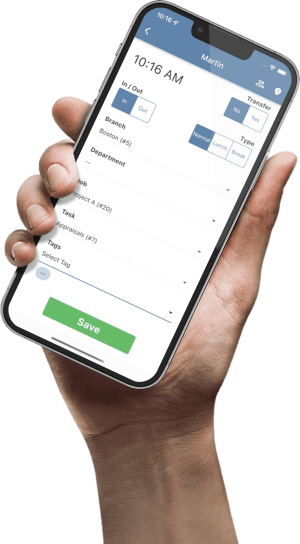
For some organizations, pushback stems from the disruption of illicit but tolerated norms. "Buddy punching"—the practice of one employee clocking in for another—is rampant in industries with loose supervision. The implementation of a system like TimeTrex's Mobile Time Clock, which combines GPS geofencing with biometric facial recognition, abruptly ends this practice. Resistance here often manifests as feigned incompetence or intentional sabotage.
The Technical Solution: Architecture as Mitigation
To effectively dismantle the "surveillance" narrative, organizations must leverage the specific architectural features of their chosen software. Understanding the difference between "Tracking" and "Verification" is the most important concept in mitigation.
Snapshot Verification vs. Continuous Breadcrumbing
The vast majority of privacy concerns stem from the idea of "continuous tracking" or "breadcrumbing"—where the software draws a line on a map showing the employee's movement throughout the day. TimeTrex allows for a fundamentally different configuration known as Snapshot Verification or Point-in-Time Geolocation.
In this mode, the GPS receiver is activated only at the precise instant the employee presses the "Clock In" or "Clock Out" button. The system captures a single set of coordinates, verifies them against the allowed geofence, timestamps the record, and then disengages. This architectural choice allows the employer to truthfully communicate: "We do not know your route. We do not know where you went for lunch. We only know that you were at the job site at 8:00 AM when you punched in."
Advanced Geofencing: The Geometry of Trust
Primitive geofencing causes frustration and false flags. TimeTrex supports complex Polygonal Geofencing, allowing administrators to draw precise boundaries around specific buildings. This distinction is critical for employee acceptance.
| Feature | Primitive Geofencing (Competitors) | TimeTrex Advanced Geofencing |
|---|---|---|
| Shape | Simple Radius (Circle) | Custom Polygon (Multi-point shape) |
| Precision | Low (Bleeds into non-work areas) | High (Snap-to-building capability) |
| Drift Logic | Often binary (In/Out) | Configurable "Buffer Zones" |
| Employee Impact | Frustration when "across the street" | Fairness; accurately reflects work zone |
Biometric Privacy: The "Who" alongside the "Where"
A unique value proposition of TimeTrex's biometric facial recognition is that it allows for less invasive GPS settings. Without biometrics, an employer must rely heavily on tight geofences to ensure the device is on-site. With facial recognition verifying the identity of the human, the administrator can expand the geofence buffer zone significantly (e.g., to 500 meters or "Soft" mode).
Privacy Note: TimeTrex does not store a database of employee photos that can be browsed. Instead, it converts facial geometry into a proprietary mathematical template or encrypted hash. This "data minimization" strategy is a key talking point for privacy-conscious staff.
Data Sovereignty: The On-Premise Advantage
For organizations facing extreme pushback regarding data privacy, TimeTrex offers On-Premise Deployment. Unlike SaaS-only competitors where data lives on a third-party server, TimeTrex allows the software to be hosted on the client’s own secure infrastructure. This guarantees that employee location data never leaves the corporate firewall.
Legal Frameworks and Compliance as Selling Points
By framing the adoption of GPS tracking as a compliance necessity—protecting the employee's rights as much as the employer's interests—management can shift the narrative from "surveillance" to "protection."
In the United States, the FLSA mandates that non-exempt employees be paid for all hours worked. A common source of friction in manual timekeeping is "rounding" or the estimation of arrival times. TimeTrex automates the calculation of overtime and shift premiums based on exact punch times, utilizing GPS to objectively protect the employee from wage theft.
State-Specific Regulations
The regulatory environment is fragmented. Compliance requires a tool that adapts to local laws, such as employee GPS tracking laws.
| Jurisdiction | Legal Requirement | TimeTrex Solution |
|---|---|---|
| California (Labor Code) | Strict requirements on break times and "off-the-clock" work. | Automated break enforcement; prevents clock-in during mandatory rest periods. |
| Illinois (BIPA) | Biometric Information Privacy Act requires strict consent. | Consent management modules; capability to disable biometrics for specific users. |
| European Union (GDPR) | "Right to Access" and Data Minimization. | Audit trails allowing employees to view all stored data; capability to anonymize records. |
Strategic Implementation: A Change Management Playbook
The failure of GPS implementations is rarely technological; it is almost always communicational. Adopting the ADKAR change management model provides a structured approach to winning hearts and minds.
1. Awareness: The Pre-Announcement Phase
Do not launch the system via a cold email. Hold town halls 4 weeks prior to launch. Focus on the "Why," avoiding words like "tracking." Instead, use "automated verification" and "safety protocols." Openly address the elephant in the room regarding privacy settings.
2. Desire: The WIIFM (What's In It For Me) Factor
Employees need a personal reason to adopt the system. For field workers, position the GPS as a safety tether in case of injury. Highlight the TimeTrex Employee Self-Service (ESS) features, showing that the app isn't just a tracker—it's a portal where they can request vacation and view pay stubs instantly.
3. Knowledge: The "Myth-Busting" Training
During training, project the TimeTrex administrator dashboard on a screen. Show the employees exactly what the manager sees. "See this map? It only has dots where you clocked in. We cannot see where you went for lunch." Walk them through device permissions to set location services to "While Using the App" rather than "Always."
4. Reinforcement: The Grace Period
Announce an amnesty policy for the first 30 days. No one should be disciplined for clock-in errors or geofence failures during this time. Actively solicit feedback on geofence boundaries to turn employees into collaborators in tuning the system.
Industry-Specific Mitigation Strategies
Construction and Field Services
The Objection: "I know how to do my job; I don't need you watching me."
Mitigation: Focus on Job Costing. TimeTrex allows employees to switch "Job Codes" seamlessly. Explain that GPS proves to the client that the crew was there, ensuring invoices are paid faster.
Healthcare and Home Health (EVV)
The Objection: "I'm busy with patients; I don't have time to fiddle with an app."
Mitigation: Focus on Compliance. Explain that the organization is required by law (EVV mandates) to prove presence to bill for care. Use TimeTrex’s biometric features to expedite clock-in so it takes seconds.
Professional Services and Remote Work (WFH)
The Objection: "You are tracking me inside my own home."
Mitigation: Disable GPS for Home Users. For remote work, TimeTrex can validate attendance via secure IP address connections, effectively removing the location tracking component while maintaining security.
Operational Best Practices and Configuration Guide
The technical configuration of TimeTrex directly impacts employee sentiment. A poorly configured system feels like a broken system, and a broken system feels like a trap.
- Optimizing for Battery: In TimeTrex mobile policy settings, ensure that background data refresh is minimized. Confirm that "Continuous Tracking" is disabled unless legally required for fleet safety.
- The Art of the Geofence: Never draw the geofence tightly around building walls. GPS accuracy can fluctuate. Always add a 50-meter buffer.
- Soft vs. Hard Launch: Start with "Soft Geofencing" (flagging exceptions) for the first month. If 40% of legitimate punches are flagged, your geofence needs adjustment before switching to "Hard Geofencing" (blocking punches).
- Handling Dead Zones: Explicitly market TimeTrex's offline mode. Assure workers that if they are in a basement or remote site, the app cryptographically signs the punch locally and performs a "Store and Forward" sync once a signal is regained.
The Role of Managerial Ethics
The most sophisticated software cannot fix a toxic culture. "Scope creep" destroys trust. If a system is sold as a "payroll tool," it must not be used as a "discipline tool" for minor infractions. Management should avoid using GPS data to nitpick an employee for being 50 feet off-target.
Instead, use the data for positive reinforcement. If GPS logs show a commute to a new site is taking longer than expected, adjust the shift start time or pay a travel differential. When employees see data used to improve working conditions, resistance evaporates.
Conclusion: The Trust Equation
The mitigation of pushback is ultimately a function of the Trust Equation:
By utilizing TimeTrex, organizations can minimize Risk through privacy-centric architecture (snapshot verification, on-premise data). They can maximize Benefit by selling safety, guaranteed pay accuracy, and self-service convenience. And they can ensure Transparency through clear policies and open communication.
When the "Digital Panopticon" is configured with empathy—when the "eye" of the system is understood to be a tool for verification rather than control—the resistance subsides. The GPS clock-in becomes just another tool in the belt of the modern worker, accepted as a necessary component of professional life.
Ready to Implement a Privacy-First GPS Time Clock?
Discover the top-rated apps that balance operational efficiency with employee trust.
View Best GPS Time Clock AppsDisclaimer: The content provided on this webpage is for informational purposes only and is not intended to be a substitute for professional advice. While we strive to ensure the accuracy and timeliness of the information presented here, the details may change over time or vary in different jurisdictions. Therefore, we do not guarantee the completeness, reliability, or absolute accuracy of this information. The information on this page should not be used as a basis for making legal, financial, or any other key decisions. We strongly advise consulting with a qualified professional or expert in the relevant field for specific advice, guidance, or services. By using this webpage, you acknowledge that the information is offered “as is” and that we are not liable for any errors, omissions, or inaccuracies in the content, nor for any actions taken based on the information provided. We shall not be held liable for any direct, indirect, incidental, consequential, or punitive damages arising out of your access to, use of, or reliance on any content on this page.
About The Author

Roger Wood
With a Baccalaureate of Science and advanced studies in business, Roger has successfully managed businesses across five continents. His extensive global experience and strategic insights contribute significantly to the success of TimeTrex. His expertise and dedication ensure we deliver top-notch solutions to our clients around the world.
Time To Clock-In
Start your 30-day free trial!
Experience the Ultimate Workforce Solution and Revolutionize Your Business Today
- Eliminate Errors
- Simple & Easy To Use
- Real-time Reporting

Saving businesses time and money through better workforce management since 2003.
Copyright © 2026 TimeTrex. All Rights Reserved.