
Why Thin Time Clocks Bleed Profit Margins
A simple punch-in and punch-out app can look cheap until the real work begins: schedule cleanup, missing punches, PTO corrections, overtime checks, payroll exports, pay-code mapping, job-cost reports, and employee questions. That is the thin time clock trap. The clock captures a timestamp, but your business still has to turn that timestamp into payroll-ready operating data.
The old buying question
Can employees clock in?
That question is too narrow for a business with hourly labor, changing schedules, overtime, PTO, breaks, departments, locations, jobs, tips, shift differentials, approvals, and payroll deadlines.
The better buying question
Can approved time become payroll-ready without a reconciliation project?
If the answer is no, the "cheap" time clock is not really cheap. It is simply moving the cost into admin labor, payroll risk, and margin leakage.
Thin clock handoff chain
Shift plan lives in one place.
Punches live somewhere else.
Payroll prep happens manually.
Errors surface at the worst possible moment.
Quick Answer: What Is The Thin Time Clock Trap?
- A thin time clock records punches but does not own the full workflow from schedule to approval to payroll readiness.
- The hidden cost is not the subscription. It is the recurring labor needed to reconcile disconnected scheduling, attendance, PTO, job costing, and payroll data.
- App sprawl research shows that even small businesses run many apps, while broader workplace research links fragmented tools to context switching and productivity loss.
- DOL and IRS recordkeeping rules make time and payroll data more than an internal convenience. The records must be accurate, durable, and reviewable.
- The better approach is a unified workforce system where time, attendance, scheduling, leave, approvals, job costing, reporting, and payroll readiness share one architecture.
- TimeTrex is built around that connected model: time and attendance, scheduling, payroll, HR, job costing, and reporting working together.
The Trap Is Not The Time Clock. The Trap Is Mistaking A Timestamp For A Workforce System.
There is nothing wrong with wanting an easy time clock. Employees should be able to clock in without a manual, managers should see who is late, and payroll should not need a detective story every pay period. The problem starts when a business treats "employee can punch in" as the entire requirement.
A thin clock is a narrow tool. It may capture clock-in, clock-out, and sometimes location. It may export a CSV. It may send totals to a payroll product. But it usually does not govern the wider business logic around time: which schedule the employee was supposed to work, whether the shift was swapped, whether PTO was approved, whether overtime rules applied, whether the time belonged to a department or job, whether an edit was approved, whether a break exception needs review, or whether the final hours are ready for payroll.
That distinction matters because time data is not just attendance trivia. For hourly businesses, it is the raw material of wages, overtime, job costing, labor forecasting, leave balances, compliance records, and employee trust. If the system captures time but leaves everything downstream to manual cleanup, the business still owns the complexity. It just owns it later, under deadline pressure.
The practical test
If a manager has to export punches, compare them to a schedule, fix missed breaks, check PTO in another tool, assign hours to jobs in a spreadsheet, and then upload corrected totals to payroll, the business does not have an automated time system. It has a digital punch collector with a human integration layer.
Why App Sprawl Makes Thin Time Clocks More Expensive Than They Look
The thin clock trap is a smaller version of a much larger software problem: app sprawl. Okta's SMB research reported that small businesses with 50 or fewer employees deployed an average of 36 apps, while SMBs averaged 58 apps. Its broader 2025 Businesses at Work reporting put the average company at 101 apps. That does not mean every company is wasteful. It does mean the modern business stack has more seams, more logins, more data owners, and more places where the same fact can disagree with itself.
For workforce operations, those seams are especially costly. A schedule lives in one app. Punches live in another. PTO lives in a third. Payroll deductions live in a fourth. Job codes live in accounting. Employee changes live in HR. The business may technically have "integrations," but if those integrations only move totals after managers have already repaired the data, the operating burden remains.
Research from Asana's Work Innovation Lab on collaboration technology found that overloaded tool stacks create daily time loss through app switching, searching for information, and tool decision fatigue. Payroll and attendance teams feel a specialized version of the same pain. Instead of hunting for a document, they hunt for the truth of a shift: Was this person scheduled? Did they clock in from the right place? Was the meal break missed? Did PTO cover the absence? Which department gets the labor cost? Has the supervisor approved the edit?
More apps
Each app adds a login, owner, permission model, update cycle, export format, and support queue.
More handoffs
Each handoff creates a point where schedules, punches, PTO, rates, and codes can drift apart.
More exceptions
Late punches, edited punches, missed breaks, swapped shifts, and uncoded hours create recurring cleanup.
More payroll risk
Bad source data becomes late corrections, manual checks, employee disputes, or inaccurate labor reporting.
Where Thin Time Clocks Leak Margin
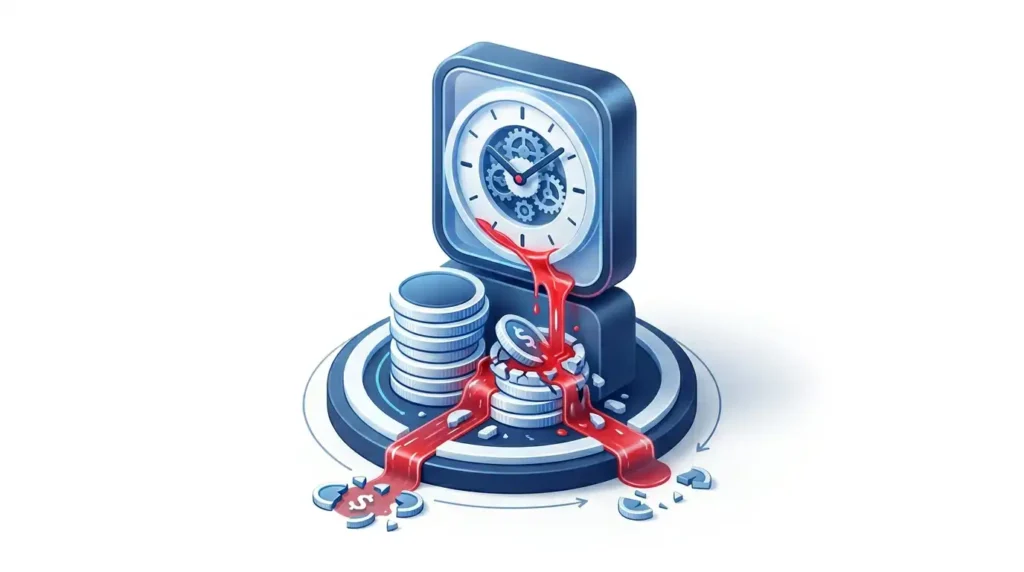
Profit leakage rarely announces itself as a single dramatic failure. It usually arrives as dozens of small recurring costs: ten minutes here, a payroll correction there, an unassigned job code, a missed overtime review, a supervisor approving hours without seeing schedule context, or an owner paying for three tools when one connected system would do the work.
| Leak | What It Looks Like | Why It Hits Profit | What A Unified System Does Instead |
|---|---|---|---|
| Manual payroll prep | Exporting timecards, cleaning totals, fixing pay codes, and re-keying data before each payroll run. | Admin hours repeat every pay period and scale with headcount, locations, departments, and exception volume. | Keeps approved time, pay rules, deductions, and payroll processing in the same operating flow. |
| Schedule mismatch | Managers review punches without seeing the schedule, shift swap, availability note, or approved absence. | Early clock-ins, late clock-outs, unscheduled work, and uncovered shifts can become labor cost surprises. | Connects scheduling and attendance so exceptions are visible before payroll cutoff. |
| PTO and accrual drift | Time off is approved in one system, schedules are changed elsewhere, and payroll has to trust a spreadsheet. | Incorrect balances cause overpayments, disputes, and repeated HR questions. | Updates schedules, balances, attendance records, and payroll context together. |
| Job costing blind spots | Hours are accurate in total but not allocated to the right job, branch, department, task, or cost center. | Owners cannot see which projects, sites, departments, or services are actually profitable. | Captures labor allocation as part of the time workflow instead of after-the-fact reconstruction. |
| Integration babysitting | Someone checks whether data synced, watches for failed imports, and keeps a spreadsheet just in case. | The business pays for automation but still funds manual monitoring and cleanup. | Reduces cross-system sync points and gives one place to resolve exceptions. |
| Weak audit trail | A punch was changed, but the reason, approver, previous value, or downstream impact is hard to reconstruct. | Recordkeeping gaps become expensive during disputes, audits, or policy reviews. | Preserves edits, approvals, corrections, and payroll context in one auditable history. |
The Payroll Deadline Turns Thin Clock Weaknesses Into Real Money Problems
A thin clock can seem acceptable during the workweek because the visible output is simple: people clock in and out. The weakness appears when payroll has to close. Payroll is where disconnected facts become expensive facts.
Under the Fair Labor Standards Act, covered employers need accurate records of hours worked and wages earned for covered, nonexempt workers. The Department of Labor lists items such as daily hours, weekly hours, pay basis, overtime earnings, wage additions and deductions, total wages, payment date, and the pay period covered. The IRS separately instructs employers to keep employment tax records for at least four years after filing the fourth quarter for the year. In other words, the data has to do more than help someone get paid this Friday. It must remain traceable later.
That is why "we can always fix it in payroll" is such a dangerous operating model. Fixing in payroll often means the source system, approval trail, schedule context, PTO status, job-cost allocation, and payroll output no longer tell the same story. The correction may solve the immediate paycheck, but it can weaken the record your business relies on for reporting, analysis, and compliance confidence.
Payroll-ready time is different from captured time
Captured time says, "A punch exists." Payroll-ready time says, "The right employee worked the right shift, under the right rules, with the right approvals, mapped to the right pay codes and cost centers, and ready for wage calculation."
The Export Economy: How "Cheap" Time Clocks Create A Hidden Department
Many businesses do not realize they have built an export economy inside the company. The process is familiar: download a CSV, open a spreadsheet, rename columns, delete blank rows, fix employee names, translate pay codes, compare totals to the schedule, add PTO, check overtime, email a manager, wait for approval, upload to payroll, correct import errors, and save a copy for records.
None of that work appears on the time clock invoice. It appears in staff time, payroll delay, manager frustration, and opportunity cost. The owner sees a low subscription price. The bookkeeper experiences a recurring mini-close every pay period.
Export
Punch totals leave the time clock system as a file or report.
Translate
Departments, jobs, PTO, break rules, and pay codes are mapped by hand.
Chase
Managers answer late questions about missed punches, early clock-ins, and schedule changes.
Upload
Payroll receives corrected data and exposes any format or validation errors.
Repair
Corrections create new records, emails, and explanations after payroll is supposed to be done.
That hidden department might be one bookkeeper, one office manager, or one owner working late. But it is still a department. And the more the company grows, the more that department becomes a bottleneck.
Estimate The Hidden Cost Of Your Thin Time Clock
This quick estimator is intentionally simple. It does not try to model every cost of disconnected systems. It focuses on the recurring payroll-cycle costs that are easiest to overlook: admin cleanup, manager review, and payroll corrections.
Thin Clock Cost Estimator
Formula: payroll runs x (admin cleanup hours + manager review hours) x blended hourly cost, plus correction cost x employees. Use your real costs for a sharper estimate.
Eight Integration Failure Modes Thin Clocks Usually Hide Until Payroll Day
Business owners often hear "we integrate with payroll" and assume the problem is solved. Integration can be useful, and TimeTrex supports integrations when a business needs them. But integration is not the same as unified architecture. An export, flat-file upload, or one-way sync may still leave managers and payroll staff responsible for deciding which system is right when records disagree.
| Failure Mode | Thin Clock Symptom | Operational Damage | Unified-System Control |
|---|---|---|---|
| Employee record mismatch | Employee exists in payroll but not the clock, or the clock has an old department or supervisor. | Missing timecards, failed imports, wrong approvals, and payroll delays. | One employee profile controls scheduling, attendance, HR, and payroll context. |
| Pay-code translation | Regular, overtime, holiday, PTO, premium, and differential hours require manual mapping. | Underpayment, overpayment, manual checks, and inaccurate labor reports. | Pay rules and time rules speak the same language before payroll is calculated. |
| Schedule blindness | The clock knows when someone punched but not what they were assigned to work. | Early starts, late departures, unscheduled work, and coverage gaps are found late. | Punch exceptions are evaluated against scheduled shifts and manager approvals. |
| PTO split-brain | Leave is tracked outside the clock and added to payroll manually. | Balance errors, payroll edits, and repeat HR questions. | Time-off requests, balances, schedules, and payroll treatment stay connected. |
| Delayed sync | Data syncs after the issue should already have been fixed. | Managers lose the chance to correct problems while the shift is fresh. | Real-time or near-real-time visibility moves correction before payroll cutoff. |
| Weak edit history | Changed punches are hard to explain later. | Disputes take longer, and audit confidence drops. | Corrections keep who, when, why, and approval context together. |
| Job-cost afterthought | Total hours are correct but labor allocation is guessed after payroll. | Profitability by job, client, department, or location becomes unreliable. | Labor allocation can be captured with the punch and reviewed before payroll. |
| Exception overload | Missed punches, missed breaks, early starts, and late departures pile up in a report. | Payroll becomes reactive and manager approvals become rubber stamps. | Exception workflows route issues to the right person before payroll is due. |
Why A Unified Workforce System Protects Margin Better Than A Stack Of Point Solutions
The better alternative is not merely a fancier time clock. It is a connected workforce architecture. In that model, scheduling, time and attendance, leave, approvals, payroll readiness, job costing, employee records, and reporting are not separate islands. They are different views of the same operating data.
TimeTrex's own product documentation describes it as a comprehensive workforce management solution with scheduling, time and attendance, job costing, invoicing, document management, and payroll. The public features page frames TimeTrex as an all-in-one platform for payroll, scheduling, time tracking, and HR processes. That matters because the product advantage is architectural: fewer handoffs between core workforce functions.
One source of truth for time
Employee punches, schedules, time-off requests, approvals, and exceptions can be reviewed in context, reducing the need to reconcile competing records.
Payroll readiness before payroll
The goal is not to dump raw time into payroll. It is to approve clean, policy-aware, payroll-ready records before wages are calculated.
Operational reporting that owners can trust
When time data is tied to departments, branches, jobs, tasks, schedules, and payroll rules, labor reporting becomes a management tool, not just a payroll artifact.
The margin difference
A thin clock says, "We know when people punched." A unified workforce system says, "We know whether the right work happened, whether it was approved, what it costs, where it belongs, and whether it is ready to pay."
What To Use Instead: The Payroll-Ready Workforce Operating Layer
For a small or mid-sized business that wants to reduce admin bloat, the target architecture should be simple to describe even if the rules behind it are sophisticated: the same system that knows the schedule should understand the punch; the same system that captures the punch should support approvals; the same system that approves time should understand payroll rules; and the same system that prepares payroll should retain the audit trail.
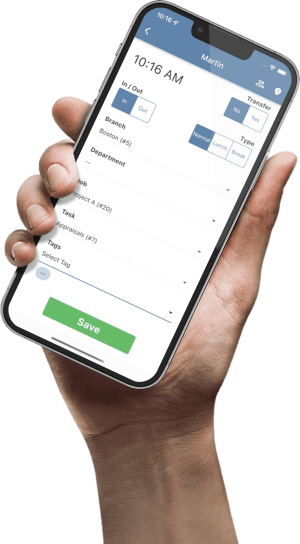
That is the operating layer TimeTrex is positioned to provide. Employees can clock in through browser-based, mobile, or biometric options. Managers can work with schedules, attendance, time-off requests, exceptions, and reports. Payroll workflows can use approved time rather than manually rebuilt time. Job costing can connect labor hours to the work that produced revenue.
Thin Clock Stack
Clock appSchedule appPTO spreadsheetPayroll appJob-cost spreadsheet
- Multiple records for the same shift.
- Payroll cleanup happens after the work is done.
- Managers approve totals without full context.
- Labor reports arrive late or require manual rebuilding.
- Compliance confidence depends on spreadsheet discipline.
Unified TimeTrex Model
TimeAttendanceSchedulingLeavePayrollJob CostingReports
- Time, schedule, leave, and payroll context stay connected.
- Exceptions can be resolved before payroll cutoff.
- Approvals are tied to the records they approve.
- Labor costs can be allocated to jobs, departments, branches, and tasks.
- Audit history is easier to preserve and review.
How To Tell If Your Current Time Clock Is Already Too Thin
You do not need a consultant to diagnose the problem. Ask the people who close payroll. The fastest way to find the hidden cost is to map every step between the last employee punch and the final payroll approval.
Payroll symptoms
- Payroll waits on manager approvals every cycle.
- Hours are exported, edited, and uploaded manually.
- Pay codes require spreadsheet translation.
- Corrections are common after payroll is run.
- Someone keeps a backup spreadsheet because the integration is not trusted.
Operations symptoms
- Overtime is discovered after it happens.
- Schedules and timecards are reviewed separately.
- PTO balances are questioned often.
- Managers cannot see labor cost by job or department fast enough.
- Clock rules vary by location because the tool is too limited.
Growth symptoms
- Adding a location creates more manual reconciliation.
- New pay policies require workarounds.
- Each new app creates a new sync dependency.
- Owner visibility gets worse as headcount grows.
- The company cannot answer basic labor cost questions without a custom report.
The simplest warning sign
If payroll day depends on one person's private spreadsheet knowledge, the time clock is too thin for the business you are becoming.
When A Thin Time Clock Is Still Fine
A balanced answer matters. A basic clock can be acceptable when the business is very small, the schedule is stable, there is little or no overtime, PTO is simple, employees work in one location, labor does not need to be allocated by job or department, and payroll is straightforward. In that environment, a thin clock may provide enough structure without adding unnecessary process.
But most growing businesses leave that phase before they admit it. The inflection point is not just headcount. It is complexity. A 22-person company with multiple locations, rotating schedules, overtime exposure, PTO requests, field work, and job costing can outgrow a thin clock faster than a 75-person office with fixed hours.
| Thin Clock May Be Enough | Unified System Is Usually Better |
|---|---|
| Fixed schedules and one worksite. | Rotating schedules, shift swaps, multi-location work, field work, or remote work. |
| Little overtime and simple pay rules. | Overtime, premiums, differentials, holidays, tips, job codes, or department transfers. |
| No serious need for labor allocation. | Profitability depends on knowing labor by project, client, branch, department, or task. |
| Payroll is easy to close from a simple export. | Payroll requires cleanup, manager chasing, PTO reconciliation, and import error handling. |
| The owner can personally spot every exception. | The business needs exception routing, approval controls, audit trails, and reports. |
A Practical Migration Plan: From Thin Clock To Unified Workforce Control
The best migration is not "rip everything out and hope." It is a controlled move from disconnected capture to payroll-ready workforce data. Start by documenting the current handoffs, then remove the riskiest ones first.
Step 1: Map the current payroll path
List every system, file, spreadsheet, and person involved between clock-in and payroll submission. Include schedule edits, PTO, missed punches, job codes, rate changes, approvals, and correction checks.
Step 2: Identify the data owner for each fact
Decide which system should own employee status, schedules, punches, PTO balances, pay rules, job codes, departments, and approvals. If two systems own the same fact, drift is inevitable.
Step 3: Move schedule context upstream
Do not wait until payroll to compare schedules and punches. The earlier a manager sees an exception, the easier it is to fix accurately.
Step 4: Standardize pay-code and job-code rules
Translate payroll logic into system rules wherever possible. Manual mapping should be the exception, not the default processing model.
Step 5: Run one controlled parallel cycle
Compare the old process with the unified workflow for at least one payroll cycle. Track differences, cleanup time, approval lag, and correction volume.
Step 6: Retire duplicate workflows
The savings come when the old backup spreadsheet, duplicate PTO tracker, and manual export ritual are no longer part of normal operations.
What TimeTrex Brings To The Table
TimeTrex is strongest when the buyer is no longer shopping for "a clock" and starts shopping for a cleaner workforce operating model. The platform combines the areas that commonly become fragmented in small and mid-sized businesses: time and attendance, scheduling, leave management, job costing, payroll, HR, reporting, mobile access, biometric options, GPS and geofencing, integrations, and employee self-service.
Time & Attendance
Browser, mobile, and biometric time capture can be connected to attendance rules, restrictions, accruals, and payroll-ready review.
Scheduling & Leave
Schedules, time-off requests, employee preferences, shift templates, and manager approvals can inform attendance exceptions before payroll.
Payroll
Because scheduling and attendance are connected, payroll can be processed from approved workforce data instead of spreadsheet reconstruction.
Job Costing
Time can be allocated to cost centers, departments, branches, tasks, or projects so labor cost visibility is not rebuilt after the fact.
Mobile Time Clock
Field, remote, and multi-site teams can use mobile time capture with location-aware controls and offline clock-in capabilities where appropriate.
Integrations
When a business still needs outside systems, integration options can reduce manual data entry while the workforce process becomes more disciplined.
Stop buying a punch collector. Start buying payroll-ready workforce control.
If your team is paying for one app to schedule, another to clock in, another to track time off, another to process payroll, and a spreadsheet to make them agree, the software stack is no longer helping. It is asking your staff to become the integration.
The Bottom Line
The thin time clock trap is attractive because it feels like a simple purchase. But the real question is not whether the clock can record time. The real question is whether the system can turn time into clean payroll, reliable labor cost reporting, defensible records, and fewer administrative handoffs.
For a tiny team with simple rules, a thin clock may be enough. For a growing business with hourly employees, scheduling complexity, PTO, overtime, multiple departments, job costing, or payroll anxiety, a thin clock usually just moves the cost out of the software invoice and into your payroll process.
That is why the better replacement is a unified workforce system: one architecture where time, attendance, scheduling, leave, approvals, job costing, and payroll readiness work from the same operational foundation. TimeTrex is built for that world. Not just punch-in and punch-out, but punch-to-approval-to-payroll-ready.
FAQ: Thin Time Clocks, App Sprawl, And Payroll-Ready Time
What is a thin time clock?
A thin time clock is a narrow time capture tool that records clock-ins and clock-outs but does not deeply connect scheduling, PTO, approvals, job costing, payroll rules, audit trails, and reporting. It may be useful for simple attendance, but it often creates downstream cleanup when the business becomes more complex.
Why do thin time clocks hurt profit margins?
They hide costs in payroll prep, manager review, manual exports, import errors, PTO reconciliation, job-code cleanup, and correction work. Those costs repeat every pay period and grow as the company adds people, locations, pay rules, and scheduling complexity.
Is an integration enough to solve the problem?
Sometimes, but not always. An integration can move data from one system to another, but it may not solve bad source data, missing approvals, weak audit trails, schedule mismatches, or PTO drift. A unified system reduces the number of places where core workforce facts can disagree.
When should a business replace a basic time clock?
Consider replacing it when payroll requires manual cleanup, managers chase approvals every cycle, PTO balances are disputed, overtime is found late, job costing is unreliable, or the company keeps duplicate spreadsheets to make payroll safe.
How does TimeTrex differ from a basic time clock app?
TimeTrex is a broader workforce management platform. It connects time and attendance with scheduling, leave management, job costing, payroll, HR, reporting, mobile time capture, biometric options, and integrations, helping businesses reduce the handoffs that make thin clocks expensive.
Does a unified system mean every business has to process payroll inside the same platform?
No. Some businesses still use outside payroll providers or accounting systems. The key is to make time data cleaner before it leaves the workforce system. A more unified workflow can reduce manual entry, improve approvals, and make payroll exports or integrations more reliable.
Research And Source Notes
- TimeTrex Workforce Management: official product positioning for integrated time, attendance, scheduling, payroll, job costing, and workforce management.
- TimeTrex Features: official feature detail for time and attendance, payroll, job costing, scheduling, leave, HR, mobile access, GPS, and related workforce tools.
- TimeTrex Integrations: official integration positioning, including API, two-way, and flat-file integration language.
- TimeTrex Help: What is TimeTrex?: product documentation describing TimeTrex as a comprehensive workforce management solution.
- U.S. Department of Labor: Recordkeeping and Reporting: official FLSA recordkeeping overview for covered, nonexempt workers.
- IRS: Employment Tax Recordkeeping: official IRS employment tax recordkeeping guidance.
- Okta SMBs at Work 2024: SMB and small-business app deployment benchmarks used to frame app sprawl.
- Okta Businesses at Work 2025: broader app deployment benchmark used to contextualize software sprawl.
- Asana Work Innovation Lab: State of Collaboration Technology: research on overloaded technology stacks, app switching, and information search time.
- BetterCloud State of SaaS 2025: SaaS management research used for the broader consolidation and app-management context.
- CloudPay payroll technology research release: payroll-sector evidence on outdated, fragmented payroll technology and error cost pressure.