
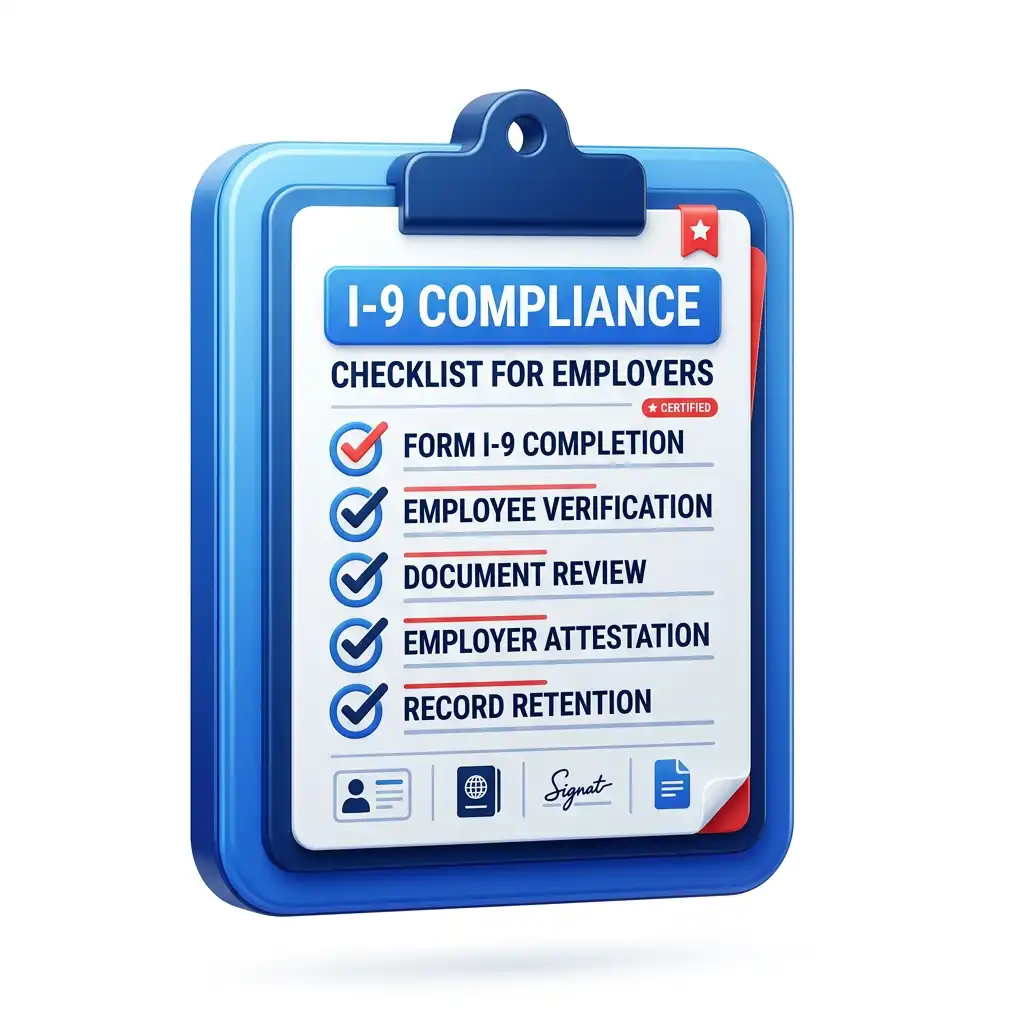
I-9 Compliance Checklist for Employers
I-9 Compliance Checklist for Employers
A practical, audit-ready Form I-9 checklist for HR, payroll, and operations teams that need to verify work authorization, avoid document abuse, handle remote hires correctly, store records cleanly, and keep reverification dates from turning into expensive surprises.
The Short Version
I-9 compliance is not just getting a form signed. It is a controlled process: complete Section 1 on time, review acceptable documents without steering the employee, complete Section 2 within the federal deadline, retain the record for the correct period, reverify only when required, and prove the system was consistent if an agency asks.
The highest-risk employers are not always the ones that ignore Form I-9 completely. More often, the danger comes from half-working processes: late Section 2s, inconsistent document copying, remote video review without meeting the DHS alternative procedure, stale EAD extension assumptions, missing audit trails, and managers who ask some employees for more documents than others.
Checklist Progress
0 of 0 controls marked complete
Progress is stored in this browser only. Use the print button for a clean review copy.
Current Rule Snapshot for 2026
This checklist is grounded in the rules in effect for U.S. employers as of June 29, 2026. Always download the current Form I-9 from USCIS before using the form, and treat the USCIS Handbook for Employers M-274 as the operational playbook for edge cases.
The employee completes and signs Section 1 at the time of hire. Do not use I-9 as a pre-offer screening tool.
The employer examines documents and completes Section 2 within three business days of hire, or at hire if employment lasts less than three business days.
Keep Form I-9 for three years after hire or one year after employment ends, whichever is later.
Authorized agencies provide at least three business days notice before inspection; records must be retrievable.
2026 reverification warning: Do not rely on old blanket assumptions about Employment Authorization Document renewal extensions. Under current 8 CFR 274a.13, renewal applications filed on or after October 30, 2025 generally do not automatically extend an expired or expiring EAD unless another law, rule, or Federal Register notice applies. Verify the exact category before extending a work authorization date.
The Master I-9 Compliance Checklist
Use this as a process checklist, not just a form checklist. The best I-9 systems make it hard to miss a deadline, hard to over-document, easy to retrieve records, and obvious when reverification is actually required.
Filter by Control Area
Required items reflect core legal or government-program obligations. Control items reduce audit risk. Best-practice items make the process easier to run consistently.
One person should own policy, training, exception review, storage, retention, and agency-response readiness. Multi-location employers should also name site-level accountable users.
Write the exact steps for offer acceptance, Section 1, Section 2, document review, receipts, E-Verify if used, corrections, storage, and reverification.
Managers must not request more documents, different documents, specific documents, or reject valid-looking documents because of citizenship, immigration status, or national origin.
Do not rely on a saved local PDF as the permanent source of truth. Check the USCIS Form I-9 page before refreshing onboarding packets.
Using the form as a pre-screening tool creates discrimination risk. Build the workflow so I-9 opens after offer acceptance and before or at the start of paid work.
Make sure the attestation is signed, preparer/translator support is captured when used, and the employee does not leave required fields blank.
The employee may present one List A document or a List B plus List C combination. HR can explain the rule, but the employee chooses the documents.
For employment lasting less than three business days, complete Section 2 at hire and do not accept a receipt in place of the required document.
Missing document details are common technical failures. Build the form review so a second person catches missing expiration or document-number fields before filing.
I-9 review is a reasonable appearance standard, not a forensic exam. Rejecting valid-looking documents because they look unfamiliar can create document-abuse risk.
If someone else completes Section 2 for the employer, give written instructions, prohibit document steering, and review the completed form quickly. The employer remains accountable for the result.
The DHS alternative procedure is limited. A video call alone is not enough for employers that do not meet the E-Verify good-standing requirements.
The employee must transmit copies first. Review front and back when a document is two-sided, then compare the same documents during the live video interaction.
The current Form I-9 includes a corresponding box for alternative procedure use. Reverification handled through the procedure must be marked appropriately too.
The alternative procedure expands document-copy retention for those employees. Store copies with the I-9 or in a linked record that can be produced in an audit.
A qualified employer may limit the alternative procedure to remote hires while using physical review for onsite or hybrid hires, but the policy cannot be based on protected characteristics.
Once enrolled, employers must create cases for newly hired employees at enrolled hiring sites under the E-Verify rules. Do not create an E-Verify case for reverification alone.
Do not suspend, fire, delay training, reduce hours, or take adverse action because an employee is resolving a tentative nonconfirmation.
Receipts are allowed only in limited situations and are temporary. Give HR a due date, escalation path, and employee reminder process.
Schedule reminders far enough ahead to collect updated documentation, but do not reverify employees or documents that USCIS guidance says should not be reverified.
For renewal applications filed on or after October 30, 2025, do not assume an automatic EAD extension applies. Check current USCIS, eCFR, and any category-specific Federal Register notice.
If a former employee is rehired within three years and the existing I-9 can be used, inspect the prior form, confirm eligibility, and update correctly instead of duplicating records unnecessarily.
This is a best practice that makes audits cleaner and limits unnecessary access to identity and work authorization documents.
Build the retention date into the employee record so purge decisions are consistent and documented.
Document copies do not replace Section 2 completion. Inconsistent copying by citizenship status or national origin creates discrimination risk.
Electronic I-9 retention must do more than store a PDF. The system must support retrieval, readable reproduction, integrity controls, process documentation, and secure access history.
Audit by date range, location, acquisition group, or full population. Do not target employees because of citizenship, immigration status, accent, name, or national origin.
Use a dated correction trail. Preserve the original information where possible, initial/date corrections, and explain material fixes in a short audit note.
Know who receives a Notice of Inspection, who contacts counsel, where records live, how electronic audit trails are exported, and who communicates with agency officials.
Continuing-employment and prior-I-9 rules can reduce duplicate work, but they require deliberate review. Create an acquisition checklist before moving employees into payroll.
Printed checklist generated from the TimeTrex I-9 Compliance Checklist.
The Hiring Timeline That Prevents Most I-9 Problems
Offer Accepted
Open onboarding and I-9 only after the accepted offer. Give the employee the Lists of Acceptable Documents and neutral instructions. If the person needs a preparer or translator, capture the supplement correctly.
First Day of Paid Work
Make sure Section 1 is complete and signed at the time of hire. Confirm the name, attestation, signature, date, and preparer/translator information before the employee leaves onboarding.
By the Third Business Day
Examine acceptable documents in person or through the authorized DHS alternative procedure. Complete Section 2, record document details, sign the employer attestation, and create the E-Verify case if the enrolled site uses E-Verify.
After Completion
Store the record in the I-9 file, attach any required document copies, create reverification reminders only when needed, and calculate the retention date. If a receipt was accepted, track the replacement-document due date.
Document Review Rules HR Must Get Right
The I-9 document review is built around employee choice and reasonable review. Employers need to verify identity and employment authorization without overreaching into immigration screening.
| Control | What to Do | What to Avoid | Why It Matters |
|---|---|---|---|
| Document choice | Let the employee choose one List A document or a List B plus List C combination. | Asking for a green card, Social Security card, passport, or "extra proof" from some employees. | Specific-document requests can become unfair documentary practices. |
| Unexpired documents | Use unexpired documents unless a specific receipt or extension rule applies. | Accepting expired documents because payroll is urgent, or rejecting a valid automatic-extension document without checking current guidance. | Wrong acceptance can create unauthorized-work risk; wrong rejection can create discrimination risk. |
| Reasonable appearance | Confirm the document reasonably appears genuine and related to the employee. | Forensic over-review, internet image searches, or different scrutiny levels by accent, name, or citizenship status. | The standard is operational, not investigative. |
| Document copies | If copies are kept, keep them consistently and retrievably; remote alternative procedure copies are required. | Copying documents only for noncitizens or only for employees who "look foreign." | Inconsistent copying can become evidence of discriminatory handling. |
Remote I-9 Examination Is Not Just a Video Call
DHS allows an optional alternative procedure for remote document examination, but only for qualified E-Verify employers in good standing. If the employer is not qualified, the documents must be physically examined by the employer or an authorized representative.
Eligibility Gate
The employer must be enrolled in E-Verify for the hiring site using the procedure, comply with E-Verify requirements, and remain in good standing while using the procedure.
Examination Steps
Within three business days, examine copies of the documents, conduct a live video interaction where the employee presents the same documents, and complete the Section 2 alternative-procedure indicator.
Retention Burden
Keep clear and legible copies of all documents presented for remote examination, including front and back when the document is two-sided, and produce them in an audit.
Policy test: A qualified employer may offer remote examination to remote hires while using physical review for onsite and hybrid hires, but the distinction must be job-location based and applied consistently. It cannot be based on citizenship, immigration status, national origin, name, language, or manager preference.
Receipts, Reverification, and EAD Extensions
This is where a clean onboarding process can go sideways later. The first Form I-9 might be perfect, but if the company misses an expiring work authorization date, over-reverifies the wrong employees, or relies on an outdated EAD extension rule, the risk moves from HR paperwork into payroll and scheduling.
Reverification Control List
- Capture the exact work authorization expiration date when reverification is required.
- Create reminders at 120, 90, 60, and 30 days before expiration for HR review.
- Use Supplement B for reverification or eligible rehire updates.
- Do not reverify merely because a document used for identity has expired.
- Do not reverify based on citizenship, national origin, language, or perceived immigration status.
- Before relying on any EAD automatic extension, verify the category, filing date, current eCFR text, USCIS guidance, and any Federal Register notice.
Why the 2025 EAD Change Matters
For renewal applications filed before October 30, 2025, 8 CFR 274a.13(d) preserves automatic-extension treatment when the listed conditions are met. For renewal applications filed on or after October 30, 2025, 8 CFR 274a.13(e) generally removes automatic extension unless another authority applies.
That means a 2026 checklist should not simply say "add 540 days." It should say: verify the category, verify the filing date, verify whether TPS or another Federal Register notice applies, record the evidence, and schedule reverification for the correct date.
Storage and Audit Readiness
The government does not need a subpoena or warrant to inspect retained Forms I-9 after the required notice. The practical question is whether the employer can retrieve exactly what was requested, quickly, with clear audit trails and without exposing unrelated personnel records.
| Storage Area | Minimum Control | Best Practice |
|---|---|---|
| Record location | Know where the original paper, electronic record, or scanned record is stored. | Keep I-9 records separate from general personnel files with role-based access. |
| Electronic retrieval | Use an indexing system that permits identification and retrieval of requested records. | Export an agency-ready index by employee, hire date, worksite, termination date, and retention date. |
| Legibility | Electronic images must be readable and printable. | Test sample exports quarterly and after every system migration. |
| Audit trails | Track who accessed, created, updated, modified, or corrected electronic records and when. | Review unusual access and keep the audit trail exportable with the I-9 packet. |
| Retention purge | Retain for three years after hire or one year after termination, whichever is later. | Run a documented purge review monthly so the company does not over-retain sensitive identity documents forever. |
High-Risk I-9 Mistakes to Remove First
Late Section 2
Section 2 is due within three business days of hire for most employees. A missing or late employer attestation is one of the fastest ways a simple onboarding miss becomes a paperwork violation.
Remote Review Without Qualification
Remote inspection is allowed only through the DHS alternative procedure for qualified E-Verify employers in good standing. A manager video call does not satisfy the rule by itself.
Document Steering
Requesting specific documents, requesting extra proof, or rejecting valid-looking documents because of citizenship or national origin can trigger DOJ IER risk.
Inconsistent Copying
If the company keeps document copies, it needs a consistent policy. Copying only some employees' documents can look like selective scrutiny.
Old EAD Extension Rules
After the October 30, 2025 EAD rule change, HR should verify each extension rather than using old auto-extension macros or spreadsheet formulas.
No Audit Export
Electronic storage is only useful if HR can retrieve forms, supporting documents, and audit trails within the inspection window.
Where TimeTrex Fits in the I-9 Control Chain
Form I-9 compliance starts in HR, but the risk often shows up in payroll: a hire starts work before verification is complete, a temporary authorization expires while schedules continue, or rehire data does not match the old record. A unified workforce system gives HR and payroll the same operating picture.
Onboarding Evidence
Keep accountable onboarding tasks, document follow-up dates, and employee record controls connected to the hiring workflow instead of scattered across inboxes.
Payroll Guardrails
Use payroll readiness checks so a worker is not moved into recurring pay runs without the required onboarding and authorization controls complete.
Reverification Follow-Up
Connect HR reminders to scheduling and payroll workflows so expiring authorization issues are visible before they become work-continuation problems.
Important: TimeTrex can help organize onboarding, payroll, time, attendance, and HR workflows, but employers remain responsible for Form I-9 completion, document review, E-Verify compliance if enrolled, and legal review of immigration-related questions.
Make I-9 a Controlled Workflow, Not a Paper Chase
Use the checklist above to tighten hiring, remote review, reverification, and record retention. Then connect onboarding status, employee records, schedules, and payroll so compliance gaps are visible before work and pay decisions are made.
I-9 Compliance FAQ
When must Form I-9 be completed?
The employee completes Section 1 at the time of hire. For most hires, the employer completes Section 2 within three business days of hire. If employment lasts less than three business days, Section 2 must be completed at hire.
Can an employer ask every employee for a passport?
No. The employee chooses which acceptable documents to present. A U.S. passport can be a List A document, but the employer should not demand a passport or any other specific document if the employee presents a valid List A or List B plus List C combination.
Can I-9 documents be reviewed remotely?
Only if the employer follows the DHS alternative procedure or uses an authorized representative for physical examination. The alternative remote procedure is limited to qualified E-Verify employers in good standing and requires document-copy review, live video interaction, the Form I-9 alternative-procedure indicator, document-copy retention, and E-Verify compliance.
How long should employers keep Form I-9?
Employers retain Form I-9 for three years after the date of hire or one year after employment ends, whichever is later. Electronic storage is allowed when the system meets federal integrity, retrieval, legibility, security, documentation, and audit-trail standards.
What are the current I-9 penalty ranges?
Current eCFR penalty ranges for violations after November 2, 2015 include $288 to $2,861 per paperwork or verification violation. Knowingly hiring or continuing to employ an unauthorized worker can carry higher per-worker penalties, from $716 to $5,724 for a first offense and higher ranges for repeat offenses. Penalty amounts can change through inflation adjustments, so verify current eCFR before relying on a dollar amount.
Is this legal advice?
No. This is an operational checklist for employers. I-9 issues can involve immigration law, discrimination law, E-Verify requirements, federal contracts, acquisitions, and agency investigations, so employers should involve qualified counsel for uncertain cases.
Sources
- USCIS, Form I-9
- USCIS, I-9 Central
- USCIS, Handbook for Employers M-274
- eCFR, 8 CFR 274a.2: Verification of identity and employment authorization
- eCFR, 8 CFR 274a.10: Penalties
- eCFR, 8 CFR 274a.13: Application for employment authorization
- Govinfo, 88 FR 47749: Optional Alternative 1 to the Physical Document Examination Associated With Form I-9
- Govinfo, 90 FR 48799: Removal of the Automatic Extension of Employment Authorization Documents
- U.S. Department of Justice, Immigrant and Employee Rights Section
- TimeTrex Payroll
- TimeTrex Time and Attendance
Disclaimer: This I-9 Compliance Checklist is provided for general informational and educational purposes only and should not be considered legal, immigration, tax, or employment advice. While every effort has been made to reflect current U.S. laws, regulations, and agency guidance, Form I-9, E-Verify, employment authorization, remote document examination, and record retention requirements may change and can vary based on an employer’s specific circumstances. Employers are responsible for complying with all applicable federal, state, and local laws and should verify current requirements with official government sources, including USCIS, DHS, DOJ, and the eCFR, before making employment or compliance decisions. Complex situations involving immigration status, work authorization, audits, mergers, federal contracts, or discrimination issues should be reviewed with qualified legal counsel. TimeTrex does not guarantee the accuracy, completeness, or applicability of this information for every situation and assumes no liability for actions taken or not taken based on this content.
Found our Free I-9 Compliance Checklist for Employers useful? Bookmark and share it.
Disclaimer: The content provided on this webpage is for informational purposes only and is not intended to be a substitute for professional advice. While we strive to ensure the accuracy and timeliness of the information presented here, the details may change over time or vary in different jurisdictions. Therefore, we do not guarantee the completeness, reliability, or absolute accuracy of this information. The information on this page should not be used as a basis for making legal, financial, or any other key decisions. We strongly advise consulting with a qualified professional or expert in the relevant field for specific advice, guidance, or services. By using this webpage, you acknowledge that the information is offered “as is” and that we are not liable for any errors, omissions, or inaccuracies in the content, nor for any actions taken based on the information provided. We shall not be held liable for any direct, indirect, incidental, consequential, or punitive damages arising out of your access to, use of, or reliance on any content on this page.
Trusted By
Trusted by 3.4M+ Employees: 23 Years of Service Across Startups to Fortune 500 Enterprises
Join our ever-growing community of satisfied customers today and experience the unparalleled benefits of TimeTrex.










Strength In Numbers
Join The Companies Already Benefiting From TimeTrex
Time To Clock-In
Start your 30-day free trial!
Experience the Ultimate Workforce Solution and Revolutionize Your Business Today
- Eliminate Errors
- Simple & Easy To Use
- Real-time Reporting

Saving businesses time and money through better workforce management since 2003.
Copyright © 2026 TimeTrex. All Rights Reserved.