
Free Time Card Conversion Calculator
Time to Decimal Chart
| Minutes | Decimal | Minutes | Decimal | Minutes | Decimal |
|---|---|---|---|---|---|
| 1 | 0.02 | 21 | 0.35 | 41 | 0.68 |
| 2 | 0.03 | 22 | 0.37 | 42 | 0.70 |
| 3 | 0.05 | 23 | 0.38 | 43 | 0.72 |
| 4 | 0.07 | 24 | 0.40 | 44 | 0.73 |
| 5 | 0.08 | 25 | 0.42 | 45 | 0.75 |
| 6 | 0.10 | 26 | 0.43 | 46 | 0.77 |
| 7 | 0.12 | 27 | 0.45 | 47 | 0.78 |
| 8 | 0.13 | 28 | 0.47 | 48 | 0.80 |
| 9 | 0.15 | 29 | 0.48 | 49 | 0.82 |
| 10 | 0.17 | 30 | 0.50 | 50 | 0.83 |
| 11 | 0.18 | 31 | 0.52 | 51 | 0.85 |
| 12 | 0.20 | 32 | 0.53 | 52 | 0.87 |
| 13 | 0.22 | 33 | 0.55 | 53 | 0.88 |
| 14 | 0.23 | 34 | 0.57 | 54 | 0.90 |
| 15 | 0.25 | 35 | 0.58 | 55 | 0.92 |
| 16 | 0.27 | 36 | 0.60 | 56 | 0.93 |
| 17 | 0.28 | 37 | 0.62 | 57 | 0.95 |
| 18 | 0.30 | 38 | 0.63 | 58 | 0.97 |
| 19 | 0.32 | 39 | 0.65 | 59 | 0.98 |
| 20 | 0.33 | 40 | 0.67 | 60 | 1.00 |
Found our Free Time Card Conversion Calculator useful? Bookmark and share it.
Time in Workforce Management
TL;DR
Workforce management faces a critical conflict: the difference between measuring time (minutes) and paying for it (decimals). This guide explores the "Temporal-Fiscal Paradox," the mathematics behind converting labor into wages, and the legal implications of rounding under the FLSA.
Table of Contents
- Introduction: The Temporal-Fiscal Paradox
- The Mathematics of Labor: Base-60 vs. Base-10
- Regulatory Compliance: The FLSA and the 7-Minute Rule
- TimeTrex System Architecture: Precision at Scale
- Payroll Administration: The Operational Workflow
- Data Export and Integration: Bridging the Software Gap
- Strategic Implications and Economic Impact
- Conclusion
- Appendix: Comprehensive Reference Tables
Introduction: The Temporal-Fiscal Paradox
The modern enterprise operates at the intersection of two distinct mathematical legacies: the sexagesimal system of timekeeping, inherited from ancient Mesopotamia, and the decimal system of currency and accounting, standardized during the rise of modern banking. This fundamental divergence, between the base-60 measurement of human experience and the base-10 measurement of financial value, creates a persistent, systemic friction in workforce management.
The translation of labor hours into monetary compensation requires a rigorous bridge between these two systems. A duration of "8 hours and 30 minutes" is a temporal fact, but "8.5 hours" is a fiscal necessity. The conversion process, while mathematically deterministic, is fraught with potential for error, ambiguity, and regulatory non-compliance. As organizations scale, the manual bridging of this gap becomes unsustainable, necessitating the deployment of advanced Time and Attendance (T&A) software.
The Mathematics of Labor: Base-60 vs. Base-10
The Historical Divergence
To understand the complexity of modern payroll, one must appreciate the historical inertia behind our timekeeping systems. The division of the hour into 60 minutes is a vestige of the Sumerian civilization, favored for its high divisibility. Conversely, the global financial system evolved around the decimal (base-10) system. This created a permanent misalignment: when a laborer works for a fraction of an hour, the duration is measured in base-60 (minutes), but their compensation is calculated in base-10 (currency).
The Precision Gap and Resolution
The distinction between "Minute Hours" (standard clock time) and "Decimal Hours" (payroll time) is fundamentally a difference in resolution. Minute-based time has a resolution of 1/60 (approximately 0.0166), while decimal time effectively has a resolution of 1/100 (0.01).
For example, a legacy time clock might record a punch at 8:12 AM. In standard time, this is 12 minutes past the hour. To convert this for payroll:
12 / 60 = 0.20
In this rare instance, the conversion is clean. However, consider a punch at 8:13 AM (13/60 = 0.21666...). A payroll system configured to two decimal places must truncate or round this value to 0.22. This rounding introduces a microscopic variance between the time worked and the time paid.
Mathematical Anomalies in Manual Conversion
Before the advent of automated software, payroll clerks relied on "Time Conversion Charts." Manual usage of these charts introduced the "Decimal Point Fallacy," where a clerk might transcribe "8 hours and 30 minutes" as "8.30 hours" instead of "8.50 hours," devaluing the employee's time by 20 minutes.
| Minute Value | Decimal Value (2 Places) | Decimal Value (Precise) | Deviation (Rounding Error) |
|---|---|---|---|
| 10 min | 0.17 | 0.16666... | +0.0033 |
| 20 min | 0.33 | 0.33333... | -0.0033 |
| 30 min | 0.50 | 0.50000 | 0.0000 |
Regulatory Compliance: The FLSA and the 7-Minute Rule
The Federal Mandate for Accuracy
In the United States, the Fair Labor Standards Act (FLSA) governs the recording of work hours. The Department of Labor (DOL) permits employers to "round" the starting and stopping times of employees to the nearest 5 minutes, or to the nearest one-tenth or quarter of an hour. However, this permission comes with a strict caveat: neutrality. The rounding practice must not result, over a period of time, in the failure to compensate employees properly for all the time they have effectively worked.
The 7-Minute Rule (Quarter-Hour Rounding)
The most prevalent rounding standard supported by TimeTrex is the "7-Minute Rule," which rounds punches to the nearest 15-minute increment (.25 hours). This rule is favored because it aligns perfectly with the decimal quarter-hours (0.00, 0.25, 0.50, 0.75).
TimeTrex System Architecture: Precision at Scale
The Database Reality: Storing Seconds
A critical distinction in high-quality workforce management software is the separation of data storage from data presentation. While users may see "8.5 Hours" or "08:30," TimeTrex stores timestamp data in its backend database with second-level precision (e.g., YYYY-MM-DD HH:MM:SS).
How TimeTrex Automates Precision:
By storing the exact second of the punch, TimeTrex preserves the "source of truth." Rounding rules are applied dynamically as a calculation layer on top of this raw data, allowing administrators to change rounding policies retroactively without destroying the original attendance records.
Payroll Administration: The Operational Workflow
TimeTrex structures the complex task of finalizing time data into a "Payroll Processing Wizard." This tool acts as a linear workflow to ensure no steps are skipped before the data is converted to decimals and locked. In real-world operations, deviations often occur at scale. TimeTrex’s Mass Edit feature allows administrators to apply changes to multiple records simultaneously, ensuring consistent decimal conversion.
Data Export and Integration: Bridging the Software Gap
One of the most frequent support queries is why reports show decimals even when preferences are set to hours and minutes. This highlights the specific purpose of the Payroll Export module. When exporting to a CSV file for ADP, Paychex, or Excel, TimeTrex forces the data into decimal format to ensure computational validity.
Strategic Implications and Economic Impact
The Cost of "Phantom" Minutes
While the difference between 0.16 hours and 0.17 hours seems infinitesimal, the "Law of Large Numbers" dictates that these variances become material at the enterprise scale. A systematic rounding error causing a loss of 3 minutes per employee per week in a 500-person company can result in tens of thousands of dollars in annual variance.
ROI of Automated Conversion
The Return on Investment (ROI) for implementing a system like TimeTrex is driven largely by the elimination of the manual conversion tax. Case studies suggest that automated time tracking can reduce payroll errors by up to 60%, significantly reducing the time spent on remediation and issuing corrective checks.
Conclusion
The dichotomy between hours/minutes and decimal time is a permanent feature of the business landscape. TimeTrex exemplifies the modern solution to this ancient problem. By treating time as high-precision data first and a display format second, it allows organizations to navigate the complexities of FLSA compliance, the technical rigidity of payroll exports, and the operational reality of human error.
Take Precision to the Field
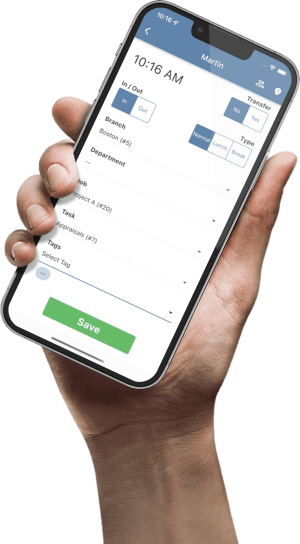
Ensure your workforce management is accurate, compliant, and efficient no matter where your employees are located. Experience the power of the TimeTrex Mobile Time Clock today.
Explore TimeTrex MobileDisclaimer: The content provided on this webpage is for informational purposes only and is not intended to be a substitute for professional advice. While we strive to ensure the accuracy and timeliness of the information presented here, the details may change over time or vary in different jurisdictions. Therefore, we do not guarantee the completeness, reliability, or absolute accuracy of this information. The information on this page should not be used as a basis for making legal, financial, or any other key decisions. We strongly advise consulting with a qualified professional or expert in the relevant field for specific advice, guidance, or services. By using this webpage, you acknowledge that the information is offered “as is” and that we are not liable for any errors, omissions, or inaccuracies in the content, nor for any actions taken based on the information provided. We shall not be held liable for any direct, indirect, incidental, consequential, or punitive damages arising out of your access to, use of, or reliance on any content on this page.
Trusted By
Trusted by 3.4M+ Employees: 23 Years of Service Across Startups to Fortune 500 Enterprises
Join our ever-growing community of satisfied customers today and experience the unparalleled benefits of TimeTrex.










Strength In Numbers
Join The Companies Already Benefiting From TimeTrex
Time To Clock-In
Start your 30-day free trial!
Experience the Ultimate Workforce Solution and Revolutionize Your Business Today
- Eliminate Errors
- Simple & Easy To Use
- Real-time Reporting

Saving businesses time and money through better workforce management since 2003.
Copyright © 2026 TimeTrex. All Rights Reserved.