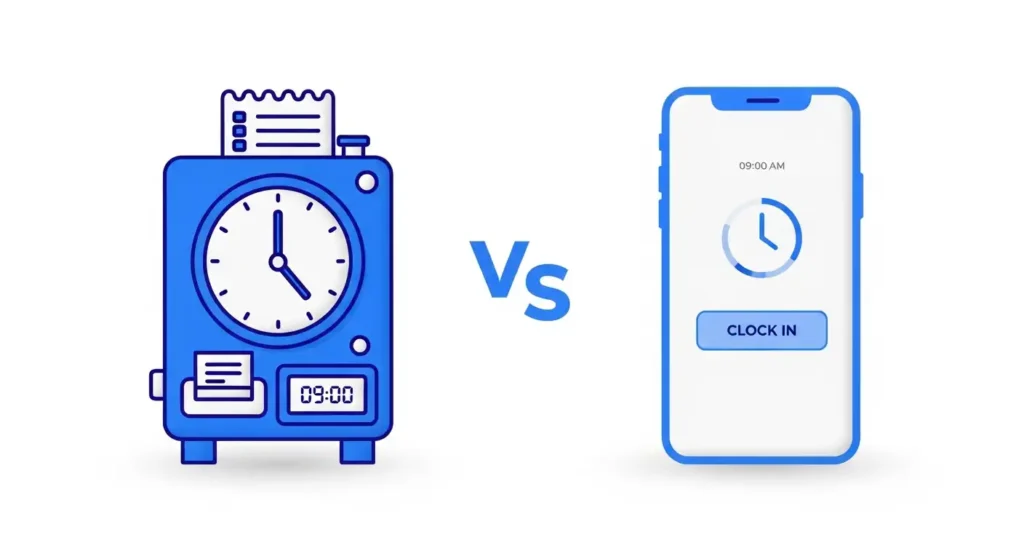

Time Clock vs. BYOD Time Tracking Software
Article Index
- The Historical and Architectural Context of Timekeeping
- The Legacy Hardware Ecosystem: A Technical and Economic Critique
- The BYOD and Mobile Kiosk Revolution: The TimeTrex Paradigm
- Biometric Identity and Security: The End of "Buddy Punching"
- Geospatial Intelligence: GPS and Geofencing
- Technical Architecture: Offline Modes and Data Integrity
- Economic Analysis: Detailed TCO Modeling
- Legal Frameworks and Compliance: Navigating the Minefield
- Operational Hygiene and Safety: The Post-Pandemic Imperative
- Industry-Specific Applications and Case Studies
- Implementation and Change Management
- Conclusion: The Strategic Imperative
- Comparative Summary Table
TL;DR
The workforce management landscape is shifting rapidly from physical, hardware-dependent time clocks to agile, Software-Defined Workforce Management solutions like Bring Your Own Device (BYOD) and tablet kiosks. This report contrasts the high "Hardware Tax" and limitations of legacy systems (like ADP and UKG) with the zero-CapEx, high-security model of modern software. By leveraging TimeTrex as a primary case study, we demonstrate how facial recognition, real-time data unification, and GPS intelligence offer superior accuracy and massive cost savings compared to traditional methods. The transition is not just technological but a strategic financial imperative, moving from obsolete, proprietary hardware to a flexible, data-rich ecosystem.
The Historical and Architectural Context of Timekeeping
To fully appreciate the divergence between traditional time clocks and modern BYOD software, one must first understand the historical trajectory of the technology. The concept of the "time clock" is deeply rooted in the factory model of the early 20th century, where labor was synchronous, centralized, and supervised.
The Era of the Physical Sentinel
The original time clock was a mechanical device designed to enforce punctuality in a manufacturing setting. Its primary function was to stamp a physical card with a time, creating an analog record that required manual calculation by a payroll clerk at the end of the week. This system was inherently reactive; management had no visibility into labor costs until the pay period closed and the manual tabulation was complete.
As technology evolved, these mechanical devices were replaced by digital terminals. Early digital clocks utilized magnetic stripe cards or barcode badges. While they digitized the input, the architecture remained "store-and-forward" in a limited sense. These devices were often "dumb terminals" that stored punches in local memory. Data was retrieved via a polling process (initially through dial-up modems and later via Ethernet connections) where a central server would request data at set intervals. This architecture introduced synchronization latency: a manager could not know who was absent until the next day.
The Proprietary Hardware Lock-In
The defining characteristic of the legacy model, championed by industry giants like ADP and Kronos (now UKG), is the coupling of software and hardware. In this ecosystem, the time tracking software is designed to function exclusively with the vendor's proprietary terminals. This creates a closed loop of dependency.
The hardware itself acts as a gatekeeper. If an organization wishes to use the vendor's workforce management suite, they must purchase or lease the vendor's physical clocks. This establishes a high barrier to entry and a significant barrier to exit. The "Clock" becomes a distinct asset class on the corporate balance sheet, subject to depreciation, maintenance contracts, and obsolescence cycles. The vendor dictates the upgrade path; when a terminal reaches "end of life," the customer is forced to reinvest in new hardware to maintain software compatibility.
The Shift to Software-Defined WFM
The emergence of cloud computing and the ubiquity of powerful consumer electronics (smartphones and tablets) shattered this proprietary model. Software-Defined WFM, exemplified by TimeTrex, decouples the timekeeping logic from the input device.
In this new paradigm, the "clock" is an application, not an appliance. It runs on operating systems that are maintained by third-party tech giants (iOS, Android), ensuring constant security updates and feature enhancements without the WFM vendor needing to manufacture silicon. This shift moves the locus of value from the box on the wall to the cloud-based database, enabling real-time processing, open API integrations, and a "hardware agnostic" deployment strategy that fundamentally alters the economic equation of labor management.
The Legacy Hardware Ecosystem: A Technical and Economic Critique
While legacy hardware clocks provide a sense of tangible permanence, a rigorous analysis reveals significant inefficiencies in cost, flexibility, and data integrity compared to modern software alternatives.
The "Hardware Tax" and Total Cost of Ownership (TCO)
The most profound difference between the two models lies in their economic architecture. Legacy vendors utilize hardware as a primary revenue stream, often obscuring the true cost through complex leasing agreements.
Capital Expenditure (CapEx) vs. Operating Expenditure (OpEx)
A single proprietary biometric terminal from a major legacy provider typically commands a purchase price between $3,000 and $5,000. For a facility with ten entry points, this represents a capital expenditure of up to $50,000 before the system is even live.
Alternatively, vendors offer leasing models. A common lease rate for a biometric clock is approximately $240 to $260 per month per device. Over a standard five-year contract, the total payments for a single terminal can exceed $14,400. This is a staggering sum for a device with the computing power of a low-end smartphone.
The Maintenance Burden
Beyond the acquisition cost, legacy hardware carries a "maintenance tax." Vendors typically mandate annual maintenance contracts, costing roughly $395 per year per device, to cover firmware updates and hardware repairs. If a device fails without a contract, the repair costs are often punitive, incentivizing the client to maintain the insurance policy.
In contrast, the Mobile Time Clock model involves zero hardware cost for the employer. The infrastructure (the smartphone) is already owned by the employee. Even the "Tablet Kiosk" model, which uses a commodity iPad ($329) and a rugged case ($150), represents a hardware cost that is 90% lower than the proprietary alternative. Furthermore, commodity tablets do not require maintenance contracts; if an iPad breaks after the warranty period, it is cheaper to simply buy a new one than to pay for a single year of legacy maintenance.
Technical Limitations of Proprietary Terminals
Proprietary terminals are often engineered with a focus on durability rather than usability, leading to significant technical deficits.
- User Interface (UI) Constraints: Legacy clocks frequently utilize resistive touchscreens or membrane keypads. These interfaces differ vastly from the capacitive, multi-touch glass screens employees use on their personal phones. The poor sensitivity and low resolution make complex interactions, such as reviewing a schedule, requesting time off, or splitting time between job codes, frustrating and error-prone.
- Connectivity Rigidity: Traditional terminals often require hardwired Ethernet connections and dedicated power (110V or PoE). This limits installation to areas with existing infrastructure. Moving a clock requires a facility work order to pull new cable, creating friction for dynamic environments like construction sites or reconfigured warehouse floors.
- Sensor Obsolescence: The biometric sensors (optical fingerprint readers) in legacy devices are often permanently integrated. If biometric technology advances or if the sensor degrades due to scratches (a common issue with optical platens), the entire unit must be replaced. In the BYOD/Tablet model, the "sensor" is the camera, which is upgraded with every new generation of the consumer device.
The BYOD and Mobile Kiosk Revolution: The TimeTrex Paradigm
TimeTrex represents the vanguard of the software-defined revolution. By leveraging the sensors and connectivity of consumer devices, it offers a "Unified" WFM platform that is more secure, more accurate, and vastly more affordable than legacy hardware.
Defining the Modalities
TimeTrex supports two primary deployment modes that replace the physical clock:
Bring Your Own Device (BYOD)
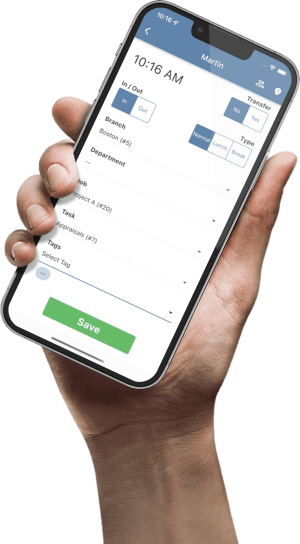
In this model, the TimeTrex mobile application is installed directly on the employee's smartphone. This effectively distributes the time clock to the "edge" of the network.
- Ubiquity: With high smartphone penetration, nearly every employee arrives at work with a GPS-enabled, high-resolution camera computer in their pocket.
- Personalization: The app provides a personalized dashboard for the employee, allowing them to view their specific schedule, accruals, and pay stubs without hogging a shared communal kiosk.
How TimeTrex BYOD Works
App Deployment
Employees download the app to their personal device or a central tablet.
Biometric Verification
Facial recognition verifies identity instantly, eliminating "buddy punching".
Geofencing Check
GPS confirms the employee is within the authorized work zone.
Real-Time Sync
Data is instantly uploaded to the cloud for payroll processing.
The Tablet Kiosk
For environments where personal devices are restricted (e.g., secure clean rooms, food processing lines) or for employees without smartphones, TimeTrex utilizes a Tablet Kiosk. A standard iOS or Android tablet is mounted to a wall or stand. The app runs in "Kiosk Mode," locking the device to the TimeTrex interface.
- Supply Chain Agility: The reliance on commodity hardware eliminates the "RMA Nightmare." If a legacy clock breaks, the company waits days for a replacement. If a TimeTrex Kiosk breaks, a manager can purchase a replacement tablet at any local electronics retailer and have the system back online in under an hour.
The Unified Database Architecture
The most critical architectural differentiator of TimeTrex is its Unified Database. In the legacy world, Time & Attendance, Scheduling, and Payroll are often distinct software modules or even separate products acquired by the vendor over time. These modules communicate via periodic data bridges or file transfers.
TimeTrex is built on a single, cohesive code base. Time tracking data, scheduling rules, and payroll calculation logic reside in the same environment.
- Real-Time "Gross-to-Net": When an employee punches in, TimeTrex doesn't just record the time; it can instantly calculate the financial impact. If a punch triggers overtime or a meal penalty, the manager can see the dollar cost immediately on their dashboard. There is no need to wait for a "batch process" or a transfer to the payroll system.
- Punch-to-Paycheck Automation: This unification allows for the complete automation of the payroll cycle. The friction of exporting a CSV file from a time clock system and importing it into a payroll system—a process rife with "fat finger" errors and data corruption—is eliminated.
Biometric Identity and Security: The End of "Buddy Punching"
A common misconception is that physical clocks are more secure than apps. Decision-makers worry that BYOD allows employees to "clock in from bed." In reality, modern software-defined solutions offer superior security measures that effectively eradicate time theft.
The Failure of Legacy Optical Sensors
Legacy biometric clocks predominantly use optical fingerprint scanners. These sensors take a 2D image of the finger's friction ridges. While effective in clean office environments, they fail catastrophically in the real world.
- The Contamination Problem: In industries like construction, manufacturing, and food service, workers' hands are often dirty, greasy, or wet. Contaminants obscure the ridges, leading to "False Rejection" errors.
- The Throughput Bottleneck: When a scanner fails to read, the employee must wash their hands or try multiple times. This creates queues at the clock during shift changes, wasting billable time.
- Sensor Degradation: Abrasive dust (concrete, drywall) on fingers acts like sandpaper, scratching the glass platen of the scanner over time, leading to permanent hardware failure.
Facial Recognition: The Superior Biometric
TimeTrex leverages the high-resolution front-facing cameras of tablets and smartphones to implement Facial Recognition.
- Touchless Efficiency: Facial recognition is inherently non-contact. The employee simply looks at the device. This eliminates hygiene concerns and the issue of dirty hands affecting sensor accuracy.
- Liveness Detection: Advanced algorithms analyze the video feed for depth and micro-movements to ensure the subject is a live person, preventing "spoofing" with a photograph.
- Identity Assurance: This technology eliminates "Buddy Punching"—the practice of one employee clocking in for another—which costs US employers an estimated 2.2% of gross payroll annually. The system creates a definitive audit trail, often capturing a "punch selfie" that serves as irrefutable proof of presence.
Geospatial Intelligence: GPS and Geofencing
One of the most significant advantages of BYOD software is the integration of geospatial data. While a physical clock proves an employee is at the wall, it cannot track employees who move.
The Geofencing Mechanism
TimeTrex utilizes the GPS and Geofencing capabilities of the mobile device to enforce boundaries. Administrators can draw virtual polygons on a map representing valid worksites.
- Lock-Out Logic: The app can be configured to disable the "Clock In" button unless the device is physically located within the geofence. This prevents employees from clocking in while still commuting.
- Dynamic Breadcrumbing: For mobile workforces (e.g., delivery drivers, home health aides), the app can capture GPS coordinates at set intervals (breadcrumbing). This provides management with a "Proof of Presence" for every client visit, which is often required for billing and contract compliance.
The Roaming Kiosk
A hybrid application of this technology is the "Roaming Kiosk." A construction foreman can carry a cellular-enabled tablet to a job site. This tablet acts as the time clock for the entire crew.
- Site Validation: The tablet itself verifies it is at the correct job site via GPS.
- Crew Punch: The foreman can clock in the whole crew, or workers can line up and use facial recognition on the foreman's tablet.
- Offline Resilience: If the site has no signal, the data is stored locally and synchronized later.
Technical Architecture: Offline Modes and Data Integrity
A critical requirement for enterprise-grade WFM is resilience. Systems must function when infrastructure fails.
Store-and-Forward Architecture
Legacy clocks often have limited internal memory. TimeTrex apps are designed with a robust "Store-and-Forward" architecture.
- Local Crypto-Signing: When a device is offline (e.g., in a basement or remote logging site), punches are recorded locally. To ensure integrity, the data is cryptographically signed at the moment of capture. This prevents a user from manipulating the device's clock to retroactively change a punch time while offline.
- Automatic Synchronization: A background service continually monitors network connectivity. The moment a connection (WiFi or Cellular) is restored, the cached data is pushed to the TimeTrex cloud. Crucially, the system applies all business rules (overtime, rounding) retrospectively based on the original timestamp, ensuring payroll accuracy regardless of sync latency.
Economic Analysis: Detailed TCO Modeling
To demonstrate the financial impact of the shift to software-defined WFM, we present a detailed Total Cost of Ownership (TCO) model comparing a Legacy Proprietary System against TimeTrex (BYOD and Tablet Kiosk).
Scenario: 100 Employees, 5 Locations (5 terminals), 5-Year Duration.
| Cost Category | Legacy Proprietary Hardware | TimeTrex Tablet Kiosk | TimeTrex BYOD |
|---|---|---|---|
| Hardware / Stipend | $75,000 (Lease) | $2,500 (Purchase) | $30,000 (Stipend)* |
| Maintenance | $9,875 | $0 | $0 |
| Installation / Setup | $2,500 | $0 | $0 |
| Replacements | Covered by Maint. | $500 | $0 |
| Total 5-Year TCO | $87,375 | $3,000 | $30,000* |
| *Note: The BYOD stipend is a direct benefit to employees, boosting morale, rather than a sunk cost to a vendor. | |||
The ROI of Fraud Prevention
The economic analysis must also consider "Negative Cost" (Savings). With "Buddy Punching" costing an estimated 2.2% of gross payroll, a company with a $5M annual payroll loses approximately $110,000/year.
TimeTrex's facial recognition eradicates this loss. The system generates $550,000 in savings over 5 years, dwarfing the cost of the software. In conclusion, the Legacy model costs nearly 29 times more in hardware fees than the Tablet Kiosk model ($87k vs $3k), while offering inferior protection against the substantial losses from time theft.
Legal Frameworks and Compliance: Navigating the Minefield
The transition to biometric and BYOD systems introduces complex legal liabilities. Organizations must navigate privacy laws and labor codes with precision.
Biometric Information Privacy Act (BIPA)
Illinois' BIPA is the strictest biometric privacy law in the US, serving as a bellwether for other jurisdictions. It regulates the collection of "biometric identifiers" (retina, fingerprint, face geometry).
- The "Template" Distinction: TimeTrex facilitates compliance through its data architecture. The system does not store raw photos as the primary identifier for matching. Instead, it converts the facial scan into an encrypted digital template—a mathematical string representing the geometry of the face.
- Security: If the database were breached, the attacker would find useless mathematical strings, not a repository of employee faces that could be used for identity theft.
- Compliance Steps: Despite this technical safeguard, the legal definition of biometric data includes these templates. Therefore, employers must obtain a written release from every employee before they use the clock. Failure to do so carries penalties of $1,000 to $5,000 per violation.
- Data Retention and Destruction: BIPA requires a public retention schedule. TimeTrex includes automated data destruction tools that can be configured to delete biometric templates immediately upon employee termination or after 3 years of inactivity.
BYOD Reimbursement: California Labor Code 2802
When an employer mandates the use of a personal device, they step into the realm of expense reimbursement.
In Cochran v. Schwan’s Home Services, California courts ruled that employers must reimburse a "reasonable percentage" of an employee's cell phone bill if the device is required for work, even if the employee has an unlimited data plan and incurs no extra cost.
The Stipend Solution: To manage this, TimeTrex's payroll engine can be configured to automatically add a tax-free reimbursement stipend (e.g., $10-$20/month) to the paychecks of BYOD users. This automates compliance and serves as a defense against class-action lawsuits.
Operational Hygiene and Safety: The Post-Pandemic Imperative
The COVID-19 pandemic fundamentally altered the perception of shared surfaces in the workplace. The "Fomite Transmission" risk—spreading disease via touch—has made high-touch surfaces like fingerprint scanners a liability.
The "Petri Dish" Effect
Research indicates that shared electronic devices in workplaces are significant vectors for microbial transmission. A study of airport surfaces found that check-in kiosks had high microbial loads. In a workplace, a fingerprint scanner is touched by potentially hundreds of employees in a short window during shift changes. Because the sensor requires firm contact to read the friction ridges, it encourages the transfer of oils, sweat, and pathogens.
The Touchless Advantage
TimeTrex’s facial recognition technology enables a Zero-Touch workflow.
- Kiosk Mode: Even on a shared tablet, the employee does not need to touch the screen. They simply walk up, the camera detects a face, identifies the user, and records the punch automatically.
- BYOD Safety: The BYOD model is the gold standard for hygiene. The employee only touches their own personal device, completely breaking the chain of transmission between coworkers. This creates a safer work environment and reduces sick leave absenteeism.
Industry-Specific Applications and Case Studies
The advantages of TimeTrex's software-defined approach manifest differently across various sectors.
Construction and Field Services
The Challenge: Distributed workforce, no fixed infrastructure, high "buddy punching" risk, complex job costing (tracking time against specific project codes).
TimeTrex Solution: The "Roaming Kiosk." A foreman carries a cellular-enabled rugged tablet. The tablet uses GPS to verify it is at the correct job site. Workers use facial recognition on the tablet to clock in. The app allows workers to select specific Cost Codes (e.g., "Framing" vs. "Electrical") for accurate billing.
Healthcare and Senior Care
The Challenge: Mobile workforce (home health aides), strict hygiene requirements, complex overtime rules (shift differentials).
TimeTrex Solution: BYOD for home health aides. The GPS "breadcrumb" feature provides an audit trail proving the aide was at the patient's residence for the full duration of the visit (Electronic Visit Verification - EVV). For hospital staff, touchless facial recognition kiosks minimize infection risk.
Retail and Hospitality
The Challenge: High turnover, young workforce, thin margins, predictable scheduling needs.
TimeTrex Solution: The tablet interface is intuitive to digital-native Gen Z employees (familiar with iPads). The "Selfie" punch adds a layer of social accountability. The system integrates with the scheduling module to prevent early clock-ins, controlling labor costs.
Implementation and Change Management
Transitioning from a physical clock to a software solution is a cultural shift as much as a technical one. Success requires careful change management.
Addressing Privacy Concerns
Employees may fear that a BYOD app is a "spy tool" tracking their off-duty movements. The implementation team must clearly communicate that the app only accesses GPS at the moment of the punch. Instructing users to set location permissions to "While Using the App" (iOS/Android) reinforces that they are in control.
The Enrollment Process
For facial recognition, the enrollment workflow is critical. The system should be configured to present the BIPA consent form digitally before the camera is activated. Initial enrollment scans should be done in well-lit environments to ensure a high-quality baseline template, reducing future false rejections.
Scalability and Future-Proofing
One of the hidden benefits of software-defined WFM is scalability. Adding a new "clock" for a seasonal pop-up store or a new construction site takes minutes (download the app) rather than weeks (order and install hardware). TimeTrex's cloud architecture allows the system to scale from 10 employees to 10,000 without infrastructure upgrades, ensuring the solution grows with the business.
Conclusion: The Strategic Imperative
The comparison between the Legacy Time Clock and BYOD Software is a study in contrasts: Analog vs. Digital, CapEx vs. OpEx, Hardware-Centric vs. Data-Centric.
The legacy model, while familiar, imposes a heavy "Hardware Tax" and traps data in local silos. It is a relic of an industrial past where labor was static and disconnected. The TimeTrex model represents the future of work. By decoupling timekeeping from proprietary hardware, it democratizes enterprise-grade security and analytics. It turns the time clock from a passive expense into a strategic asset—a sensor network that provides real-time visibility into the organization's most valuable and expensive resource: its people.
Comparative Summary Table
| Feature | Legacy Physical Time Clock | TimeTrex (BYOD / Tablet Kiosk) |
|---|---|---|
| Hardware Cost | High ($3k-$5k or Leased) | Low ($300 Tablet) or Zero (BYOD) |
| Maintenance | Expensive Contracts ($400/yr) | None (Consumer Electronics) |
| Deployment | Weeks (Shipping, Wiring, Install) | Minutes (App Download) |
| Biometric Type | Optical Fingerprint (Prone to dirt) | Facial Recognition (Touchless, Secure) |
| Location Tracking | Fixed (Wall Mounted) | Dynamic (GPS & Geofencing) |
| Connectivity | Ethernet / Analog Line | WiFi / 4G / 5G / Offline Mode |
| User Interface | Limited (Keypad/Small Screen) | Rich (Multi-touch, High Res) |
| Data Flow | Batch Polling (Delayed) | Real-Time Sync (Unified DB) |
| Hygiene | High Touch (Fomite Risk) | Contactless / Personal Device |
Ready to Modernize Your Workforce Management?
Eliminate hardware costs and enhance security with TimeTrex's mobile solutions.
Upgrade to Mobile Time ClockDisclaimer: The content provided on this webpage is for informational purposes only and is not intended to be a substitute for professional advice. While we strive to ensure the accuracy and timeliness of the information presented here, the details may change over time or vary in different jurisdictions. Therefore, we do not guarantee the completeness, reliability, or absolute accuracy of this information. The information on this page should not be used as a basis for making legal, financial, or any other key decisions. We strongly advise consulting with a qualified professional or expert in the relevant field for specific advice, guidance, or services. By using this webpage, you acknowledge that the information is offered “as is” and that we are not liable for any errors, omissions, or inaccuracies in the content, nor for any actions taken based on the information provided. We shall not be held liable for any direct, indirect, incidental, consequential, or punitive damages arising out of your access to, use of, or reliance on any content on this page.
About The Author

Roger Wood
With a Baccalaureate of Science and advanced studies in business, Roger has successfully managed businesses across five continents. His extensive global experience and strategic insights contribute significantly to the success of TimeTrex. His expertise and dedication ensure we deliver top-notch solutions to our clients around the world.
Time To Clock-In
Start your 30-day free trial!
Experience the Ultimate Workforce Solution and Revolutionize Your Business Today
- Eliminate Errors
- Simple & Easy To Use
- Real-time Reporting
Saving businesses time and money through better workforce management since 2003.
Copyright © 2026 TimeTrex. All Rights Reserved.