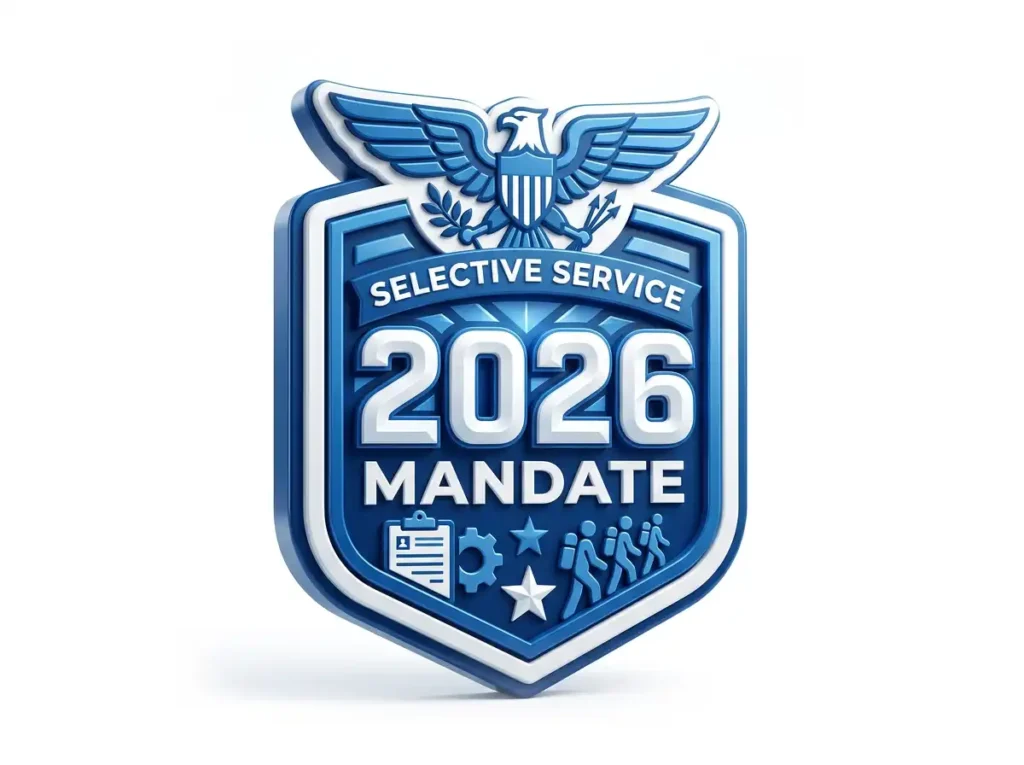

2026 Selective Service Mandate
TL;DR
- The FY 2026 NDAA authorizes the Selective Service System (SSS) to transition from a voluntary registration model to an automated aggregation system by December 2026.
- The legislative update utilizes interagency data from the SSA, IRS, and DHS to automatically register draft-eligible individuals, addressing compliance metrics while introducing new administrative data management practices.
- Legal scholars observe a framework challenge: evaluating the "knowing and willful" standard for non-compliance relies heavily on provable delivery of induction notices under a passively registered system.
- A concurrent bipartisan legislative proposal, the Selective Service Repeal Act, seeks to evaluate the necessity of the system and presents an alternative approach to managing military readiness data.
Introduction: Updates in Civil-Military Relations
On December 18, 2025, President Donald Trump signed into law the National Defense Authorization Act (NDAA) for Fiscal Year 2026, marking a significant structural update in United States civil-military policy. Included within the comprehensive defense policy legislation is a mandate that adjusts the legal and administrative framework between the government and eligible citizens: the authorization for the Selective Service System (SSS) to implement an automated registration process for the military draft.
This statutory adjustment transfers the operational and administrative responsibility for draft registration from individual citizens to the federal agency. By December 2026, the SSS is mandated to operationalize an administrative system that utilizes interagency federal data sources to automatically populate and manage the database of draft-eligible individuals residing in the United States.
The transition to an automated registration framework represents a notable administrative modernization and a structural realignment of the nation's security infrastructure, data management protocols, and registration processes. For several decades, the Selective Service System operated on a model requiring active civilian compliance. The law stipulated that eligible men voluntarily submit their registration within thirty days of their eighteenth birthday. The newly enacted automated mandate replaces this participatory model in favor of an automated demographic data aggregation strategy.
Proponents of the legislation, including defense strategists, executive branch officials, and congressional sponsors, state that this modernization is a practical administrative measure designed to optimize resources and support mobilization readiness by ensuring a complete database in the event of a national emergency. Concurrently, various civil liberties organizations and privacy advocates have raised points of discussion regarding the data-sharing authorities granted to the SSS. These groups express concern that the systemic shift involves complex considerations regarding due process and the procedural processes that historically factor into the executive branch's authorization of military deployments.
Historical Context: The Evolution of Civic Compliance and the 1980 System
To analyze the administrative reasons behind the automation of the Selective Service System, it is helpful to examine the historical data regarding the voluntary compliance model. The United States military has utilized an all-volunteer force since 1973 following the conclusion of the draft during the Vietnam War era. However, the registration apparatus remained intact. In 1980, President Jimmy Carter reinstated the federal requirement for draft registration, functioning largely as a demonstration of national resolve during the Cold War. Under the framework of the Military Selective Service Act (MSSA), eligible individuals aged eighteen through twenty-five were mandated to register their information with the SSS.
Under current law, draft-eligible individuals residing in the US must register within 30 days of their 18th birthday.
The year the United States ended conscription and transitioned fully to an All-Volunteer Force (AVF). The registry acts as a contingency system.
The enforcement mechanisms supporting this mandate were strict on paper. Failure to register is classified as a federal felony punishable by up to five years in federal prison and a fine of up to $250,000. However, the punitive criminal enforcement of this statute has not been a primary strategy for several decades. The Department of Justice has not prosecuted an individual for failing to register since January 1986. This prosecutorial approach is related to the evidentiary standard required: proving that a young man's non-compliance was "knowing and willful," a standard requiring documented proof of intentional evasion rather than administrative oversight.
In place of criminal prosecution, the federal government linked compliance to secondary civil requirements. Non-registrants were deemed ineligible for various federal and state programs. These included eligibility for federal employment, federal job training under the Workforce Innovation and Opportunity Act, and state-based student loans and grant programs in 31 different states. Additionally, the SSS maintained a network of more than 2,000 local draft boards nationwide, staffed by civilian volunteers tasked with reviewing potential deferment claims.
Administrative Ramifications of Non-Registration
Failing to register manually affects eligibility for several federal programs. Automating the system aims to ensure eligible individuals do not inadvertently face these administrative limitations due to non-registration.
For several decades, this administrative structure maintained relatively high registration rates. However, compliance metrics shifted in recent years alongside legislative updates in other sectors. Notably, in 2022, the federal government removed the Selective Service registration requirement from the Free Application for Federal Student Aid (FAFSA). With the decoupling of registration from college financial aid applications, the statistical compliance rates changed. By 2023, the Selective Service System reported that 39.9 percent of draft-eligible individuals complied with the registration requirement upon reaching the mandatory age of eighteen.
Current Compliance Metrics
A stated goal of the automatic registration proposal is to stabilize compliance data. While a significant portion of the demographic registers, the remaining percentage factors into discussions regarding data completeness and program eligibility.
The reduction in registration rates introduced challenges regarding the accuracy of the SSS database. The registry experienced issues with outdated residential addresses, as registrants frequently did not update their residency information with the agency upon relocating. Former Selective Service System Director Bernard Rostker provided testimony to Congress indicating that the manual database faced significant functional limitations regarding completeness and compliance. These operational metrics, combined with discussions regarding mobilization readiness, influenced the Department of Defense and congressional lawmakers to evaluate automated data solutions.
Historical Draft Context
While registration methods are being updated, an active draft has not been utilized since the 1970s. Conscription was historically a method used to expand military capacity during large-scale global conflicts.
Legislative Architecture: The NDAA and the Administrative Goals of Automation
The legislative process for automatic registration involved standard procedural steps within the annual National Defense Authorization Act. The statutory updates redefine the operational approach of the Selective Service System by directing integration with existing federal data sources to construct an inclusive roster of draft-eligible individuals. This procedural shift was managed alongside broader defense policy discussions encompassing the NDAA.
The language for automatic registration was discussed during the drafting of the FY 2025 NDAA (H.R. 8070, the "Servicemember Quality of Life Improvement and National Defense Authorization Act"). During these committee sessions, the House Armed Services Committee reviewed various international topics, such as regional infrastructure funding, defensive system support, and strategic aircraft capacities. Among these broader policy debates, the domestic policy adjustment regarding automatic draft registration was advanced as an administrative update, officially passing in the FY 2026 iteration of the NDAA.
The legislative reasoning focused on operational efficiency and resource allocation. Representative Chrissy Houlahan, a sponsor of the automated registration language, stated that the previous manual model required taxpayer funds to be spent on public education and advertising campaigns intended to encourage registration. By utilizing an automated process, lawmakers noted that the government could reallocate financial resources and personnel hours from public outreach toward mobilization infrastructure and administrative readiness.
| Operational Category | Self-Registration Model (1980-2025) | Automated Registration Model (2026 Onward) |
|---|---|---|
| Locus of Responsibility | Individual citizens. | The Selective Service System (State apparatus). |
| Data Acquisition Mechanism | Submission via postal mail or web portal. | Aggregation from interagency federal databases. |
| Reported Compliance Rate | Recorded at 39.9% at age 18 by 2023. | Expected to reflect the digitally recorded demographic. |
| Agency Resource Focus | Advertising, educational campaigns, and mailings. | Technology modernization and data management. |
| Administrative Alignment | Linked to civil benefit eligibility requirements. | Passive inclusion; focus shifts to data verification. |
To support this framework, the Selective Service System requested a baseline operating budget of $31.3 million for FY 2026. This appropriation directs funds specifically toward administrative readiness, local board maintenance, and database infrastructure, explicitly separate from actual induction operations. The SSS Strategic Plan for Fiscal Years 2026-2030 outlines this focus, noting the agency's use of a $6 million award from the Technology Modernization Fund (TMF) to update legacy software applications. The goal of this technological update is to maintain a scalable data system capable of delivering personnel statistics to the Department of Defense if authorized.
The Administrative Mechanics of Interagency Data Aggregation
Developing the automated system involves following specific administrative procedures. To meet the December 2026 implementation date, the Selective Service System is engaged in drafting administrative rules and establishing memorandums of understanding (MOUs) with partner federal agencies. On March 30, 2026, the SSS officially submitted a proposed rule titled "Automatic Registration" under the Regulation Identifier Number (RIN) 3240-AA09 to the Office of Information and Regulatory Affairs (OIRA) for review.
The implementation process for RIN 3240-AA09 requires the SSS to follow compliance steps under federal data protection statutes, including the Paperwork Reduction Act, the Computer Matching and Privacy Protection Act, and the Privacy Act of 1974. The agency is required to formulate System of Records Notices (SORN) and Privacy Impact Assessments (PIA) detailing the methods by which personally identifiable information (PII) will be managed and acquired through these interagency channels.
To populate the database, the 2026 NDAA authorizes the SSS to utilize information from federal databases that assist in identifying potential registrants. The operational architecture relies on data integration from departments such as the Social Security Administration, the Internal Revenue Service, and the Department of Homeland Security. The standard information fields aggregated from these departments include names, dates of birth, Social Security Numbers, recorded residential addresses, and sex assigned at birth.
Process Transformation Summary
The FY25 NDAA provision enables the Selective Service System to securely reference existing federal databases to register eligible individuals, shifting the procedural steps from the individual to the agency.
Interagency Operations: The Department of Government Efficiency and Data Utilization
The expansion of the SSS database involves interactions with other federal entities tasked with reviewing administrative efficiency. An operational development occurred in April 2026, when personnel from the Department of Government Efficiency (DOGE) initiated reviews at the Selective Service System headquarters and were provided access to elements of the registration infrastructure.
The nature of DOGE's evaluation of the SSS database involves interagency oversight, a process that has prompted organizations like the National Lawyers Guild Military Law Task Force (MLTF) to request clarification regarding the specific computer matching agreements and legal frameworks guiding this data access. An SSS spokesperson confirmed the engagement with DOGE personnel, noting that formal computer matching programs involving SSS registration records had not been finalized at the time of the initial evaluation.
Policy analysts point out that when demographic data collected for national defense mobilization is accessed by agencies managing governmental restructuring or financial audits, it necessitates strict adherence to the data limitation principles outlined in the Privacy Act of 1974. The integration of data processes between the SSS and DOGE represents an operational shift in how the draft registry interacts with broader federal tracking and auditing initiatives.
Legal Considerations: Provable Delivery and the "Knowing and Willful" Standard
The shift to automatic registration involves legal discussions regarding the enforcement of the Military Selective Service Act. Securing a conviction for failing to comply with induction orders requires demonstrating that the violation was "knowing and willful." This legal standard has been a primary factor in the Department of Justice's evaluation of non-compliance cases.
Under the manual registration model, the individual participated in an affirmative action to register. Under the automated model, the registration is processed using interagency data without the active participation of the citizen. Legal scholars note that this passive registration creates complexities in establishing the "knowing and willful" standard for potential evasion.
In the event of an official draft activation, the SSS relies on induction notices sent to addresses on file. Because the automated database utilizes aggregated records, and citizens are not universally required to provide continuous address updates to the federal government, the database relies on the accuracy of its source agencies. Consequently, ensuring the provable delivery of induction notices presents a logistical and legal challenge for enforcement agencies seeking to differentiate between a missed communication and a willful refusal to report.
Constitutional Inquiries and Structural Adjustments
The Selective Service mandate also involves ongoing constitutional discussions regarding the demographic requirements of the registry. The Military Selective Service Act specifies registration based on sex. In the 1981 case Rostker v. Goldberg, the Supreme Court upheld the male-only registration requirement based on the military policies of that era regarding combat roles.
Following the Department of Defense's decision to update policies regarding women in combat roles in 2013, legal organizations such as the American Civil Liberties Union (ACLU) and the National Coalition for Men (NCFM) have petitioned the courts to re-evaluate the constitutionality of a male-only registry. The implementation of automatic registration in 2026 continues to apply the current statutory framework, maintaining the male-only parameter within the automated data infrastructure.
The Role of Public Discourse and Strategic Flexibility Considerations
The automation of draft registration represents a shift in military policy that has generated public debate. The previous self-registration requirement served as an active civic process, requiring individuals to formally acknowledge the registration mandate and providing a defined process for civic interaction.
Civil liberties organizations express that automated registration modifies this process, changing how individuals interact with the system prior to any potential induction. Anti-war coalitions suggest that the active registration process served as a structural element in the broader democratic discussions regarding military deployment.
| Civic Category | Administrative Shift | Procedural Implication |
|---|---|---|
| General Registrants | Transition from active submission to passive inclusion. | Alters the individual's direct interaction with the registration process. |
| Conscientious Objectors | Change in the initial registration interaction. | Procedural shifts in how and when objections are formally filed and recorded. |
| Local Draft Boards | Shift from managing manual registrations to potential data review. | Redefines the administrative scope of volunteer boards prior to mobilization. |
Defense strategy often involves maintaining visible military readiness metrics. Policy analysts note that possessing an automated roster provides military planners with comprehensive demographic data. The discussion centers on how the availability of this automated manpower data factors into strategic planning and the political evaluations required when considering large-scale military operations.
Legislative Proposals: The Selective Service Repeal Act
Alongside the implementation of the automated mandate, there is a concurrent legislative proposal known as the Selective Service Repeal Act, which seeks to evaluate the necessity of the Military Selective Service Act.
The Repeal Act proposes to end the registration requirement, dissolve the civilian local boards, and transfer the records of the Selective Service System for archival purposes. The legislation also aims to address past compliance issues by removing the administrative penalties associated with non-registration, effectively restoring eligibility for affected federal and state benefits.
Proponents of the repeal act suggest that maintaining an automated registry is an inefficient use of resources and that a technologically advanced, all-volunteer military fulfills current national security requirements without relying on mass conscription frameworks. As the 2026 timeline approaches, legislative discussions continue to weigh the administrative goals of data automation against proposals to fundamentally restructure or repeal the registry system.
Conclusion
The inclusion of automatic Selective Service registration within the Fiscal Year 2026 National Defense Authorization Act represents a procedural update in national security and demographic data management. Initiated as a solution to address changing rates of voluntary compliance and to modernize agency infrastructure, the federal government has authorized a system designed to maintain readiness metrics through interagency data utilization.
The implementation of this automated system involves navigating specific administrative and legal frameworks. The reliance on external databases requires processes to manage data accuracy and adherence to specific statutory guidelines. Additionally, the shift to passive registration requires legal evaluations regarding how enforcement standards, such as provable delivery, function within the new model.
The secondary considerations of this policy update involve discussions on data privacy and interagency information sharing. The expansion of the Selective Service database and its intersections with other federal operations highlight the complexities of utilizing demographic data across government departments. As the December 2026 deadline for implementation proceeds, policy discussions continue to examine the administrative functionality of the automated system alongside legislative proposals seeking alternative approaches to military readiness planning.
Streamline Your Workforce Management
Ensure your organization stays compliant, efficient, and ready for any regulatory changes with our specialized tools.
Explore Government Agency SolutionsDisclaimer: The content provided on this webpage is for informational purposes only and is not intended to be a substitute for professional advice. While we strive to ensure the accuracy and timeliness of the information presented here, the details may change over time or vary in different jurisdictions. Therefore, we do not guarantee the completeness, reliability, or absolute accuracy of this information. The information on this page should not be used as a basis for making legal, financial, or any other key decisions. We strongly advise consulting with a qualified professional or expert in the relevant field for specific advice, guidance, or services. By using this webpage, you acknowledge that the information is offered “as is” and that we are not liable for any errors, omissions, or inaccuracies in the content, nor for any actions taken based on the information provided. We shall not be held liable for any direct, indirect, incidental, consequential, or punitive damages arising out of your access to, use of, or reliance on any content on this page.
About The Author

Roger Wood
With a Baccalaureate of Science and advanced studies in business, Roger has successfully managed businesses across five continents. His extensive global experience and strategic insights contribute significantly to the success of TimeTrex. His expertise and dedication ensure we deliver top-notch solutions to our clients around the world.
Time To Clock-In
Start your 30-day free trial!
Experience the Ultimate Workforce Solution and Revolutionize Your Business Today
- Eliminate Errors
- Simple & Easy To Use
- Real-time Reporting

Saving businesses time and money through better workforce management since 2003.
Copyright © 2026 TimeTrex. All Rights Reserved.