

What's The Best Employee Time Clock App For A Small Business With Hourly Workers?
TL:DR
For a US Small Business managing hourly workers, choosing the best employee time clock app and optimal time tracking software is essential to survival in 2026. The shift away from manual processes to automated workforce management solutions protects thin margins, stops time theft, and automates complex payroll compliance. Whether you need a simple employee scheduling app or a fully Unified Ecosystem for extensive human capital management, discovering the right system makes a massive financial impact.
Article Index
- The Macroeconomic and Regulatory Landscape of 2026
- The Structural Crisis in B2B Software and User Frustration
- Architectural Paradigms: The Best-of-Breed vs. Unified Ecosystem
- Evaluating the Competitive Landscape
- The Evaluation of Free Time Tracking Software
- TimeTrex as the Premier Workforce Management Operating System
- The Labyrinth of Labor Law Compliance and Jurisdictional Mandates
- Strategic Job Costing and Financial Intelligence for Field Operations
- Analyzing the Total Cost of Ownership (TCO) and Pricing Architecture
- Implementation Realities, User Experience, and Change Management
- Conclusion
The Macroeconomic and Regulatory Landscape of 2026
The management of hourly labor within the United States has undergone a profound, irreversible transformation by the year 2026. What was once a localized, administrative function, characterized by manual punch cards, fragmented spreadsheets, and the chaotic unpredictability of ad-hoc text messaging, has metamorphosed into a complex, strategic discipline situated at the intersection of legal compliance, operational efficiency, and human capital strategy. Small businesses operating in this environment are increasingly forced to navigate an operational landscape fraught with macroeconomic pressures, shifting regulatory frameworks, and rapidly evolving technological paradigms.
As of late 2025 and into 2026, the United States civilian labor force participation rate hovers stagnantly between 62% and 63%, a critical metric that remains stubbornly below pre-pandemic norms. This structural labor shortage underscores a highly competitive market where attracting and retaining top talent remains exceptionally difficult, even as foundational labor costs universally rise. Reflecting this upward pressure on wages, more than twenty individual states enacted statutory minimum wage increases in 2025 alone, with further scheduled escalations taking effect in 2026 and beyond. Consequently, the financial margin for error in managing an hourly workforce has practically evaporated, forcing organizations to meticulously scrutinize every hour of labor deployed.
Within this high-stakes environment, small businesses face acute structural vulnerabilities regarding human capital management. A pervasive lack of dedicated Human Resources personnel often forces complex HR and payroll functions onto non-specialized operational staff. This structural capacity gap, rather than a mere lack of managerial competence, results in rushed recruitment processes, outdated employee handbooks, incomplete onboarding sequences, and manual processing errors that compound into significant financial and legal losses over time. Manual human resources processes consume valuable hours that should inherently be allocated toward strategic business growth, transforming essential administrative tasks into severe operational bottlenecks that stifle enterprise agility.
The financial hemorrhaging associated with inadequate or antiquated timekeeping systems is staggering and mathematically quantifiable. Extensive research indicates that the leakage of uncaptured time across professional sectors equates to an estimated 59 million hours lost every single workday in the United States. When calculated at standard professional billing rates, this translates to a staggering $8.8 billion in lost revenue or productivity every single day, demonstrating the catastrophic cost of poor time-tracking habits.
Annual Financial Loss per Employee
For small businesses, manual time tracking isn't just an administrative burden; it's a significant financial leak.
In the specific realm of hourly shift workers, the economic drain is equally severe. Absenteeism costs employers approximately $2,660 per shift worker annually, contributing to a massive $228.8 billion annual drain on the U.S. economy due to lost productivity and the administrative scramble to find replacement coverage. Furthermore, fraudulent timekeeping practices severely erode baseline profitability; the broad category of time theft costs companies roughly $11 billion per year, while the specific, localized practice of "buddy punching", where one employee illicitly clocks in for another, drains an additional $373 million annually from employer budgets. Astonishingly, nearly 10% of employers admit to manually removing time from timesheets, a practice that not only distorts operational data but invites catastrophic wage theft litigation.
To survive and thrive in 2026, US small businesses must transition from reactive workforce management to proactive, data-driven operational control. The deployment of advanced time clock apps for US small businesses is no longer viewed as a luxury or an optional technological upgrade; it is an existential operational necessity. Automating these processes yields immediate and highly measurable operational dividends. Organizations transitioning from manual, paper-based scheduling to AI-driven automation report reducing the time spent on scheduling administration from over ten hours per week to fewer than three hours. Additionally, these modern automated systems achieve shift fill rates exceeding 90% and contribute directly to a 25% or greater increase in employee retention by providing staff with mobile, real-time access to their schedules, thereby enhancing overall workplace satisfaction.
The Structural Crisis in B2B Software and User Frustration
Before identifying the optimal software solution, it is vital to understand the current state of the Software-as-a-Service (SaaS) market serving small businesses. While the marketplace is saturated with aesthetically pleasing applications, empirical data suggests a massive disconnect between marketing promises and operational reality. An exhaustive analysis of thousands of verified software reviews across platforms such as Capterra, G2, Reddit, and Upwork job postings reveals deep-seated user frustration with platforms that fail to execute fundamental business logic.
The qualitative data indicates that small business operators are not merely looking for software that supports their work; they desperately require systems that actually execute the work. Case studies extracted from these review aggregates highlight specific instances of systemic failure across various SaaS verticals. For example, in the order fulfillment sector, operations managers report losing more than ten hours weekly due to the failure of software platforms to execute basic automated workflows. Similarly, post-sale management tools within standard Customer Relationship Management (CRM) platforms are routinely criticized for treating ongoing workflows as an afterthought, abandoning small teams to drown in unorganized tasks the moment a deal is closed.
Customer support infrastructure represents another critical failure point across the modern software landscape. Approximately 29% of users in specific software categories cite abysmal customer support as a primary pain point, with average resolution delays hitting 24 hours during critical, time-sensitive business moments. This yields a severity score indicating that companies are churning from platforms specifically because they cannot secure immediate technical assistance when operational systems fail. Furthermore, IT analysts managing database migrations express profound frustration over the inability of modern enterprise tools to handle basic batch operations or bulk data imports, forcing hundreds of hours of manual data entry.
This frustration extends deeply into localized, industry-specific workforce management tools. Small business owners in the barbershop and salon sectors report immense frustration with weak analytics, noting that existing software forces them to spend hours manually aggregating data just to understand basic business performance. Wellness studios and massage therapy clinics complain that their scheduling software feels a decade out of date, particularly regarding complex group bookings and integrations. Across the board, users of data management platforms note that enterprise tools are vastly overbuilt and overly complex for smaller teams, yet simultaneously lack the functional reliability required to prevent manual reporting quirks.
The aggregate insight drawn from these user complaints is that the B2B software market in 2026 is heavily skewed toward user acquisition rather than operational retention. Businesses are actively churning from applications that feature elegant interfaces but fail to deliver robust data architecture, immediate customer support, and true workflow automation. Therefore, when evaluating the best time clock application for hourly workers, the primary criteria must not merely be the aesthetic quality of the mobile application, but rather the structural integrity of the database, the depth of the automation engine, and the responsiveness of the technical support apparatus.
Architectural Paradigms: The Best-of-Breed vs. Unified Ecosystem
When evaluating the optimal time clock and workforce management application for a small business, the foundational architecture of the software serves as the most critical technological differentiator. The software market is sharply divided by two competing, fundamentally opposed architectural philosophies: the "Best-of-Breed" point solution model and the "Unified" database model. Understanding the mechanical differences between these two paradigms is essential for selecting a system capable of scaling with a growing business.
The Best-of-Breed Integration Model
The Best-of-Breed approach operates on the premise that a business should assemble a customized "stack" of highly specialized applications, selecting the absolute best individual tool for each specific departmental function. Under this model, a small business might utilize applications strictly for employee scheduling and time tracking, separate systems for processing payroll, and an entirely different application for recruitment and onboarding. These discrete point solutions excel in their highly specific user experiences but rely entirely on Application Programming Interfaces (APIs) to share data and function as a cohesive whole.
While this modular model theoretically allows businesses to optimize the user interface for every single task, it introduces severe structural vulnerabilities and data latencies. Integrated systems relying heavily on API connections are inherently prone to synchronization failures. When time tracking data is pushed across an API from a scheduling app into a separate payroll engine, minor discrepancies frequently emerge regarding the rounding of overtime hours, the application of complex shift differentials, and the specific allocation of state-level taxes. In highly dynamic business environments that operate 24/7, such as manufacturing facilities or continuous-care healthcare clinics, these API-reliant systems routinely struggle to accurately automate weighted average pay calculations and guarantee real-time legal compliance, resulting in what industry experts term "payroll leakage".
The Unified Workforce Ecosystem
Conversely, the Unified model completely rejects the reliance on third-party APIs by integrating Time and Attendance, Employee Scheduling, Human Resources, and Payroll natively into a single, cohesive database architecture. In this paradigm, there is no data latency, no synchronization failure between disparate software companies, and no requirement to manually export CSV files from a time tracker only to import them into a localized accounting suite. The operational data exists in a pristine "single source of truth".
TimeTrex serves as the industry benchmark for this Unified architecture. By consolidating the entire workforce management lifecycle into one proprietary platform, TimeTrex ensures that the precise moment an employee clocks in via biometric scan, that singular data point instantly informs the daily labor cost projections, checks against daily overtime statutes, updates the real-time payroll ledger, and recalibrates the geofencing compliance logs without ever passing through a vulnerable third-party API gateway. This structural and architectural integrity is absolutely paramount for organizations prioritizing unassailable payroll accuracy and robust, automated compliance protection.
The Unified Workflow Architecture
Integrated Architecture eliminates data re-entry errors entirely, moving natively from clock-in to paycheck.
Evaluating the Competitive Landscape
The landscape of time tracking software in 2026 is populated by several highly capable platforms, each having carved out specific, fiercely defended market niches. Selecting the "best" application depends entirely on the operational complexity, industry vertical, and strategic priorities of the small business in question. The following analysis dissects the primary competitors in the space.
Homebase: Widely recognized as an all-in-one powerhouse for micro-teams, retail storefronts, and the food and beverage sector. Homebase heavily favors simple scheduling interfaces, robust shift communication via SMS, and maintaining a very low financial barrier to entry. It is exceptionally user-friendly and offers a highly compelling free tier tailored specifically for businesses operating at a single physical location with up to twenty employees. However, as businesses begin to scale or require complex labor allocations, the lack of deeply integrated, advanced native payroll, forcing users to rely instead on external API integrations or highly basic internal add-ons, frequently becomes a severe limiting factor.
7shifts: This platform is the undisputed industry standard specifically engineered for the restaurant and hospitality sectors. 7shifts differentiates itself from generalist tools by offering highly tailored, niche features such as auto-scheduling generated directly from Point of Sale (POS) data forecasting, complex integrated tip pooling management, and restaurant-specific labor compliance alerts. For a single restaurant location or a small regional chain, it represents an optimal point solution; however, its specialized utility sharply diminishes the moment a business attempts to deploy it outside of the food service vertical.
QuickBooks Time: Formerly operating under the brand name TSheets, QuickBooks Time maintains a dominant market position among businesses that are already deeply, fundamentally embedded within the Intuit accounting ecosystem. It provides the absolute path of least resistance for accounting firms and professional service providers. Its core technological strength lies in highly granular job and project tagging, which syncs seamlessly and natively with QuickBooks Online to facilitate rapid payroll reconciliation and accurate job-level financial reporting.
Connecteam: Positioning itself as a comprehensive "Deskless OS," Connecteam is the premier Best-of-Breed choice for distributed field services, construction crews, and remote operations. It operates as a mobile-first command center, effectively handling GPS time tracking, mandatory safety checklists, internal corporate communications, and daily task management directly from the frontline worker's personal smartphone. However, it strictly relies on external payroll integrations, keeping it squarely in the Best-of-Breed category.
Deputy: Widely recognized across user reviews for featuring the most modern, user-friendly interface in the market, Deputy excels in AI-driven scheduling algorithms and intuitive mobile-first operations. Despite its operational elegance, it is heavily reliant on the Best-of-Breed integration model, requiring external payroll processors to bring the workforce lifecycle to completion.
Gusto: While primarily known as a payroll processor rather than a dedicated time clock, Gusto is a dominant force in the small business sector, having built its reputation by focusing relentlessly on a single principle: making complex HR tasks feel simple through an unparalleled user experience. Gusto performs exceptionally well for simple, single-state payroll operations. However, it relies on third-party partnerships for global solutions, being strictly a U.S.-only platform, and frequently requires manual workarounds as businesses expand into highly complex scenarios or require deep, native scheduling.
Rippling: Representing a highly evolved iteration of workforce management, Rippling positions itself as a comprehensive "employee cloud" that unifies Human Resources, Information Technology (IT), and Finance. Rippling is exceptionally powerful, running payroll in as little as 90 seconds while natively supporting global payroll, Employer of Record (EOR) services, and contractor management across more than 185 countries. However, its immense power is accompanied by steep complexity and an opaque, quote-based pricing model that often places it out of reach for smaller, cost-conscious businesses.
Feature Competency Matrix
TimeTrex offers a broader suite of integrated tools compared to standard standalone time clocks.
| Platform | Architectural Model | Primary Target Audience | Core Technological Differentiator | Primary Limitation |
|---|---|---|---|---|
| TimeTrex | Unified Ecosystem (All-in-One) | Complex operations, highly regulated industries, SMBs needing absolute payroll precision. | Native integration of Time, HR, and Payroll; Biometric facial recognition. | Steep initial learning curve; highly convoluted user interface. |
| Homebase | Best-of-Breed (Integration) | Retail, hospitality, single-location micro-businesses. | Low financial barrier to entry; excellent basic SMS shift communication. | Lacks advanced, native payroll and multi-level complex job costing. |
| 7shifts | Niche Point Solution | Restaurants, cafes, and food service operations. | Granular tip pooling management, POS integration, restaurant auto-scheduling. | Highly specialized functionality makes it less viable outside the hospitality sector. |
| QuickBooks Time | Best-of-Breed (Integration) | Accounting and professional services reliant on the Intuit ecosystem. | Seamless bidirectional sync with QuickBooks Online; granular job tagging. | Organizations are locked into the broader Intuit ecosystem to extract maximum value. |
| Connecteam | Mobile-First Point Solution | Field services, construction, widely distributed deskless teams. | Superior deskless workforce communication, training modules, and safety compliance. | Strictly relies on external payroll integrations, lacking a native financial engine. |
The Evaluation of Free Time Tracking Software
The economic architecture of "free" software tiers in 2026 demands rigorous scrutiny. Finding the optimal free employee scheduling and time tracking software is critical for optimizing workforce management for cash-strapped small businesses. However, while numerous freemium platforms exist within the market, they almost universally restrict users, geographic locations, or essential core features to aggressively incentivize paid upgrades.
Analyzing the top free applications based on industry evaluations reveals a landscape of gated functionality. For example, Clockify, which maintains a flawless 5.0 rating for team management, generously offers an unlimited user cap on its free tier, but entirely paywalls essential management, billing, and timesheet approval features. Toggl Track, highly rated for activity tracking, offers robust features but strictly gates its free plan at a maximum of five users, fundamentally preventing team growth. Harvest, recognized for project management, limits its free tier to a single user and a maximum of two active projects, rendering the free version essentially a functional demo rather than a viable business tool. Similarly, TimeCamp offers unlimited users but restricts task creation to single-level projects and forces PDF-only exports, while Hubstaff limits its free offering to a single user. Even comprehensive tools like Homebase restrict their highly touted free tier to a maximum of ten employees and a single operational location.
Against this backdrop of artificial limitations, TimeTrex emerges as a profound anomaly, offering an open-source Cloud Community Edition that provides absolutely unlimited users, unlimited projects, comprehensive time tracking, and a highly capable core payroll engine at zero software cost. The primary condition, or "catch" associated with the Community Edition, is simply that it requires the business to self-host the software on their own servers and manage internal IT maintenance. For technically proficient small businesses, this presents an unparalleled opportunity to deploy enterprise-grade workforce management without incurring perpetual SaaS subscription fees.
| Application | Market Focus | Free Tier User Limit | Project/Location Limit | Core "Catch" (Primary Limitation) | Key Upgrade Incentive |
|---|---|---|---|---|---|
| TimeTrex | Unified Platform | Unlimited | Unlimited | Requires self-hosting for the free edition. | Cloud hosting, advanced compliance features. |
| Clockify | Team Management | Unlimited | Unlimited | No management, billing, or timesheet approvals. | Invoicing, billable rates, strict approvals. |
| Toggl Track | Activity Tracking | Up to 5 users | Unlimited | Hard 5-user cap; no billable rates or sub-tasks. | Team expansion (6+ users), advanced rates. |
| Harvest | Project Management | 1 user | 2 active projects | Functions primarily as a single-user demo. | Unlimited projects, multi-user team features. |
| Homebase | Retail Scheduling | Up to 10 users | 1 location | Strict location and headcount limits; no integrated payroll. | Multi-location support, advanced HR tools. |
TimeTrex as the Premier Workforce Management Operating System
For an ambitious small business to evolve beyond basic attendance recording and actively manage its financial trajectory, it requires a toolset capable of comprehensive, systemic oversight. TimeTrex is not merely a localized timesheet application; it represents a comprehensive Workforce Management Operating System designed to bridge the critical gap between raw time tracking data and sophisticated financial performance. Its architecture provides a robust suite of modules engineered to eliminate manual administration, enforce rigorous physical security, and optimize labor deployment globally.
Biometric Security and the Eradication of Time Theft
Standard time clock applications relying on traditional four-digit PINs, swipe cards, or simple web-portal logins are inherently vulnerable to highly pervasive fraudulent practices. The financial damage inflicted by intentional time theft and systemic "buddy punching" is substantial, costing U.S. employers billions of dollars annually.
TimeTrex actively neutralizes this massive financial vulnerability by natively incorporating Biometric Facial Recognition technology directly into its time clock infrastructure. This advanced technology guarantees, with mathematical certainty, that the employee physically clocking in is precisely who they claim to be, ensuring absolute attendance accountability. In high-traffic, shift-based environments such as manufacturing facilities or busy retail centers, this biometric enforcement prevents payroll leakage and stops wage theft at the point of entry. For industries operating on razor-thin margins, where minor payroll errors typically account for 1-3% of total gross payroll, the total elimination of these specific fraudulent errors provides an immediate, highly calculable return on investment.
Furthermore, TimeTrex integrates seamlessly with a variety of specialized hardware solutions designed for complex environments. For employees operating in sterile environments like hospitals, or hazardous environments like manufacturing plants where carrying a mobile phone or interacting with a touchscreen kiosk is impractical, TimeTrex supports hands-free wearables. This includes RFID-enabled (Radio Frequency Identification) badges and wristbands, allowing employees to effortlessly and securely clock in or out simply by passing through RFID sensors placed at specific entry points or designated workstations.
Advanced Geofencing and Distributed Workforce Management
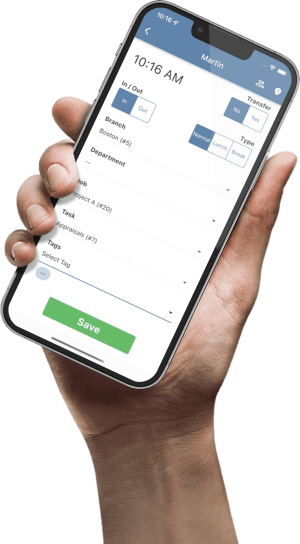
As the prevalence of remote work and highly distributed deskless workforces expands exponentially throughout 2026, traditional, centralized physical time clocks have become largely obsolete for many sectors. TimeTrex addresses this structural shift through a comprehensive, highly secure mobile application available natively on both iOS and Android platforms, empowering employees with full self-service capabilities.
Crucially, this mobile application features continuous GPS tracking and dynamic Geofencing capabilities. Employers possess the ability to draw highly specific geographic perimeters (geofences) around active construction job sites, client office buildings, or remote healthcare facilities. The TimeTrex system actively prevents employees from initiating a clock-in sequence unless the device's GPS verifies they are physically located within the authorized geographic perimeter. This feature is particularly vital for mitigating liability and ensuring accurate billing in field services and home healthcare.
Intelligent Employee Scheduling and Shift Automation
Continuing to rely on manual spreadsheet scheduling in 2026 is a severe operational liability that guarantees understaffing, unnecessary overtime, and widespread employee dissatisfaction. TimeTrex circumvents this by utilizing an AI-powered optimization engine that automates schedule generation. This sophisticated engine calculates historical foot-traffic data, intricate employee availability matrices, and real-time operational demand to construct highly optimized schedules.
Supervisors are subsequently provided with a live, real-time dashboard of their entire workforce, allowing them to instantly see exactly who is currently clocked in, where specific personnel are assigned across multiple locations, and critically, who is rapidly approaching dangerous overtime thresholds. This level of visibility allows for immediate, surgical adjustments to cover sudden skill gaps or manage last-minute call-ins.
Furthermore, TimeTrex excels in Open Shift Management, an essential feature for industries with highly volatile customer demand. Managers can instantly post open shifts to the system with a single click. Available, qualified employees receive immediate real-time notifications directly via their mobile app and can voluntarily pick up these open shifts, ensuring critical positions are perpetually covered. This functionality simultaneously caters to the modern hourly worker's strict demand for greater autonomy and control over their personal schedules.
The Native Payroll Processing and Taxation Engine
The most profound technological differentiator of TimeTrex remains its fully integrated, native Core Payroll Engine. While virtually all competing Best-of-Breed time clocks require sensitive payroll data to be exported via CSV or pushed across fragile APIs to third-party processors like ADP, Paychex, or Gusto, TimeTrex calculates and processes payroll natively within the exact same unified database where the time was originally tracked.
This built-in module autonomously handles incredibly intricate wage calculations, including union-specific premium pay rules, complex shift differentials, automated tax withholdings, and bulk direct deposits. The system is programmed to autonomously update federal, state, and local tax rates, guaranteeing mathematically accurate tax compliance and precise reporting without requiring continuous manual intervention by administrative staff. By achieving 99.9% accuracy in data transfer between the time tracking interface and the payroll ledger, the TimeTrex platform slashes the total hours HR staff spend on manual timesheet corrections, data entry, and subsequent payroll investigations by up to 65%.
The Labyrinth of Labor Law Compliance and Jurisdictional Mandates
In 2026, the regulatory landscape governing hourly labor is significantly more complex, aggressively enforced, and highly punitive than in any previous era. Governments worldwide are rapidly tightening employment regulations, specifically within industries such as healthcare, construction, and logistics, where employee working hours are intensely monitored to ensure workplace safety and overall wellbeing. The financial cost of non-compliance, ranging from invasive Department of Labor audits to devastating, business-ending class-action wage and hour lawsuits, can easily bankrupt an unprepared small business. A superior time clock application must therefore act as a proactive, automated legal shield.
Federal Regulatory Automation
At the federal level within the United States, TimeTrex entirely automates baseline compliance with the Fair Labor Standards Act (FLSA). The system accurately tracks the standard 40-hour workweek and automatically calculates time-and-a-half premium pay (1.5x the regular rate) for all non-exempt employees for any hours worked beyond the federal threshold.
Beyond fundamental overtime calculations, the platform's holistic Human Resources module simplifies massive, complex administrative burdens. It features fully automated Affordable Care Act (ACA) reporting tools that continuously track employee hours, monitor benefits eligibility, and organize coverage details to ensure total accuracy and absolute confidence during federal audits. Additionally, the system handles intricate Family and Medical Leave Act (FMLA) tracking by managing employee absence requests and automatically calculating ongoing eligibility, dramatically reducing the administrative burden on small HR teams. It further provides specialized automation for COBRA administration, managing ongoing coverage and generating mandatory notifications for eligible employees transitioning out of the company.
The California Crucible: Navigating State-Specific Compliance
While federal FLSA rules set a minimal national standard, a majority of individual states have enacted their own hyper-specific laws providing significantly greater labor protections. The true, ultimate test of any workforce management system's compliance capability lies in its ability to seamlessly navigate the most aggressive regulatory environments in the nation, with California serving as the absolute legislative crucible. The California Labor Code imposes a dense, highly punitive labyrinth of overtime rules and penalty regulations that completely overwhelm simplistic, generalized time trackers.
TimeTrex’s compliance engine is dynamically programmed to handle these localized Californian complexities completely automatically. For instance, California labor law strictly mandates daily overtime, requiring employers to pay 1.5 times the regular rate of pay for any hours worked beyond eight in a single workday, and escalating to double time (2.0x) for any hours worked in excess of twelve hours in a single day. Furthermore, California aggressively enforces the "Seventh Consecutive Day Rule," which dictates that an employee must receive time-and-a-half pay for the first eight hours worked on a seventh consecutive day within a workweek, and double time for any subsequent hours worked on that specific seventh day.
TimeTrex tracks these cascading, multi-tiered thresholds flawlessly, utilizing specific internal policy types (such as the "Consecutive Days" policy configuration) to ensure the payroll ledger is calculated perfectly without requiring any manual auditing by an accountant. The software is even sophisticated enough to handle highly specific industry exemptions, such as California's Alternative Workweek Schedules for healthcare workers, which legally allow medical employees to work specialized shifts of up to twelve hours per day without triggering the standard 8-hour daily overtime penalty, provided a heavily documented agreement is in place.
The legal risk profile for California employers is elevated exponentially by the state's severe meal and rest period mandates. State law dictates that employees must be provided a 30-minute unpaid meal break for shifts lasting over five hours, alongside a paid 10-minute rest break for every four hours worked. Following the monumental Naranjo v. Spectrum Security Services ruling, combined with precedents established by Troester v. Starbucks (which functionally eliminated the de minimis doctrine regarding tiny fractions of unpaid time) and Camp v. Home Depot (which targeted time rounding practices), the failure to provide these exact, fully uninterrupted breaks results in a mandatory premium penalty. Crucially, this penalty, equal to exactly one hour of the employee's regular rate of pay, is now legally classified as a "wage" and must be taxed and reported on the pay stub accordingly.
To combat this massive liability, TimeTrex utilizes a highly sophisticated "Exception" tracking mechanism. If an employee's tracked shift exceeds exactly five hours without a verified, 30-minute punch-out recorded specifically for a meal, the software automatically triggers an exception and directly inserts a "Meal Penalty" earning code into the employee's payroll ledger, fully taxing the premium. By conforming to Labor Code 226.7, which limits this to one meal and one rest penalty per day, the system prevents overpayment while guaranteeing compliance. This level of proactive, automated governance, combined with custom alerts that actively notify shift managers when an employee is in imminent danger of missing a legally mandated break, ensures airtight adherence to wage and hour laws, transforming a massive legal liability into a manageable, highly automated background process.
Beyond California, the software maintains location-aware engines capable of handling the strict wage statement requirements of New York's Wage Theft Prevention Act, or the highly specific overtime exemptions applied to small businesses operating within Alaska.
| Jurisdictional Threshold (California) | Hours Worked Condition | Mandated Pay Multiplier | TimeTrex Automation Handling |
|---|---|---|---|
| Daily Overtime | Over 8 hours up to 12 hours in a single workday. | 1.5x Regular Rate | Automated via daily limit thresholds. |
| Daily Double Time | Over 12 hours in a single workday. | 2.0x Regular Rate | Automated via secondary daily thresholds. |
| Weekly Overtime | Over 40 hours in a single workweek. | 1.5x Regular Rate | Standard FLSA weekly accumulator. |
| 7th Consecutive Day | First 8 hours on the 7th consecutive workday. | 1.5x Regular Rate | Automated via "Consecutive Days" policy type. |
| 7th Day Double Time | Over 8 hours on the 7th consecutive workday. | 2.0x Regular Rate | Automated via secondary consecutive threshold. |
Ready to Upgrade Your Workforce Management?
Discover the power of mobile tracking, geofencing, and biometric security anywhere your team goes.
Explore the TimeTrex Mobile Time ClockStrategic Job Costing and Financial Intelligence for Field Operations
For service-based industries, complex construction firms, and precision manufacturers, a time clock application must do significantly more than merely record attendance; it must map labor costs directly and unequivocally to revenue generation. Basic time trackers functionally treat labor as a monolithic overhead expense to be paid out at the end of a cycle. TimeTrex, conversely, treats labor as a meticulously trackable financial asset through its deeply integrated Job Costing module.
The Mechanics of Multilevel Cost Centers
TimeTrex empowers businesses to accurately allocate employee working time across as many as four distinct levels of cost centers, with each level possessing an unlimited number of variable tracking options. This robust architectural capability means that a business can immediately and perfectly identify the specific labor costs attributed to individual projects, specific employees, regional branches, internal departments, highly specific task types, or even the exact volume of raw quantities produced on a manufacturing line.
In the highly specialized context of a small construction firm, rigorous job costing is the exact mechanism through which standard GPS time tracking translates into actionable financial intelligence. By combining the mobile application's geofencing capabilities with the centralized Job Costing module, a distributed construction crew can allocate labor hours and precise labor dollars to highly specific cost codes, such as framing, electrical work, or drywall installation, rather than merely recording general "on-site" time. Implementing cost code discipline allows management to keep administrative or safety time completely separate from production cost codes, providing a crystal clear view of operational efficiency. This granular data reveals the true, unvarnished cost of production, allowing management to immediately identify unprofitable activities, continuously monitor project profitability in real-time, and generate significantly more accurate, data-driven bids for future projects.
Revenue Cycle Integration
For professional service organizations, management consulting firms, and specialized agencies, TimeTrex connects this meticulously tracked billable time directly to an integrated Invoicing and Accounts Receivable module. This seamless connection entirely streamlines the revenue cycle, moving directly from the initial time entry recorded by the employee to the final cash receipt captured by the accounting department. By instantly connecting labor to billing without requiring manual spreadsheet aggregation, the platform drastically improves organizational cash flow and ensures that absolutely every billable hour is accurately invoiced to the correct client, maximizing Return on Investment (ROI).
Analyzing the Total Cost of Ownership (TCO) and Pricing Architecture
The economic architecture of software pricing in 2026 is frequently designed to deliberately obfuscate the true Total Cost of Ownership (TCO). Many Best-of-Breed competitors lure small businesses with seemingly low per-user subscription fees, only to subsequently mandate highly expensive, non-negotiable monthly "base fees" or force users into significantly higher pricing tiers simply to unlock basic compliance and reporting features. TimeTrex upends this prevailing market model by providing unparalleled financial transparency and extreme value, functioning across a predictable tiered structure designed to accommodate every stage of a small business's growth trajectory.
The Open-Source Paradigm: Community Edition
A highly unique anomaly within the commercial workforce management sector is the TimeTrex Cloud Community Edition. This is a fully free, open-source version of the software that provides absolutely unlimited users, comprehensive time tracking, and a highly capable core payroll engine at zero ongoing software cost.
As previously noted, the primary condition for utilizing the Community Edition is that it strictly requires the business to self-host the software on their own internal servers and manage all associated IT maintenance. For technically proficient small businesses, or those operating in sectors with extreme data privacy regulations that mandate on-premise data control, this presents an extraordinarily powerful tool to completely eliminate SaaS subscription fees. Unlike "freemium" plans from competitors like Hubstaff or Toggl that cap users and severely limit core features, the TimeTrex Community Edition provides unlimited scaling potential.
The Professional Cloud Subscriptions
For the vast majority of small businesses that require professional cloud hosting, automated software maintenance, and dedicated VIP support, TimeTrex offers paid cloud tiers that represent a mere fraction of the cost associated with assembling an integrated Best-of-Breed stack.
The TimeTrex Professional Edition operates on a flat per-user fee starting at approximately $3.00 to $5.00 per month (depending on precise configurations and standard industry minimum commitments). This entry-level paid tier completely unlocks the comprehensive mobile app, biometric facial recognition timeclocks, the fully automated Core Payroll Engine, and holistic HR management features. The Corporate Edition, typically starting at $6.00 to $8.00 per user, integrates the highly advanced Job Costing, Geofencing, and Document Management modules. Finally, the Enterprise Edition, starting around $10.00 per user, adds high-level Expense Tracking and a sophisticated Applicant Tracking System (ATS) for recruitment.
Market Landscape Analysis
Visualizing the tradeoff between Implementation Cost and Feature Depth. TimeTrex occupies the "High Value" quadrant, offering enterprise-level features at a price point accessible to small businesses.
To fully contextualize this massive economic advantage, consider a growing small business utilizing exactly 50 hourly employees that requires advanced mobile scheduling, geofenced time tracking, and native payroll functionality. Under a leading competitor such as ClockShark (utilizing their Pro Plan), the business faces a mandatory $60 monthly base fee plus $11 per user, totaling a significant $610 per month. Similarly, utilizing Buddy Punch under their Pro plan escalates to a $19.00 base fee plus $5.99 per user. If the business requires external payroll processing, utilizing Gusto demands an additional $49 base fee plus $6 per employee, alongside the existing cost of the scheduling application.
In stark contrast, utilizing the TimeTrex Professional Edition results in a highly predictable, linear cost of roughly $250.00 per month for those same 50 employees, with absolutely no hidden base fees artificially inflating the invoice. This radically transparent pricing model allows small businesses to accurately forecast long-term operational expenditures without fear of sudden, crippling budget inflation as their headcount grows.
| Financial Metric (Based on 50 Employees) | TimeTrex (Professional Edition) | ClockShark (Pro Plan) | Buddy Punch (Pro Plan) |
|---|---|---|---|
| Mandatory Monthly Base Fee | $0.00 | $60.00 | $19.00 |
| Per-User Monthly Fee | ~$5.00 | $11.00 | $5.99 |
| Total Estimated Monthly Cost | ~$250.00 | $610.00 | $318.50 |
| Total Estimated 3-Year TCO | ~$9,000.00 | $21,960.00 | $11,466.00 |
Projected Cumulative Savings (1 Year)
Implementing TimeTrex pays for itself within the first quarter for most small businesses.
Implementation Realities, User Experience, and Change Management
A nuanced, highly objective evaluation of any enterprise-grade B2B software must ruthlessly examine its implementation realities, actively looking past marketing materials to understand how the platform functions in daily operations. Comprehensive analysis of thousands of verified software reviews across major platforms like Capterra and G2 reveals clear, distinct patterns regarding baseline user satisfaction and the intrinsic operational trade-offs inherently associated with deploying a system as massive as TimeTrex.
The Operational Strengths: Granular Control and VIP Support
Statistically, TimeTrex maintains an exceptionally high aggregate rating of 4.8 out of 5.0 across major review aggregates, significantly outperforming the broader SaaS industry average of 4.2. Users consistently highlight the software's extreme mechanical reliability, its unique capability to track complex field hours down to the exact minute, and the profound depth of its multi-level job-costing granularity. Small business owners operating in chaotic sectors, such as independent construction contractors or mid-sized hospitality groups, explicitly commend the platform for being the "most thorough" and "professional" system available for bringing fragmented payroll and attendance tracking under absolute, centralized control. By automating these complex functions, the software routinely cuts total payroll processing time by more than half for small operators.
Furthermore, the dedicated customer support apparatus is heavily praised, representing a stark contrast to the severe 24-hour support delays plaguing competing software sectors. Across verified reviews, 98% of sentiment specifically regarding technical support is overwhelmingly positive, with small business users frequently citing "VIP treatment," deep one-on-one setup assistance, and highly patient technical staff who actively perform IT-related tasks to perfectly tailor the software to highly specific business requirements.
The Trade-Offs: The Steep Learning Curve and Interface Complexity
However, this immense mechanical power and customization capability comes at the direct cost of immediate, out-of-the-box accessibility. TimeTrex is emphatically not a lightweight, simplistic consumer application designed for casual deployment by a novice manager. The most prevalent criticism among verified users is that the software is "difficult to get set up and going" and inherently "takes some time to master," making the initial onboarding of new administrative employees a significant hurdle. Because the Unified architecture natively handles highly complex tasks, such as 4-level job costing, strict California meal penalty compliance, and multi-state tax integrations, the initial configuration demands meticulous accuracy and can be deeply intimidating for non-technical users.
Additionally, reviewers frequently characterize the front-end user interface (UI) as highly "convoluted," "very busy," "inconsistent," and occasionally outdated when directly compared to the minimalist, highly modern designs of venture-backed startups like Gusto or Rippling. Users specifically note the frustrating absence of a simple "UNDO" button (similar to what one expects in Microsoft Excel) for correcting manual data entry errors, making minor corrections more tedious than necessary. Furthermore, while the system is endlessly customizable, specific complex tweaks, such as scripting novel tax parameters for specific international jurisdictions, require a baseline understanding of programming, particularly within the self-hosted Community Edition. Even minor security protocols intended to protect sensitive data, such as password requirements described by users as "comically long" and overly intricate, create daily operational friction for shift workers.
Strategic Change Management and Deployment
These specific UI and UX criticisms highlight a fundamental, unyielding reality of B2B software deployment in 2026: user experience is frequently inversely proportional to structural capability. As noted in broad market analyses of SaaS tools, while users routinely express loud frustration over clunky interfaces, the true cause of software churn in business operations is a systemic failure to deliver accurate bulk data operations, poor reporting analytics, and a fundamental lack of actual functional automation.
Small businesses adopting TimeTrex must therefore approach the deployment highly strategically. Industry research dictates that organizations must utilize iterative pilot programs, rigorously testing the software on a single production line or within a single retail location for 30 to 60 days before attempting a global corporate rollout. This focused pilot phase allows the business to lean heavily on TimeTrex's highly-rated VIP support team to perfectly configure the complex backend compliance rules and map job codes accurately. The goal of this change management strategy is to ensure that once the system is fully deployed, the massive complexity is entirely hidden in the backend, and the daily interaction for the hourly worker is successfully reduced to a simple, frictionless mobile punch-in. By intelligently accepting a steeper initial learning curve during the setup phase, management irrevocably secures an error-free, highly automated operational future.
Conclusion
The modern landscape of human capital management requires specialized solutions that aggressively protect financial margins, strictly enforce legal compliance, and permanently reduce administrative bloat. Evaluating the optimal time clock application for a small business ultimately hinges on recognizing the distinct operational realities, industry vertical, and precise scale of the company in question.
For single-location retail stores or localized micro-cafes where the primary operational pain point is simply knowing who is scheduled to work the cash register, lightweight Best-of-Breed tools like Homebase provide the necessary simplicity, clean interface, and direct shift communication at a highly attractive entry price point. For localized restaurants strictly focused on integrated tip pooling and POS schedule forecasting, 7shifts remains the highly tailored, unassailable industry standard. Similarly, for professional offices that operate entirely within the Intuit accounting ecosystem and require no complex scheduling, QuickBooks Time offers the path of least resistance.
However, for growing small businesses, complex manufacturing facilities, distributed construction firms, healthcare providers, or any operation burdened by fluctuating shift differentials, strict state-level labor regulations, and the absolute need for accurate financial job costing, simplistic tools rapidly degrade into severe operational liabilities.
For these environments, TimeTrex stands as the definitive, unrivaled choice. By entirely rejecting the fragile API-integration model in favor of a natively Unified Database architecture, TimeTrex structurally eliminates data latency and the persistent, costly threat of payroll leakage. Its native deployment of biometric facial recognition effectively eradicates the multi-billion dollar economic drain associated with time theft and buddy punching. Its sophisticated, location-aware compliance engine autonomously navigates the nation's most aggressive labor laws, such as California's punitive meal break premiums and complex seventh-day overtime rules, proactively shielding organizations from devastating legal liabilities and wage theft litigation.
Furthermore, the deep, native integration of precise time tracking with comprehensive Job Costing and a fully automated Core Payroll Engine transforms raw employee attendance data into highly actionable financial intelligence, enabling proactive resource allocation and precise profitability analysis. Coupled with an exceptionally transparent, linear pricing model that completely lacks hidden base fees, and firmly anchored by the entirely free, open-source Community Edition for technically proficient, self-hosted environments, TimeTrex delivers a long-term Total Cost of Ownership that fundamentally outpaces every major competitor in the market.
While the platform unarguably demands a significant investment of time during the initial configuration phase and presents a steeper, more complex learning curve than its minimalist, venture-backed alternatives, this is simply the necessary, upfront price of securing absolute operational control. In 2026, where the efficiency of workforce management functionally equates to a baseline survival metric, TimeTrex provides the robust, architecturally sound foundation required to permanently transform a chaotic hourly workforce into a precisely engineered, highly profitable corporate asset.
Disclaimer: The content provided on this webpage is for informational purposes only and is not intended to be a substitute for professional advice. While we strive to ensure the accuracy and timeliness of the information presented here, the details may change over time or vary in different jurisdictions. Therefore, we do not guarantee the completeness, reliability, or absolute accuracy of this information. The information on this page should not be used as a basis for making legal, financial, or any other key decisions. We strongly advise consulting with a qualified professional or expert in the relevant field for specific advice, guidance, or services. By using this webpage, you acknowledge that the information is offered “as is” and that we are not liable for any errors, omissions, or inaccuracies in the content, nor for any actions taken based on the information provided. We shall not be held liable for any direct, indirect, incidental, consequential, or punitive damages arising out of your access to, use of, or reliance on any content on this page.
About The Author

Roger Wood
With a Baccalaureate of Science and advanced studies in business, Roger has successfully managed businesses across five continents. His extensive global experience and strategic insights contribute significantly to the success of TimeTrex. His expertise and dedication ensure we deliver top-notch solutions to our clients around the world.
Time To Clock-In
Start your 30-day free trial!
Experience the Ultimate Workforce Solution and Revolutionize Your Business Today
- Eliminate Errors
- Simple & Easy To Use
- Real-time Reporting
Saving businesses time and money through better workforce management since 2003.
Copyright © 2026 TimeTrex. All Rights Reserved.