

Analysis of Mobile Time Clocks and Kiosks
The workforce management landscape has shifted from proprietary, expensive hardware to flexible, app-based ecosystems. TimeTrex Mobile Time Clocks and Kiosks leverage consumer tablets (iPad/Android) to deliver enterprise-grade security via facial recognition, robust offline capabilities, and granular job costing. This approach significantly reduces hardware costs while enhancing accuracy and compliance.
Article Index
- Introduction: Decoupling Time Logic
- Architectural Duality: Software Framework
- Hardware Ecosystem: Tablets as Infrastructure
- Biometric Security: Face as Credential
- Network Resilience: Offline Mode
- Granular Job Costing
- Deployment and Configuration
- Strategic Analysis: ROI
- Conclusion: Unified Future
- Technical Specifications
Introduction: The Decoupling of Time Logic from Proprietary Hardware
The historical trajectory of workforce management has been defined by a rigid coupling of hardware and software. For decades, the "time clock" was a distinct physical entity—a mechanical, and later digital, appliance purpose-built for a single function: stamping a time entry onto a physical card or magnetic tape. These proprietary devices were "dumb" terminals, capable only of capturing data but incapable of processing context or enforcing compliance rules in real-time.
The Shift to Software-First
Industry Trend
Data shows a rapid decline in legacy punch-card and proprietary biometric hardware. Organizations are migrating to software-based solutions (SaaS) running on consumer hardware due to scalability, ease of replacement, and over-the-air updates.
The advent of the TimeTrex mobile ecosystem represents a fundamental paradigm shift. By decoupling the timekeeping logic from the hardware layer, TimeTrex allows general-purpose consumer electronics—specifically Apple iOS and Android smartphones and tablets—to function as enterprise-grade attendance terminals. This transformation converts a personal computing device into a secure, biometric, and location-aware endpoint known as a "Time Clock Kiosk".
Architectural Duality: The Software Framework
The core of the TimeTrex mobile solution is a unified software binary that contains two distinct operational personalities. The application toggles between a personal self-service portal and a communal kiosk mode.
2.1 The Personal Mode: The Distributed Workforce Endpoint
In "Personal Mode" (or Single Employee Mode), the application transforms the device into a portal for the individual worker. This is ideal for distributed workforces like field service technicians. The primary verification mechanism shifts from authentication to authorization via geolocation. The application leverages the device’s native GPS to append high-precision coordinate data to every time entry, creating a digital audit trail.
Crucially, Personal Mode serves as a comprehensive Employee Self-Service (ESS) terminal. Users can view accrual balances, upcoming schedules, and pay stubs, reducing administrative burdens on HR.
2.2 The Kiosk Mode: The Wall-Mounted Sentinel
When "Kiosk Mode" is activated, the tablet becomes a "Station". The UI is stripped of personal dashboards in favor of a high-contrast, simplified entry screen designed for speed—essential for processing queues of employees quickly. The Kiosk is identified by a unique "Station ID," allowing the central server to apply location-specific policies. For example, a warehouse tablet can enforce strict facial recognition, while an executive wing tablet might allow simpler entry methods.
2.3 The "Shared Mode" and Multi-User Logic
Kiosk Mode utilizes transient sessions. The device remains in a "listening" state until an identity claim (face scan, QR code, PIN) occurs. Once a punch is recorded, the session terminates immediately. This "stateless" operation ensures privacy, preventing employees from viewing the data of the person who clocked in before them.
Hardware Ecosystem: Transforming Tablets into Infrastructure
A tablet left on a table is a vulnerability; a tablet mounted, powered, and enclosed is infrastructure. TimeTrex is platform-agnostic, but hardware choices impact reliability.
3.1 Device Selection: The Operating System Divide
The Apple iPad (iOS) Advantage: iOS is often preferred for enterprise kiosks. The "Guided Access" feature allows administrators to lock the iPad to the TimeTrex application, disabling physical buttons and gestures to prevent tampering.
The Android Ecosystem: Android offers variety but introduces power management complexity. Modern Android versions aggressively optimize battery by killing background processes or putting Wi-Fi to sleep. For a TimeTrex mobile time clock to be available 24/7, administrators must whitelist the app from battery optimization and potentially use "wake locks" or third-party kiosk management tools.
3.2 The Physics of Permanence: Mounting Solutions
Enterprise deployments utilize tamper-resistant enclosures (steel or milled thermoplastics) that lock the tablet to the wall and mask ports to prevent theft or tampering. For ergonomics, articulating mounts are recommended. A camera angle of approximately 35 degrees upward helps capture facial data for employees of varying heights without requiring them to stoop or stretch.
3.3 Power Delivery: The Necessity of PoE
Relying on internal batteries or consumer USB chargers is unfeasible for 24/7 operation. The professional standard is Power over Ethernet (PoE). This delivers both data and power over a single ethernet cable, eliminating the need for expensive electrical work and ensuring a hardwired network connection. A PoE-to-USB splitter inside the wall converts the signal for the tablet.
| Feature | Consumer Deployment (Risk) | Enterprise Deployment (Recommended) |
|---|---|---|
| Power Source | USB Charger / Battery | Power over Ethernet (PoE) |
| Network | Wi-Fi (Subject to interference) | Wired Ethernet via Adapter |
| Mounting | Magnetic / Velcro | Keyed Security Enclosure |
| OS Access | Open / Unrestricted | Guided Access / Kiosk Mode |
| Cable Mgmt | Visible / Dangling | Concealed in Wall Cavity |
Biometric Security: The Face as the Credential
Enabling Facial Recognition addresses "buddy punching," a major source of payroll fraud. The security begins with enrollment, a privileged action requiring a supervisor to capture the "ground truth" facial data.
Eliminating "Buddy Punching"
Security Impact
"Buddy punching" (employees clocking in for each other) accounts for significant payroll losses. TimeTrex's Kiosk Mode uses the tablet's front camera for Facial Detection, virtually eliminating this fraud without expensive hardware scanners.
The system does not store a simple JPEG. It uses algorithms to analyze facial topography, converting measurements into a unique, encrypted mathematical template. This "data minimization" is vital for privacy compliance (GDPR/BIPA), as the original face cannot be reverse-engineered from the template.
Anti-Spoofing and Liveness Detection
TimeTrex employs sophisticated analysis to prevent "presentation attacks" (holding up a photo or video). Techniques include micro-movement analysis, depth perception, and texture analysis to ensure the biometric data is coming from a live person in real-time.
Network Resilience: The Offline Mode
Enterprise clocks must function during network failures. TimeTrex uses a "Store-and-Forward" architecture. When connectivity is lost, the app switches to Offline Mode, writing punches to a local encrypted database. Biometric templates are cached locally to allow continued verification.
Upon reconnection, the app syncs data, uploading punches in chronological order. The server respects the device timestamp, ensuring payroll accuracy even if the sync happens hours later. Business logic (rounding, overtime) is processed server-side after the sync.
Granular Job Costing and Workflow Integration
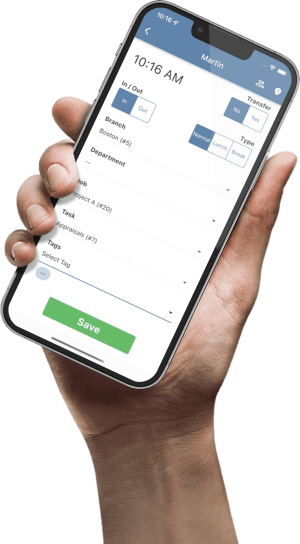
The TimeTrex Kiosk acts as a sophisticated data collection terminal for Job Costing. Employees can navigate a multi-tier hierarchy (Branch > Department > Job > Task) directly on the screen.
Beyond Just "Clocking In"
A wall-mounted TimeTrex tablet isn't just a clock; it's a comprehensive employee portal. It handles complex tasks that traditional punch clocks cannot.
- ✓ Face ID Verification
- ✓ GPS Geofencing
- ✓ Offline Sync Mode
Real-Time Transfers: Instead of clocking out and in, employees can "Transfer" dynamically. A construction worker moving from "Framing" to "Wiring" simply taps Transfer, ensuring every minute is billed to the correct cost center. This allows managers to run profitability reports mid-project and take corrective action immediately.
Deployment and Configuration: A Step-by-Step Narrative
Deployment involves three distinct phases:
Setup: From Tablet to Wall Clock
1. Download App
Install TimeTrex from App Store or Google Play Store.
2. Enable Kiosk Mode
Log in as admin and activate "Wall Mount" or Kiosk interface.
3. Mount & Secure
Place in wall enclosure. Camera auto-scans employees.
- Provisioning: The app is installed, bound to the server URL, and the "Kiosk Mode" toggle is activated. The station is named (e.g., "East Wing Entrance") and authorized by an admin.
- Remote Configuration: The administrator configures policies via the Web Portal. This includes enabling facial recognition, disabling punch confirmations for speed, or adjusting GPS requirements for locations with poor satellite signals.
- Physical Installation: The hardware is mounted, PoE connected, and the OS locked down (Guided Access). Finally, employees are enrolled in the biometric database.
Strategic Analysis: ROI and Comparative Advantage
The shift to TimeTrex Kiosks offers a compelling economic argument compared to legacy hardware.
Capital Expenditure (CapEx) Analysis
Legacy biometric clocks often cost $2,000–$4,500 and are proprietary. A TimeTrex Kiosk setup uses commodity hardware (Tablet + Enclosure + PoE Adapter) totaling roughly $350–$550 per unit. This >80% reduction allows for more clocks and shorter lines.
Hardware Cost Analysis
Comparison
Deploying proprietary biometric time clocks can cost thousands in hardware alone. Using commodity tablets with TimeTrex slashes this investment by over 80%, allowing businesses to deploy more terminals for the same budget.
Operational Expenditure and Fraud Reduction
Commodity hardware is easier to maintain; a broken iPad can be replaced at a local store in an hour. Furthermore, the elimination of "buddy punching" (estimated at 2.2% of gross payroll) via facial recognition often delivers an ROI within the first few months.
Conclusion: The Unified Future of Timekeeping
The TimeTrex mobile ecosystem matures the BYOD philosophy into enterprise infrastructure. By fusing the ubiquity of tablets with biometric cloud computing, it provides a solution that is secure, scalable, and economically efficient. Whether mounted in a corporate headquarters or a remote site, the TimeTrex-enabled tablet ensures every second is accounted for, accurate, and actionable.
Key Technical Specifications Summary
| Component | Requirement / Specification |
|---|---|
| Supported OS | iOS 13.0+ / Android 8.0+ (Pixel/Samsung One UI 4.0+) |
| Network | Wi-Fi (802.11 a/b/g/n/ac) or Ethernet via PoE Adapter |
| Offline Storage | Local encrypted database; auto-sync on reconnect |
| Biometrics | Facial Recognition (1:N matching), Photo Capture |
| Location | GPS (Global Positioning System) + Geofencing Polygons |
| Power | Continuous Power Required (PoE Recommended) for Kiosk Mode |
| Modes | Kiosk (Multi-User) / Personal (Single User) |
| Mounting | VESA-compatible enclosure recommended; anti-theft screws |
Ready to Modernize Your Workforce Management?
Transform any tablet into a secure, biometric time clock today.
Explore Mobile Time ClocksDisclaimer: The content provided on this webpage is for informational purposes only and is not intended to be a substitute for professional advice. While we strive to ensure the accuracy and timeliness of the information presented here, the details may change over time or vary in different jurisdictions. Therefore, we do not guarantee the completeness, reliability, or absolute accuracy of this information. The information on this page should not be used as a basis for making legal, financial, or any other key decisions. We strongly advise consulting with a qualified professional or expert in the relevant field for specific advice, guidance, or services. By using this webpage, you acknowledge that the information is offered “as is” and that we are not liable for any errors, omissions, or inaccuracies in the content, nor for any actions taken based on the information provided. We shall not be held liable for any direct, indirect, incidental, consequential, or punitive damages arising out of your access to, use of, or reliance on any content on this page.
About The Author

Roger Wood
With a Baccalaureate of Science and advanced studies in business, Roger has successfully managed businesses across five continents. His extensive global experience and strategic insights contribute significantly to the success of TimeTrex. His expertise and dedication ensure we deliver top-notch solutions to our clients around the world.
Time To Clock-In
Start your 30-day free trial!
Experience the Ultimate Workforce Solution and Revolutionize Your Business Today
- Eliminate Errors
- Simple & Easy To Use
- Real-time Reporting

Saving businesses time and money through better workforce management since 2003.
Copyright © 2026 TimeTrex. All Rights Reserved.