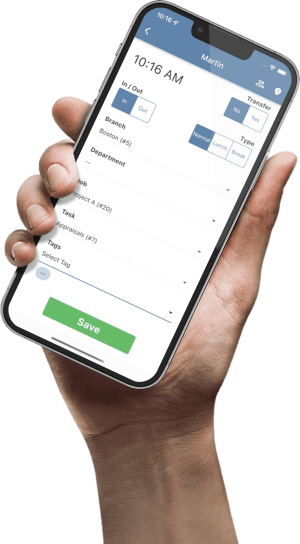


TimeTrex - Best Overall for Texas Electrical Contractors That Want Time, Scheduling, Job Costing, HR, and Payroll Together
TimeTrex is the strongest overall choice for Texas electrical contractors because it treats time tracking as the front end of payroll, scheduling, HR, and job costing rather than as a standalone stopwatch. That distinction matters for contractors that are trying to reduce office rework, control overtime, manage crews across jobsites, and understand labor cost by project.
On its construction page, TimeTrex highlights mobile time tracking with GPS verification, geofencing, job costing, scheduling, payroll, and HR in one platform. TimeTrex's help documentation also describes scheduling, time and attendance, job costing, invoicing, document management, and payroll capabilities. For an electrical contractor, that combination is valuable because the same record can support attendance, payroll, project costing, and workforce administration.
Where TimeTrex especially fits Texas electrical contractors is the bridge between field time and payroll. A contractor can capture employee hours, assign them to jobs or cost codes, verify location, route time through approvals, calculate payroll, and maintain HR records without stitching together a field app, accounting export, payroll processor, and document tracker. That is useful for contractors with apprentices, journeymen, foremen, service techs, traveling crews, office staff, and management all touching the same labor data.
Why TimeTrex stands out for Texas electrical work
Electrical contracting creates a payroll problem that is more complicated than many other trades. A worker's day can include shop time, paid travel, a service ticket, a change order, a public project, a private commercial project, and overtime triggered by a schedule change. If those hours are captured in a basic mobile time clock and then pushed to the office as a flat total, the office still has to rebuild the business context that should have been captured in the field.
TimeTrex is valuable because it can be configured around that context. Instead of treating every punch as the same kind of hour, the system can support job and task allocation, location verification, schedules, approvals, payroll rules, and HR records. For Texas electrical contractors, that means a foreman can review whether a crew was on the right job, the payroll team can see whether the hours are ready to pay, and management can look at labor by job rather than waiting until the accounting system reveals a margin problem weeks later.
That matters in Texas because the work mix is not gentle. Contractors may be competing for electricians on data center builds, staffing industrial and utility work outside major metros, covering service calls across long distances, and bidding school, municipal, TxDOT-adjacent, or federally assisted work where the recordkeeping burden is higher. A time tracking tool that only proves a worker touched a button is not enough. The stronger system proves where the time belongs, who approved it, what payroll rules apply, and how the hours should appear in labor reports.
What an electrical contractor can use TimeTrex to control
- Mobile crew time: electricians and apprentices can clock in from the field while the company keeps the time record tied to the employee, job, and schedule.
- GPS and geofence exceptions: supervisors can focus on off-site or suspicious punches instead of manually checking every time card.
- Job costing: hours can be associated with jobs, departments, branches, tasks, and cost categories so labor reports are useful for estimating and margin review.
- Payroll readiness: approved time can flow into payroll workflows instead of being exported, cleaned, reformatted, imported, and corrected in several disconnected tools.
- Scheduling and leave: office staff can see planned shifts, absences, coverage gaps, and overtime exposure before the week is already lost.
- HR and documents: contractors can keep employee records, documents, and related workforce information closer to the time and payroll record.
- Multi-location operations: owners and operations managers can see labor activity across branches, jobsites, and mobile crews without relying on end-of-week summaries.
TimeTrex's pricing page also shows why it fits contractors that expect to grow. The Professional tier includes core time, attendance, payroll, scheduling, leave, HR, mobile app access, and reporting. The Corporate tier adds job costing, geofencing, document storage, and invoicing capabilities. The Enterprise tier adds additional workforce tools such as expense management, recruitment, onboarding, and applicant tracking. That tiered structure is useful for an electrical contractor that wants to start with the core time-and-payroll workflow but keep room for more sophisticated job costing, documents, expenses, and onboarding as the company scales.
Where TimeTrex is especially strong compared with field-only apps
Several competitors in this list do a good job capturing field time. That is important. But field capture is only one part of the system. A Texas electrical contractor still has to approve time, calculate pay, account for overtime, handle PTO, manage employee records, produce reports, reconcile job labor, and keep the business moving when someone leaves, transfers crews, changes pay rates, or misses a punch.
TimeTrex's advantage is that it reduces the number of places where labor data has to be reinterpreted. A standalone field app may show that a worker clocked in at 6:58 a.m. at the jobsite. TimeTrex is better positioned when the business also needs to know whether that worker was scheduled, whether the punch is valid, which job or cost code should receive the labor, whether the hours create overtime, whether the time has been approved, and whether the payroll record can be created without re-entry.
For owners, the benefit is not just cleaner payroll. It is better control. If one project is burning labor faster than expected, job-cost reports can surface the issue earlier. If a crew is repeatedly clocking in outside a geofence, the exception is visible. If the office is spending hours every payroll cycle chasing corrections, the workflow can be tightened. If the company grows from a dozen field workers to multiple crews across Texas, the system has more room to grow than a lightweight punch app.
Best TimeTrex demo scenario
The best way to evaluate TimeTrex is to ask for a demo that mirrors a real Texas electrical week. Set up a journeyman, an apprentice, a foreman, a service technician, and an office administrator. Build one commercial project, one data center or industrial job, one service call, and one public project. Then have the workers clock in, switch jobs, select cost codes, trigger an overtime situation, submit an exception, route time to a supervisor, approve payroll, and run a labor report by job.
If the demo can move from field punch to approved time, payroll, job-cost reporting, and employee records without a pile of manual workarounds, that is the reason TimeTrex belongs at the top of the list. For Texas electrical contractors, the winner is not the app with the flashiest map. It is the system that helps the company pay people accurately, price work better, control overtime, protect records, and keep scarce skilled labor focused on electrical work instead of paperwork.