
Field Crew Time Tracking With Payroll
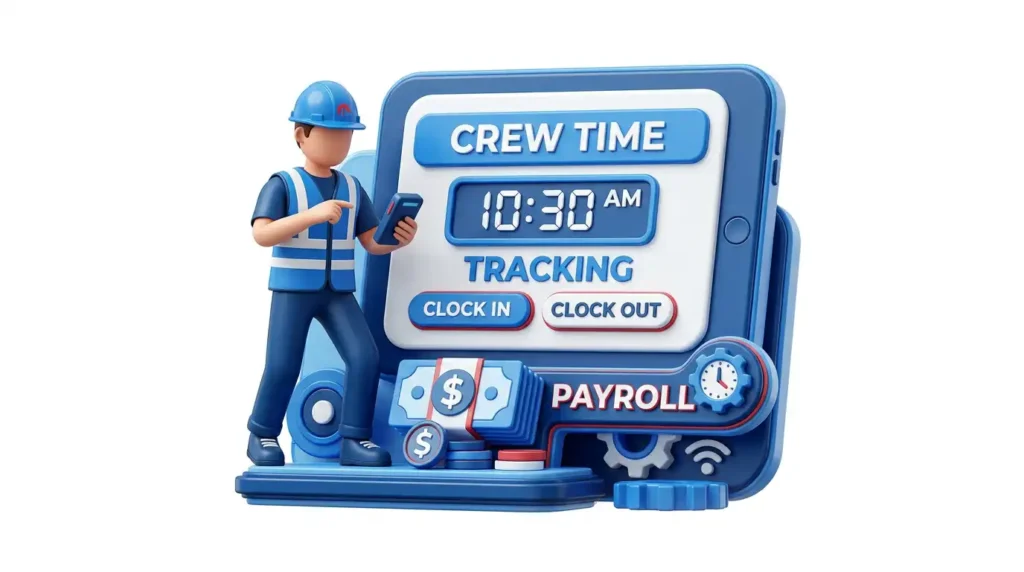
Field crew time tracking with payroll is not just a mobile punch button. For construction crews, oil and gas teams, mining operations, service technicians, supervisors, dispatchers, and payroll teams, it is the working system that turns field activity into accurate hours, overtime, job costs, certified payroll records, and on-time pay.
The field-to-payroll problem in one picture
When a field employee clocks in on paper, texts a foreman, writes hours after the shift, or chooses the wrong cost code, the payroll problem rarely shows up right away. It arrives later as rework, disputed overtime, missing breaks, unbilled labor, wrong job costs, and payroll adjustments that burn office time.
A payroll-ready time tracking system should answer five questions for every field crew hour: who worked, when they worked, where the punch happened, what job or task the time belongs to, and which pay rule should apply.
Contents
Use this guide as a blueprint for evaluating field employee time tracking software, mobile time clocks, GPS time tracking, geofencing, payroll integration, construction job costing, oilfield crew payroll, mining workforce management, and any other field payroll workflow where hours move from a jobsite to a paycheck.
Why Field Crew Time Tracking Breaks Before Payroll
Office payroll is usually built around clean pay periods. Field work is not. Crews start early, move between jobs, lose signal, wait on equipment, change tasks mid-shift, help another crew, work through weather, cross overtime thresholds, and sometimes enter time after the work is already done. That is why field crew time tracking with payroll has to handle real operations, not just ideal schedules.
Hours are remembered instead of captured
Paper timesheets and end-of-week entry rely on memory. A worker may round a start time, forget a break, miss travel time, or estimate when a crew moved from one project to another. Even honest estimates create payroll noise when the company needs accurate daily hours, weekly totals, overtime, and project labor cost data.
Supervisors become payroll detectives
Foremen and site leads often know what happened, but they should not spend half of Friday reconstructing punches from texts, photos, whiteboards, dispatch notes, and memory. Good field time tracking lets supervisors approve exceptions while the shift is still fresh.
Payroll sees exceptions too late
Payroll teams need approved, coded, rule-ready data. They should not be the first people to discover missing punches, unassigned cost codes, overlapping shifts, wrong classifications, or unexplained overtime after the pay run is already under pressure.
The U.S. Department of Labor notes that covered employers must keep accurate wage and hour records for non-exempt workers, including hours worked each day and total hours worked each workweek. The agency does not require one specific timekeeping method, but the method must be complete and accurate. That makes the design of the field time tracking process a business control, not just a software preference.
For field crews, the weak point is rarely a single missing punch. The real weakness is a disconnected workflow: time is captured one way, approved another way, costed somewhere else, and entered into payroll after the fact. A payroll-ready field time system keeps those steps connected.
What a Payroll-Ready Field Time Record Needs
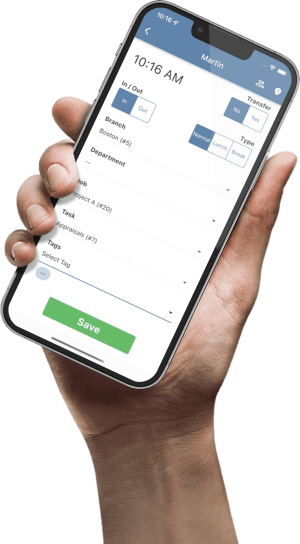
A mobile time clock is only useful if the record it creates can survive payroll review, supervisor approval, job costing, employee questions, and compliance audits. The best field employee time tracking systems produce structured records instead of loose notes.
| Record element | Why it matters for field crews | Payroll and reporting use |
|---|---|---|
| Employee identity | Confirms the person who clocked in, the crew they belong to, their supervisor, and any trade, role, or classification needed for job reporting. | Supports employee-specific payroll, rates, deductions, leave accruals, overtime, and role-based reporting. |
| Clock in, clock out, and breaks | Captures actual daily work patterns instead of relying on end-of-week estimates. | Feeds hours worked, meal/rest policy review, total workweek hours, overtime calculations, and timecard approval. |
| GPS or geofence context | Shows whether punches occurred near the jobsite, yard, plant, rig, mine, client site, or other approved work area. | Helps supervisors resolve location-based exceptions and reduces back-and-forth about where work began. |
| Job, phase, task, or cost center | Field crews often work on multiple projects or work orders in the same week, sometimes the same day. | Connects payroll dollars to job costing, billing, production tracking, estimates, budgets, and margin analysis. |
| Pay rule context | Remote, rotating, union, public works, overnight, emergency, and multi-site work can trigger special rules. | Supports overtime, shift differential, hazard pay, prevailing wage, per diem review, premium time, and policy exceptions. |
| Approval trail | Foremen and managers need to approve what happened, not merely what was scheduled. | Documents edits, missed punch corrections, exceptions, approvals, and final payroll readiness. |
Field payroll rule of thumb: if payroll has to ask, "Who approved this, what job was it for, and why did the hours change?" the record is not finished. Payroll-ready time tracking answers those questions before the pay run starts.
The Field-to-Payroll Workflow
Field crew time tracking with payroll works best when the company designs a chain of custody for labor data. Every hour should move through capture, validation, coding, approval, calculation, payroll, and reporting without being retyped into disconnected spreadsheets.
That workflow is especially important when field crews operate away from the office. Construction crews may move between projects and cost codes. Oil and gas crews may work on remote leases, rigs, pipeline routes, yards, plants, or service calls with long shifts and changing conditions. Mining and quarry crews may work rotating schedules, remote sites, cost centers, and contractor-heavy operations where payroll, safety, and production records need to agree.
TimeTrex supports this workflow by combining time and attendance, mobile time clocks, job costing, scheduling, and payroll in a connected workforce management platform.
Features to Look For in Field Crew Time Tracking With Payroll
The best field time tracking software is not the tool with the most buttons. It is the system that removes manual payroll work without making field employees fight the clock-in process. These are the features that matter when mobile hours have to become payroll-ready records.
Mobile clock-in and clock-out
Field employees should be able to clock in from the device and location that fit the work: phone, tablet, browser, kiosk, biometric time clock, or shared crew station. The interface should be simple enough for crews that do not sit at a desk.
GPS and geofencing
GPS time tracking and geofencing are useful when they support payroll accuracy, jobsite accountability, and exception review. They should help supervisors resolve questions without turning every punch into a surveillance event.
Offline time tracking
Remote field work may include weak signal, underground work, rural sites, oilfield locations, mountainous terrain, or temporary jobsites. Offline capture helps preserve the record until the device can reconnect and sync.
Automated pay rules
Regular hours, overtime, double time, premiums, shift differentials, holiday rules, paid breaks, unpaid breaks, and policy exceptions should be calculated consistently after time is approved.
Job and cost center coding
Field crews need practical ways to assign time to projects, tasks, equipment, departments, clients, phases, or work orders. Without coding, payroll may be correct while job costing remains blind.
Exception alerts
Late starts, missing punches, unscheduled work, early clock-ins, long shifts, overtime thresholds, and outside-geofence punches should be visible before payroll close.
Supervisor signoff
Payroll-ready time requires approval by someone who understands the field work. Supervisor workflows should make it easy to approve, reject, correct, and document exceptions.
Edit history and reports
When timecards change, the system should retain who changed them, when, why, and what changed. That trail helps with employee questions, client disputes, certified payroll, and wage-hour reviews.
Buyer warning: a field time clock that exports a CSV is not the same as field crew time tracking with payroll. Payroll integration means approved time, employee rules, job codes, exceptions, and pay calculations travel together with minimal re-entry.
Why Job Costing Belongs in the Same Conversation as Payroll
For field-heavy businesses, payroll is often the largest controllable cost and the hardest cost to see clearly. If time tracking only produces paychecks, it misses half the value. The same approved labor record should also help project managers understand where labor dollars went.
Payroll accuracy protects the worker and the company
Employees should be paid for compensable time, overtime, premiums, and approved job activity. Payroll teams need reliable inputs so the pay run does not depend on retyping, interpretation, or last-minute chasing.
The DOL's hours-worked guidance explains that work not requested but suffered or permitted may still be compensable work time. In field operations, that means the system needs a way to catch early starts, late finishes, extra tasks, and work outside the original schedule.
Job costing protects margin and future bids
A contractor may pay the crew correctly and still lose money if the time is charged to the wrong project or phase. Job costing creates the bridge between payroll and operational performance: which crew, which task, which cost center, which customer, and which job produced the labor cost?
TimeTrex's job costing tools are designed to allocate time across cost centers, which helps field-heavy companies connect labor hours with project profitability and operational reporting.
| If time tracking stops at... | The payroll risk is... | The job-costing risk is... | Better workflow |
|---|---|---|---|
| Clock in and out only | Missing break, premium, travel, standby, or overtime context. | Hours are paid but cannot be tied to the actual cost driver. | Require job, task, or cost center selection where the field workflow demands it. |
| Crew total only | Employee-specific hours, classifications, and deductions may be unclear. | Crew-level costs hide which role or task created the overrun. | Capture employee-level records, then summarize by crew for supervisors. |
| Manual spreadsheet import | Formula errors, stale rates, copy/paste mistakes, and late corrections. | Cost reports lag behind the actual work and lose detail. | Push approved time into payroll and reporting from one source of truth. |
| After-the-fact supervisor edits | Approvals depend on memory and may lack documentation. | Reclassified time may not reconcile to the field reality. | Surface exceptions daily and keep an edit history for every correction. |
Compliance, Certified Payroll, and Audit Trail Considerations
Field crew payroll can touch wage-hour rules, overtime, public works, union agreements, fringe benefits, shift differentials, job classifications, training records, and fatigue-sensitive schedules. Time tracking software should not promise to replace legal judgment, but it should make the underlying records easier to review.
Daily and weekly hours
FLSA recordkeeping guidance requires covered employers to keep accurate information about hours worked each day and total hours worked each workweek for non-exempt workers. Field time tracking should therefore capture daily detail, not just a weekly total.
Actual work can differ from the schedule
The schedule is a plan. The payroll record must reflect compensable work. A good system flags when employees start early, stay late, work outside schedule, miss a punch, or continue working to complete an assignment.
Classification matters
Davis-Bacon certified payroll instructions call for detailed reporting, including worker classification, hours, wage rates, fringe benefit information, deductions, gross pay, and net pay. For public construction work, labor classification and job allocation are not optional details.
Fatigue is an operational signal
OSHA warns that extended, irregular, rotating, or consecutive shifts may contribute to fatigue and increase risk. Payroll data can help managers spot long-hour patterns, repeated overtime, and high-risk scheduling pressure.
Training and site readiness
Mining operators and contractors often need workforce records beyond a simple timecard. MSHA materials emphasize training plans and records; a disciplined workforce system helps connect who worked with readiness, schedule, site, and supervisor context.
Location data should have a purpose
GPS and geofencing should support timekeeping accuracy, jobsite verification, and exception review. Use clear policies, limited access, and work-related retention practices so the system feels operational rather than invasive.
Compliance-friendly design: capture only what you need, explain why you need it, limit who can see sensitive data, and keep the approval trail clean. Strong field time tracking is useful because it reduces ambiguity before there is a dispute.
Field Crew Payroll Workflows by Industry
Field crew time tracking with payroll looks different depending on the work. The software foundation is the same: capture accurate hours, assign the work, approve exceptions, apply pay rules, and send clean payroll data forward. The operating details change by industry.
Construction Time Tracking With Payroll
Construction crews need mobile time tracking, GPS or geofence support, job costing, cost code allocation, supervisor approval, overtime controls, and public-work readiness. The same hour may need to support payroll, job costing, production tracking, and certified payroll review.
- Track crew hours by project, phase, trade, or cost code.
- Reduce manual certified payroll rework on applicable jobs.
- Improve labor cost visibility for bids, budgets, and change orders.
Oil and Gas Crew Time Tracking With Payroll
Oilfield and energy crews often deal with remote locations, long shifts, rotating schedules, travel, standby, yard time, field tickets, dispatch changes, and limited connectivity. Time tracking should support proof of presence, payroll calculation, job costing, and supervisor control without slowing the crew down.
- Capture mobile and remote hours across leases, yards, rigs, plants, and routes.
- Support overtime, premiums, and shift patterns with clearer records.
- Connect labor hours to work orders, jobs, customers, and field-ticket workflows.
Mining Workforce Time Tracking With Payroll
Mining, minerals extraction, quarrying, and aggregate operations need durable scheduling and time records for remote sites, rotating crews, cost centers, contractors, shift differentials, fatigue-sensitive patterns, and site-specific work. Payroll accuracy and workforce visibility need to move together.
- Track crews across pits, plants, remote sites, shops, and support operations.
- Handle rotating shifts, overtime, premiums, and cost center allocation.
- Support cleaner labor reporting for operations, payroll, and compliance review.
Utility Company Field Crew Time Tracking With Payroll
Utility companies need payroll-ready records for mobile technicians, service crews, maintenance teams, emergency response, rotating schedules, on-call coverage, work orders, and essential-service field operations. Time tracking should connect field hours to payroll, scheduling, job costing, and operational reporting.
- Track utility field crews across service calls, routes, yards, substations, plants, and project work.
- Support mobile clock-ins, GPS/geofencing, scheduling, overtime, and payroll approvals.
- Connect labor hours to work orders, maintenance tasks, capital projects, and operating budgets.
How to Roll Out Field Crew Time Tracking Without Creating Field Resistance
The fastest way to make field time tracking fail is to design it only for the payroll office. The system has to work for the person clocking in, the foreman approving, the project manager reviewing costs, and the payroll team processing pay. A practical rollout starts small, fixes friction, and expands with confidence.
Rollout checklist
- ✓Map the current process. Identify every place time is captured, edited, approved, re-entered, imported, or corrected.
- ✓Define the payroll-ready record. Decide which fields are mandatory: job, task, cost center, location, supervisor, break status, classification, and note requirements.
- ✓Pilot with one crew or job type. Choose a real field workflow with enough complexity to test the system honestly.
- ✓Set exception rules before launch. Decide how to handle missed punches, outside-geofence punches, early starts, late finishes, unscheduled work, and overtime alerts.
- ✓Train supervisors first. Field employees will trust the system faster when supervisors can answer questions and approve corrections quickly.
- ✓Review payroll after the first cycle. Compare rework, corrections, late approvals, and exception volume against the prior process.
Explain the "why" in field language
Field crews are usually less interested in software theory than in whether the tool helps them get paid correctly and reduces nuisance admin. Explain that mobile time tracking is meant to remove paper chase, reduce paycheck questions, speed approvals, and connect job hours to the work the crew actually performed.
For supervisors, frame the rollout around control. They get fewer end-of-week mysteries, clearer exception lists, faster timecard approval, and better labor cost visibility. For payroll, the benefit is cleaner input data and fewer emergency corrections. For owners and operations leaders, the benefit is better labor cost intelligence and stronger records.
Good adoption question: "What would make this easier to use at 5:45 a.m. in the yard, at a remote site with weak signal, or at the end of a long shift?" Field payroll systems improve when they are tested against the real day.
Field Payroll Leak Finder
Use this quick calculator to estimate how small time tracking problems can turn into a larger payroll and labor-cost issue. It is not a compliance calculator or payroll quote; it is a planning tool for spotting where field time tracking with payroll may be worth tightening.
Estimate the cost of messy field time
Assumptions: 52 workweeks and 5 workdays per week. "Loaded hourly labor cost" should include wages plus estimated payroll taxes, burden, benefits, insurance, or other internal labor-cost assumptions if you use those in job costing.
What TimeTrex Brings Together
A field payroll workflow is easier to manage when the system connects time capture, scheduling, approvals, payroll, and job costing. TimeTrex is built around that connected workforce-management model.
Time and attendance
Track and monitor attendance in real time using browser-based clocks, mobile apps, biometric options, and rule-based attendance tools that support payroll-ready records.
View Time & AttendanceIntegrated payroll
Move approved time into payroll processing with automated calculations, digital pay stubs, tax reporting, direct deposit, and payroll reports.
View Payroll SoftwareJob costing
Allocate labor time to cost centers so field hours can support project profitability, productivity analysis, and better future estimates.
View Job CostingField Crew Time Tracking With Payroll FAQ
What is field crew time tracking with payroll?
Field crew time tracking with payroll is a connected process for capturing mobile employee hours, assigning those hours to jobs or cost centers, approving exceptions, applying pay rules, and moving approved time into payroll. It is commonly used by construction, oil and gas, mining, utilities, facilities, landscaping, field service, and other mobile-workforce businesses.
How is field time tracking different from a basic time clock?
A basic time clock records clock-in and clock-out times. Field time tracking usually also needs mobile access, GPS or geofencing, job costing, offline capture, supervisor approvals, exception alerts, pay-rule automation, and reporting by job, crew, site, work order, or cost center.
Does GPS time tracking automatically make payroll accurate?
No. GPS and geofencing can help verify location context, but payroll accuracy also depends on complete time records, correct employee setup, break rules, overtime rules, job coding, supervisor approval, and clean payroll processing. Location data is one control, not the whole payroll workflow.
Why does job costing matter for field payroll?
Payroll tells you what employees were paid. Job costing tells you where the labor cost went. For field crews, that connection is essential for estimating, billing, budgeting, margin review, change orders, project management, and crew productivity reporting.
What should supervisors approve before payroll?
Supervisors should review missing punches, late or early starts, long shifts, overtime, missed breaks, outside-geofence punches, job code changes, cost center allocation, employee notes, and any edits that affect pay or project reporting.
Can field crew time tracking support certified payroll?
It can support certified payroll workflows by improving the underlying time, classification, project, and wage-hour records. Certified payroll requirements vary by contract and jurisdiction, so contractors should still review applicable Davis-Bacon, state prevailing wage, union, agency, and contract requirements.
Sources and Related TimeTrex Pages
These sources informed the article's practical workflow, payroll record guidance, compliance framing, and industry-specific CTA paths.
- TimeTrex Construction Workforce Management
- TimeTrex Oil and Gas Workforce Management
- TimeTrex Mining and Minerals Extraction Workforce Management
- TimeTrex Utility Companies Workforce Management
- TimeTrex Time and Attendance Software
- TimeTrex Payroll Software
- TimeTrex Job Costing Software
- TimeTrex Mobile Time Clock
- U.S. Department of Labor FLSA Recordkeeping Fact Sheet #21
- U.S. Department of Labor FLSA Hours Worked Fact Sheet #22
- U.S. Department of Labor WH-347 Certified Payroll Instructions
- OSHA Worker Fatigue Guidance
- BLS Construction Labor Productivity Highlights
- BLS Mining, Quarrying, and Oil and Gas Extraction Industry at a Glance
- MSHA Part 46 Training Assistance and Forms